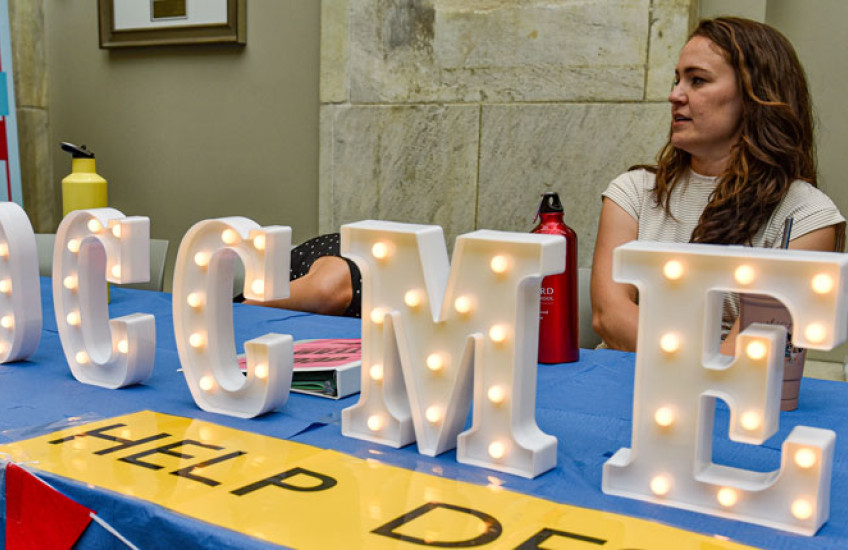
Harvard Medical School officially launched the Office for Community Centered Medical Education this fall to better support students at HMS and the Harvard School of Dental Medicine who are interested in engaging with community-based organizations and community health centers in the Roxbury, Mission Hill, and Jamaica Plain neighborhoods near Boston’s Longwood area.
In addition to gaining exposure to the science, clinical care, and publishing that make up academic medicine, these students want community engagement to be an important center focus, too, said Nancy Oriol, faculty associate dean for community engagement in medical education.
“They see that it’s when you engage with the community that you get to actually understand the context of the lives of the people for whom you will provide medical care,” she said. “It’s seeing community engagement as a relevant part of academic medicine, and expanding the ability of doctors to care for all their patients.”
Related Stories

The office also aims to be a centralized source of information and resources for medical and dental students who are interested in community-engagement efforts and also to be an academic home for faculty who are seeking to engage medical and dental students in their community-engagement work, said David Duong, director of the Office for Community Centered Medical Education. The office also builds on the work of the HMS Center for Primary Care, which has engaged and partnered with local community health centers to strengthen primary health care delivery services for more than a decade.
Taking stock
The formation of the office was the result of a confluence of movements at the School, including one with a longstanding history.
“The roots of this movement have been here all along—in the Department of Global Health and Social Medicine, which just celebrated its 150th anniversary,” said Oriol. “Community engagement makes up the core of what that department is.”
Science. Medicine. Humanity.
Harvard Medicine magazine delivered to your inbox
More than 30 years ago, working in partnership with organizations and individuals in Boston communities, Oriol created The Family Van, a mobile health clinic that provides access to health care in some of Boston’s most medically underserved communities and which seeks to address health disparities in those neighborhoods.
More recently, during the onset of the COVID-19 pandemic and the beginning of the Black Lives Matter movement, Harvard medical and dental students met with HMS Dean George Q. Daley to discuss the relationship between HMS and its surrounding communities.
Questions raised, according to Duong, included: How was HMS contributing to the local Boston community? How was it interacting with the local community-based health and social service organizations? And what role did these community organizations have in the education of our students?
Additionally, students who wanted to meaningfully engage with community-based organizations and clinics often felt they had to seek out and build their own relationships with local organizations or find their own funding — and then make time during their already demanding study and clinic schedules, he said.
“The students were saying, ‘we come here with this passion and desire to learn about and promote health equity and social justice and we enter medicine wanting to serve our patients, and then throughout our years at HMS, through no fault of the curriculum, it becomes very hard to engage with our local communities,’” said Duong.
Building a foundation
At the same time, other students were advocating for a more formalized structure at the School to support students interested in community-centered work in talks with Edward Hundert, HMS dean for medical education.
When Duong was a medical student at HMS he was on the School’s inaugural Student Leadership Committee when the Center for Primary Care was founded, in 2010. He received funding from the center’s Agents of Change program for a project that paired students from all 12 of Harvard’s professional schools with community health centers to improve primary care for medically underserved individuals through innovation.
Hundert recalled Duong’s contributions as a medical student and asked him to evaluate current student and community perspectives on what was needed to help boost student engagement opportunities and improve support for local communities.
For more than a year, Duong and a cadre of volunteer HMS and HSDM students, faculty, staff, and representatives from local community organizations met to envision what they could create; what an initiative’s mission, vision, and values would be; and how it would be governed.
“It was an amazing process,” Oriol said. “It was a long process, as it had to be, and the outcome is this office, which was launched with the class that was admitted this year.”
Bringing it home
The new office is housed within both the Program in Medical Education and the Center for Primary Care.
Over the past year, Duong has assembled a management and leadership team and hired staff. He and his team have recruited students, and together developed relationships with more than 20 Boston community-based and community health organizations.
The goal is to provide medical and dental students with robust programming and community-centered engagement opportunities from the moment they first step onto campus until they graduate.
In August, first-year students visited communities around Longwood during the first week of classes to become acquainted with how area residents live, work, and go to school and to learn how community health centers are promoting health equity.
Throughout their training — from preclerkship to principal clinical experience to postclerkship — the office will connect students with community service opportunities in Boston’s Longwood area while providing the resources, advising, and structure that will help balance their community work with their academic studies and clinical activities.
“We now have staff who can focus on helping maintain bridges as students are moving through the curriculum,” said Oriol. “That’s a major part of what the office can provide.”
The team has bolstered existing HMS courses and electives that deal with community health in the medical education curriculum. They have created a new community-engagement track, adopted a community-engagement clerkship, and developed a track for doing a scholarly project. More programming is in the works.
“We’re working in collaboration with our students to create two mini tracks that the Program in Medical Education can insert into the formal curriculum,” said Duong, including a first-year community engagement certificate program that includes workshops about community engagement and on-site collaboration and volunteering with community organizations.
There is also a first-year community engagement award program, which involves shadowing at community health centers and a year-long project with a community-based organization, he added. To date, 45 first-year medical and dental students are involved in either the certificate or award program.
“Part of the office’s responsibility is to help create experiences that work for both sides — where the community and the students and faculty can engage in ways that are reliable and well-supported,” Oriol said.
She sees the new office as making concrete and operational the goal of having community engagement be “meaningful, relevant, useful, and respectful” for both community members and HMS/HSDM students.
“Our long-term goal is that the ethos and philosophy of community engagement touches every single Harvard Medical School student’s life,” said Duong.
As students go on to their future careers as physicians and dentists, Oriol and Duong said, they will benefit from gaining the critical skills of partnering with community members and relating to people.
Both said that in addition to our more longitudinal community-engagement work and the scholarly projects that this office will support, sometimes just showing up to do whatever work needs to be done — such as serving meals in a food kitchen or helping to weed a community garden — is an important way for students to connect to the people who may be their future patients.
Oriol said this approach gives students an opportunity to talk with people who they may not have met before and to see who they are, how they think, what they feel, and what they care about in order to understand the circumstances that might make someone’s life really difficult, that might not fit so perfectly with the expectations of the health care system.
“It’s not the activity that’s important, it’s the planning, the doing, and the connecting,” Oriol added. “It’s the building of a mutual respect and understanding.”
“Whether they’re going to be a primary care doctor, a cardiothoracic surgeon, or the director of the NIH, they will have to relate with people who are different from them, and our office provides our students with meaningful opportunities to do that,” Duong added.