At a glance
Researchers have built a catalog of mitochondrial proteins found in six eukaryotic organisms — five parasites and one plant — that, along with existing inventories of human and yeast mitochondria, reveals new insights into this essential organelle.
By highlighting mitochondrial proteins shared by multiple pathogens that are absent in humans, the results suggest new therapeutic targets for neglected tropical diseases.
Findings from MitoCarta Tree of Life consortium spanning multiple institutions are published in nine related papers.
A research consortium has generated the broadest look yet at the proteins that make up mitochondria, capturing the organelle’s diversity across multiple branches on the tree of complex life.
The results reveal unexpected functions of the organelle, clues to its origin and role in the evolution of complex-celled organisms known as eukaryotes, and potential new drug targets for neglected tropical diseases. The data also help establish comparative mitochondrial biology as a field of research.
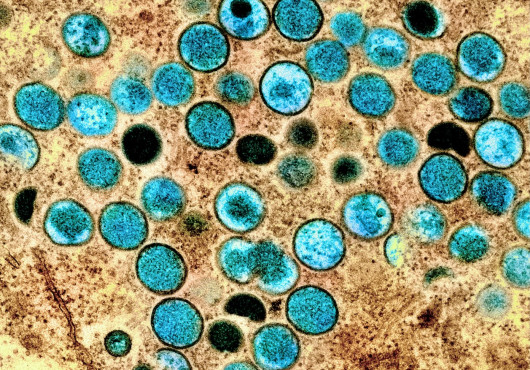
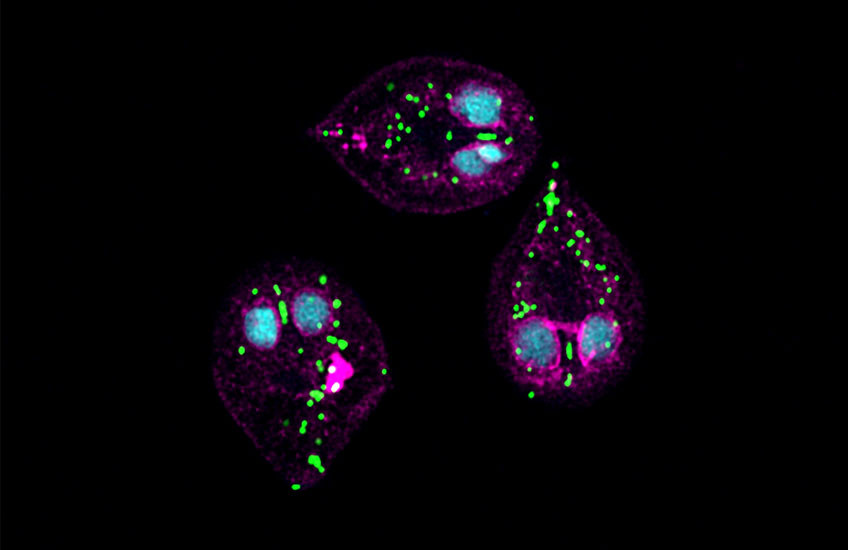
The MitoCarta Tree of Life consortium, or MitoTOL, generated and analyzed the mitochondrial proteomes of one plant and five single-celled pathogens that affect millions of people globally every year, including the intestinal parasite Giardia; the tick-borne pathogen Babesia; trypanosomes that cause sleeping sickness, Chagas disease, and leishmaniasis; and an amoeba that can infect contact lens wearers.
The effort was led by scientists at Harvard Medical School, Massachusetts General Hospital, the Broad Institute of MIT and Harvard, Harvard T.H. Chan School of Public Health, and Boston University Henry M. Goldman School of Dental Medicine.
Their findings appear Oct. 1 in nine scientific papers and a commentary in the Cell family of journals.
“With this consortium, we’ve repurposed everything we’ve learned over the last 15 years characterizing the mammalian mitoproteome to rapidly and diligently build out these inventories, creating a foundational resource for a new field of comparative mitochondrial biology,” said project leader Vamsi Mootha, professor of systems biology at HMS, HMS professor of medicine at Massachusetts General Hospital, an institute member at the Broad Institute, and corresponding author of three of the papers.
Mitochondrial marvels
It’s been two billion years since an ancient host cell engulfed a bacterium that later became the mitochondrion, the “powerhouse” producer of chemical energy for eukaryotic cells. Most of the bacterial DNA ended up in the host cell’s nuclear genome, with a fraction remaining as a tiny mitochondrial genome. As single-celled and multicellular organisms evolved over time, the organelle’s composition and function shifted to suit the needs of each organism.

In 2008, a Broad-led team announced MitoCarta, the first comprehensive inventory of the mammalian mitochondria’s 1,100 proteins — a so-called mitoproteome. This was later used to discover genes underlying illnesses such as metabolic disease and neurodegeneration. Yet, the researchers knew they could learn even more about the organelle by comparing it across different forms of life and exploring not only its origins but also how it might be targeted in pathogens to treat infections.
In 2022, with support from the Howard Hughes Medical Institute Emerging Pathogens Initiative, Mootha and colleagues built a consortium of 25 researchers in seven labs to produce mitoproteomes of organisms spanning the tree of life, focusing on the model plant Arabidopsis and five parasites that cause human disease.
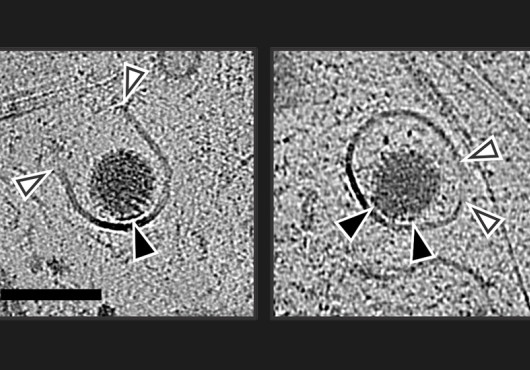
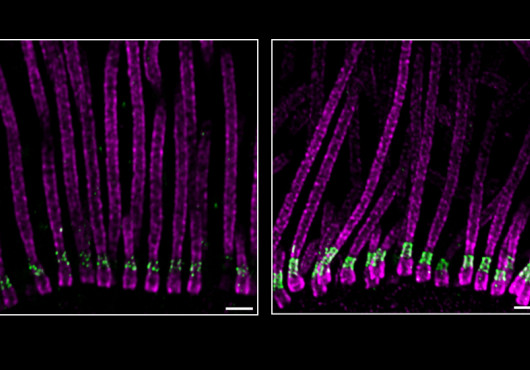
The researchers worked with advanced mass spectrometry technologies at the Broad Institute to help determine which nuclear genes encode proteins that end up in each organism’s mitochondria. They also used cryo-electron microscopy, or cryo-EM, technology at the Harvard Cryo-EM Center for Structural Biology at HMS and the Cryo-Electron Microscopy Facility at MIT to uncover the structures of various mitochondrial proteins and energy production components at near-atomic resolution.
In one of the papers, led by team member Michael Chen, a student in the Harvard-MIT MD-PhD program, the researchers compared the data on these six organisms along with the existing human and yeast inventories. They discovered many mitochondrial proteins in multiple pathogens that are missing from human mitochondria. These represent potential targets for new drugs to treat tropical diseases.
The researchers also used the new data to explore a longstanding scientific mystery about whether mitochondria originated early or late in eukaryotic evolution. Using the new data to retrain a machine-learning based tool and predict the mitoproteomes for hundreds of untested species, the scientists reconstructed the timeline of when various organelles first appeared. Their analysis supports the notion that mitochondria appeared relatively late, after the ancestral eukaryote had already developed other complex parts.
More than half of the proteins in these catalogs have unknown functions, so future studies may one day reveal even more clues to what makes human life, and that of all complex organisms on Earth, possible.
A flurry of mitochondria discoveries
The other papers focused on individual organisms.
Analyzing the mitoproteome of Acanthamoeba, an organism that can cause blindness in contact lens wearers, team members observed the most complicated energy-producing machinery of any organism.
In one paper — led by senior author Luke Chao, HMS associate professor of genetics at Mass General, and first author Michelle Fry, HMS research fellow in genetics in the Chao Lab — team members combined cryo-EM and mass spectrometry to reveal an unexpected way that parts of two energy production pathways in Acanthamoeba are physically connected.
Team member Jonathan Stefely — who conducted the research as an HMS clinical fellow in pathology at Brigham and Women’s Hospital and Mass General and is now at the Morgridge Institute for Research in Wisconsin — is senior author of another paper that showed Acanthamoeba mitochondria are capable of switching between aerobic and anaerobic respiration based on oxygen conditions, possibly reflecting an ancient adaptation to the fluctuating oxygen in its primordial environment.
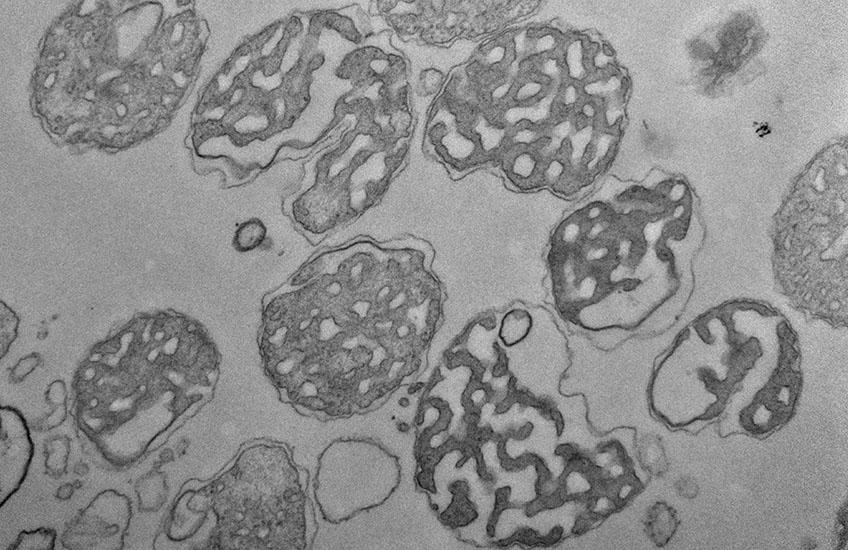
In another paper, team members including senior author John Samuelson of BU School of Dental Medicine catalogued the mitochondrial machinery of Giardia, which causes a diarrheal disease. They found that it contains a mere 59 proteins and lacks energy-producing capabilities, making it more of a “remnant” mitochondrion that further challenges the narrow view of the organelle as simply a powerhouse.
For another paper, researchers including senior author Manoj Duraisingh of Harvard Chan School developed new methods to study the mitochondria of Babesia, a tick-borne pathogen behind a malaria-like illness that’s spreading in New England, fueled by climate change. Importantly, those methods may also work for related pathogens, such as those that cause malaria and toxoplasmosis.
Consortium members also studied the weed Arabidopsis, which is a leading model organism and uses energy not only from chloroplasts but also from mitochondria. While prior work had helped to define the plant mitochondrial proteome, this new inventory appears to be the most comprehensive and accurate and was generated using an approach that can likely work for other plants.
Two papers on Leishmania and Trypanosoma, led by senior authors Ruslan Afasizhev and Inna Afasizheva of BU School of Dental Medicine, revealed massive mitochondrial proteomes that are 50 percent larger than that of humans and that contain proteins unique to those classes of parasites. Yi-Ting Liao, HMS research fellow in genetics in the Chao Lab and co-first author of one of the papers with Md Solayman of BU, used cryo-EM to reveal how previously unrecognized subunits are incorporated into the respiratory complexes of these organisms.
The data produced in these studies are freely available at mitocarta.org.
Adapted from a Broad Institute news release.
Authorship, funding, disclosures
Additional authors on the nine studies can be found in the papers, along with information on potential conflicts of interest. Mootha is a Howard Hughes Medical Institute (HHMI) Investigator.
The work was supported by the HHMI Emerging Pathogens Initiative (HHMI EPI) and by Mark and Lisa Schwartz in addition to the National Institutes of Health (grants 5R01AR071942-07, R35GM142553, 1K08AI193194, T32GM007753, and T32GM144273).