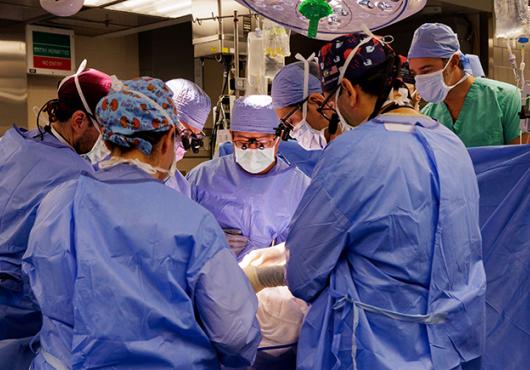
In January 2026, Tim Andrews, who had received a genetically edited pig kidney in January 2025, became the recipient of a donated human kidney. His case represents the longest dialysis-free survival following porcine (pig) kidney xenotransplantation in a living human and the first transition to human kidney transplantation.
In a paper published Sept. 3 in The Lancet, Harvard Medical School physician-scientists at Massachusetts General Hospital and colleagues detail Andrews’ experience and how xenotransplantation is moving closer to achieving its promise of bridging the gap between end-stage kidney failure and human kidney transplantation, allowing a patient to forgo dialysis in the meantime.
The authors report that Andrews, who was 66 at the time of xenotransplantation, successfully lived with the genetically edited kidney for 271 days — during which he did not need dialysis — before receiving a human kidney from a donor.
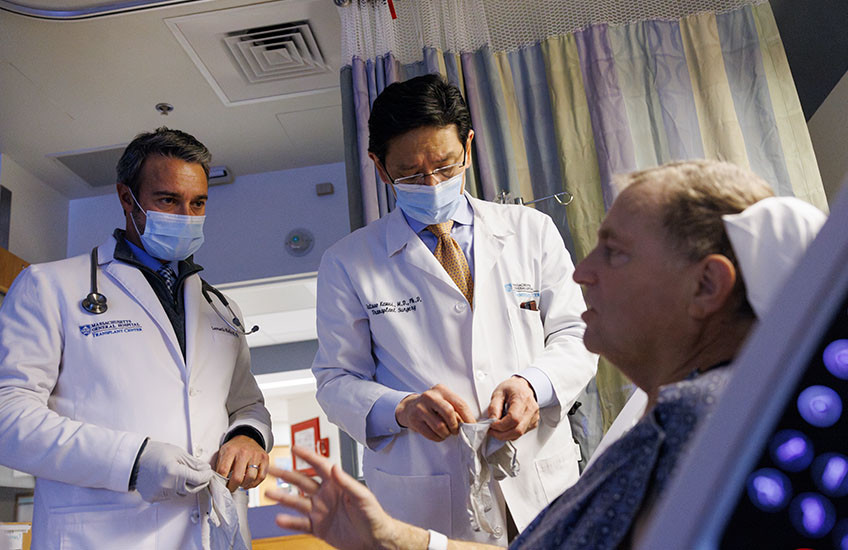
“The organ shortage is the greatest crisis we have right now in transplantation,” said lead author Leonardo Riella, the HMS Harold and Ellen Danser Associate Professor of Surgery at Mass General and medical director for kidney transplantation at Mass General Brigham. “We know that the best treatment option for patients with end-stage kidney disease who have developed renal failure is transplantation, but we simply don’t have enough human organs to transplant in a timely manner.”

“Our vision is that xenotransplantation could help address this gap — initially as a bridge to get patients off dialysis while they wait for a human donor kidney, and potentially, as we establish long-term safety and durability, as a destination therapy in its own right,” he said.
The recent history of pig kidney transplantation
The world’s first xenotransplant of a genetically engineered pig kidney to a living human recipient occurred in 2024 at Mass General, with the patient surviving 52 days before death from cardiac causes unrelated to the transplant. No previous studies have documented xenograft survival beyond two months, a successful “bridge” to receipt of a human organ, or the mechanisms leading to late xenograft failure in living recipients.
The modified kidneys have been provided by eGenesis, a xenotransplantation therapy company co-founded by HMS geneticist George Church and former HMS postdoctoral fellow Luhan Yang. HMS, Mass General, and eGenesis researchers have conducted extensive studies, including findings published in Nature in 2023.
Leonardo Riella sees animal-to-human kidney transplants getting closer to the clinic
Andrews received the genetically engineered pig kidney under an FDA Expanded Access Investigational New Drug application. He was then monitored for kidney function, rejection, antibody development, and potential pig-to-human infection. The kidney functioned immediately. An early episode of T-cell-mediated rejection resolved with treatment, and no pig pathogen transmission was detected.
After approximately six months, immunosuppression was reduced in the setting of infection. The xenotransplant subsequently developed microvascular injury and inflammation that progressed to organ failure. The patient then received a deceased-donor human kidney, with immediate graft function and no evidence of sensitization during follow-up.
eGenesis reported Sept. 3 that a second study participant also transitioned from a xenotransplant to a human kidney.
The findings illustrate both the promise and areas for improvement for xenotransplants as a bridge for patients awaiting human kidneys. Importantly, the microvascular injury to the porcine kidney has implications in the development of immunosuppressive strategies, donor genetic engineering, and monitoring in future clinical transplantation studies.
Adapted from a Mass General Brigham news release.
Authorship, funding, disclosures
Tatsuo Kawai, HMS professor of surgery at Mass General, is senior author of the study. Additional authors include Thiago J. Borges, Ivy A. Rosales, Claire T. Avillach, Ragnar Palsson, Frank Hullekes, Ruchama Verhoeff, Anna Pomahac, Jia-Yun Chen, Sandro Santagata, Alessia Giarraputo, R. Neal Smith, Helen N. Le, Jay A. Barth, Susan C. Low, Kristen Getchell, Michael Curtis, Steve Perrin, Martin Kolev, Sivan Bercovici, Martin S. Lindner, Guilherme T. Ribas, Varsha K. Tanguturi, Aneesh C. Bapat, Vikram Pattanayak, Alban Longchamp, Joseph El-Khoury, Michael Duggan, Shimul Shah, Richard Pierson, Joren C. Madsen, Jay A. Fishman, Nahel Elias, and Robert B. Colvin.
This study was funded by Massachusetts General Hospital and eGenesis. The authors also acknowledge Eledon Pharmaceuticals and Apellis Pharmaceuticals for scientific collaboration and operational support during the conduct of this study; guidance provided by the U.S. Food and Drug Administration throughout the expanded access process; and the patient and his family for their trust and commitment to advancing the field.
Riella reports investigator-initiated grants to his institution from eGenesis, Veloxis Pharmaceuticals, and Visterra, and participation on advisory boards for Apellis, Eledon, Alexion, and Novo Nordisk. Borges, Palsson, and Colvin report grant support from eGenesis, with the grants to institutions where specified in the manuscript. Rosales reports consulting fees from eGenesis. Fishman reports consulting fees from eGenesis and Eledon and royalties from UpToDate. Kawai reports consulting fees from eGenesis and Visterra; honoraria and travel support from the University of Pittsburgh, Stanford University, SUNY Upstate University, the Japan Society for Transplantation, and the Japanese Society for Xenotransplantation; and an issued patent. Pattanayak reports intellectual property licensed through Harvard University and Massachusetts General Hospital, and consulting fees and stock options from SeQure Dx. Barth, Low, and Curtis are employees of eGenesis; Low, Curtis, and Getchell hold eGenesis stock options. Perrin is an employee and board member of Eledon Pharmaceuticals and holds Eledon stock options. Kolev is an employee of Apellis Pharmaceuticals and holds Apellis stock options. Bercovici is an employee of Karius, holds Karius equity, and reports eGenesis funding to Karius. Lindner is an employee of Karius, holds Karius equity, and reports planned patent applications related to cell-free DNA sequencing.