At a glance
Scientists have discovered that the cellular composition of the striatum — a key brain area involved in psychiatric disorders, neurodegeneration, and addiction — varies among people.
The team also identified six new molecular zones in the striatum and found that proportions of certain kinds of neurons and glial cells decline with advancing age.
The work promises to enable efforts to study brain disorders and generate a detailed cellular atlas of the entire human brain.
Scientists at Harvard Medical School and the Broad Institute of MIT and Harvard have charted previously hidden architecture and patterns of cellular makeup in a key part of the brain called the striatum, which is involved in decision-making and movement and is affected in psychiatric disorders, addiction, and neurodegeneration.
The work promises to enable efforts to study brain disorders and generate a detailed atlas of the entire human brain.
Reporting Nov. 12 in two papers in Cell, the researchers reveal six new zones within the striatum based on patterns of gene expression. They also demonstrate how the zones’ boundaries blur with age and highlight ways that advancing age and interpersonal genetic variation affect gene expression in the brain.
The discoveries appear alongside two dozen other studies in related journals from hundreds of scientists in the BRAIN Initiative Cell Atlas Network (BICAN), a flagship project of the National Institutes of Health’s BRAIN Initiative, which aims to build a detailed cellular map of the human brain.
“The findings of genomics and neuroscience over the last decade have uncovered incredible complexity in the brain that can seem overwhelming, but by identifying structures and organizing principles as we’ve done here, we can make sense of that complexity and its relevance to human health and disease,” said Evan Macosko, HMS associate professor of psychiatry and of neurobiology at Massachusetts General Hospital, senior author of one of the two HMS- and Broad-led studies and co-author of the other.
Cell-type proportions in the striatum vary between people
BICAN researchers first set out to study the basal ganglia, a network of structures that regulate movement and behavior and influence many diseases and conditions. The striatum is the largest structure in the basal ganglia.
In one of the new papers, a team led by co-senior authors Steven McCarroll, the Dorothy and Milton Flier Professor of Biomedical Science and Genetics in the Blavatnik Institute at HMS and an institute member at the Broad Institute, and Kiku Ichihara, manager of the Center for Human Brain Variation at the Broad Institute, showed how proportions of cell types in the striatum vary widely from person to person.
Performing single-nucleus RNA sequencing on 4 million cells from the striatum and the prefrontal cortex of nearly 200 adult postmortem brains, the researchers found that while the balance of different cell types was consistent across an individual’s brain tissues, cellular makeup varied significantly between people. This was especially true for non-neuronal cells such as astrocytes and microglia.
The researchers also observed changes with age in all brain regions studied. For instance, the abundance of one cell type, known as oligodendrocyte progenitor cells, declined by approximately 40 percent from age 30 to 80. Patterns of gene expression also changed with age in all cell types. Changes were particularly large in projection neurons, which communicate with distant brain regions.
“By establishing common ranges for cell-type proportions and for gene expression, this work provides important context for studying disease,” said co-first author Steven Burger, a computational scientist in the McCarroll Lab.
“Hidden histology” of neuronal zones
In the second study, senior author Macosko and colleagues analyzed more than 1 million cells across the striatum of 19 postmortem brains.
They used a spatial mapping method called Slide-tags, which pinpoints the location of individual cells within tissues and was invented by Macosko and Fei Chen, associate professor of stem cell and regenerative biology at HMS and the Harvard Faculty of Arts and Sciences and core institute member at the Broad Institute. For the new study, the team adapted Slide-tags to capture larger tissue areas.
The results revealed six zones in which projection neurons exhibited distinct gene expression profiles. Each zone appeared to express genes related to certain brain functions.
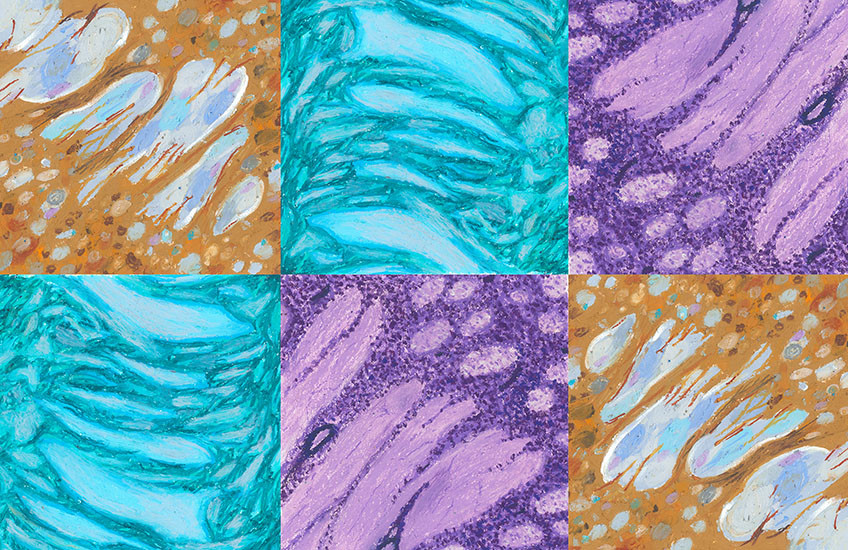
“We call it hidden histology because the cells in these zones all look the same under the microscope but have very strong transcriptional differences and are strikingly consistent from person to person,” said Macosko, who is also a core institute member and the Edward Scolnick Professor of the Broad Institute.
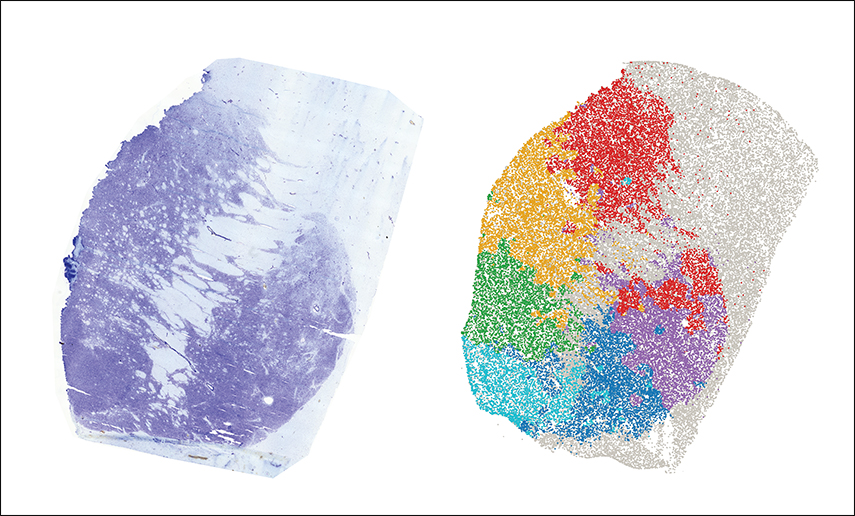
The team next explored the impact of aging on these six zones in more than 130 brains from the first study. They discovered that with increasing age, the zone boundaries began to blur, with less distinction in gene expression among zones.
A foundation for further discovery
With complementary findings from other BICAN researchers using spatial, functional, epigenomic, and other approaches, these studies demonstrate how cutting-edge methods such as Slide-tags that generate high-resolution data at scale can help chart and redefine what’s known about a complex organ like the brain.
“This is just the start of the atlas,” said Ichihara. “Through BICAN, we will now use the tools and methods that we’ve been applying to the basal ganglia to continue on to the rest of the brain.”
The researchers have shared their data and workflows openly for the studies on common variation and striatal zones, in addition to a portal for exploring the spatial datasets and common variation in gene expression. They encourage other scientific groups to explore their results.
The scientists also express gratitude for the contributions of tissue donors and their families, along with the commitment of several brain banks to making these studies possible.
Adapted from a Broad Institute news release.
Authorship, funding, disclosures
McCarroll is a Howard Hughes Medical Institute Investigator.
James Nemesh, Olivia Yoo, and Ezra Muratoglu are co-first authors with Burger of the first study (Common variation of cell abundances and gene expression in the human striatum). Additional authors are Charles Vanderburg, Jiayi Yuan, Khalid Shakir, Curtis J. Mello, Haoyuan Gao, Nirmala A. Rayan, Emily Finn, Julianna Milidantri, Abir Mohsin, Kathleen Kim, Sadie Drouin, Nikita Budnik, Melissa Goldman, Stanislav Bratchikov, Haley Fritch, Giulio Genovese, Marina Hogan, Olivia Catalini, Seva Kashin, Nicole Rockweiler, Alec Wysoker, Lauren Macaisa, Lucas Reese, Katelyn Flowers, Andrew W. Kraft, Stephen J. Fleming, Madelynn Coe, Riyaan Gunaratne, Liv Spina, Geneva Fischer, Catherine Crombie, and Nolan Kamitaki.
The work was supported by the National Institutes of Health/National Institute of Mental Health (UM1MH130966).
Andrew W. Kraft and Matthew Lee are co-first authors of the second study (Mesoscale molecular architecture of the human striatum across cell types and lifespan). Additional authors are Haoyuan Gao, Abir Mohsin, Nirmala A. Rayan, Alyssa J. Lawler, Garam Kim, Julianna Milidantri, Charles Vanderburg, Karol Balderrama, Naeem Nadaf, Vipin Kumar, Katelyn Flowers, Emily Finn, Matthew Shabet, Ezra Muratoglu, Olivia Yoo, Khalid Shakir, James Nemesh, Burger, Sadie Drouin, Olivia Catalini, Mukund Raj, Nikita Budnik, Lucas Reese, McCarroll, and Ichihara.
The work was supported by the National Institutes of Health/National Institute of Mental Health (BRAIN UM1MH130966), Alzheimer’s Association, Mass General Brigham Neuroscience Institute, Heitman Foundation, and Stanley Center for Psychiatric Research.
Macosko is a founder of Curio Bioscience.