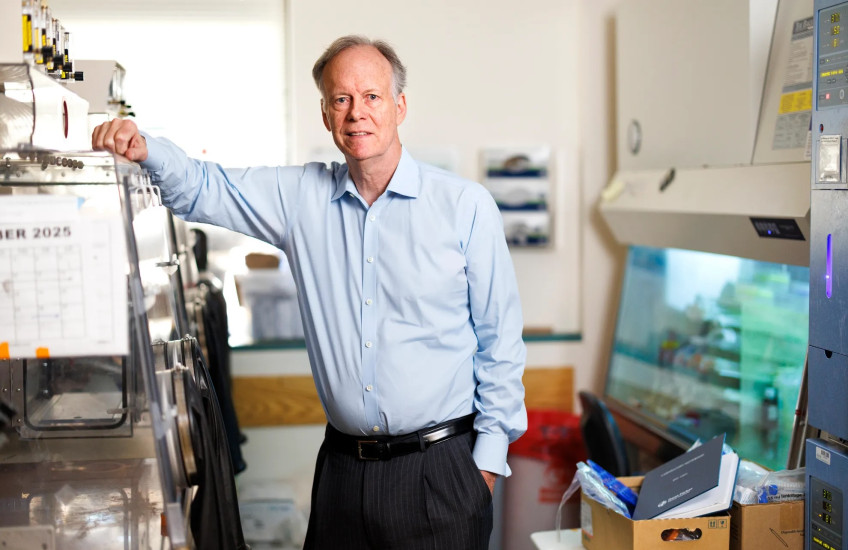
Scientific discovery, according to William Kaelin, is a little bit like fishing: You can be taught how to bait a hook or cast a line, but there is an art to knowing where to look for the big one.
Over the course of decades, Kaelin meticulously discovered a fundamental physiological mechanism: the way that cells sense and respond to oxygen levels. The work led to novel treatments for kidney cancer, and in 2019 it earned him a joint Nobel Prize in physiology or medicine, along with Peter Ratcliffe and Gregg Semenza.
Kaelin says the groundbreaking research, which also has implications for treating conditions such as anemia and heart attacks, was based on looking in the right place.
“A lot of science is just seeing connections and possibilities,” said Kaelin, the Sidney Farber Professor of Medicine at Harvard Medical School and Dana-Farber Cancer Institute. “I used to think it was mostly about mastering fancy techniques, but that is really of secondary importance. It’s really picking a good question to work on and seeing a possible connection that other people hadn’t seen.”
Fishing for insight
Kaelin, who was born in 1957 and grew up fishing with his dad on the south shore of Long Island, recalls his parents supplying him with chemistry kits, construction toys, and a microscope to foster an interest in the sciences.
“We were in the midst of the Cold War and the space race,” he said. “Scientists and engineers were celebrated.”
He was drawn to mathematics, where problems have one correct answer, and computer science, where a simple message to the mainframe leads to a clear result. At Duke University, he pursued a pre-med degree and went on to medical school.
During his third year he was working in a lab studying blood flow to tumors when he made the first observation that would send him down his Nobel-winning path.
He started reading about an unusual disease called von Hippel-Lindau disease, or VHL. Patients with VHL develop tumors in multiple organs. The tumors, Kaelin learned, somehow stimulate the excess formation of new blood vessels, a process called angiogenesis.
Years later, when he was chief medical resident at Johns Hopkins, VHL showed up again in a different body of literature, listed as a cause of excess red blood cell production.
He remembers thinking at the time: “Here’s von Hippel-Lindau disease-related tumors. What are they doing on this list?”
He was learning to think like a scientist.
Applied curiosity
When Kaelin launched his own lab at Dana-Farber, he returned to the lingering puzzle. His working hypothesis: Since increased angiogenesis and red blood cell production are ways that tissues try to deal with low oxygen, perhaps the VHL gene was required for cells to sense oxygen properly. He reasoned that studying the VHL gene could teach him about angiogenesis, oxygen sensing, and even kidney cancer. That’s because patients with non-hereditary kidney cancers usually have acquired VHL mutations, in contrast to VHL disease, which is caused by an inherited mutation.
There was particular interest around angiogenesis when Kaelin started his lab because of the pioneering work of the late Judah Folkman, the Julia Dyckman Andrus Professor of Pediatric Surgery and professor of cell biology at HMS. Folkman championed the idea of treating cancers with angiogenesis inhibitors — drugs that block the formation of new blood vessels.
“If we were going to have angiogenesis inhibitors, we were really going to need to understand the molecular circuitry that controls angiogenesis,” Kaelin said.
It was known that mutations on the VHL gene caused VHL disease, in which the body makes too many blood vessels. Like most genes, the VHL gene contains instructions for a protein — in this case, the VHL protein. Kaelin’s research — much of it supported by federal funding — confirmed the hypothesis that the VHL protein is required for oxygen sensing.
Together with other research in the field, his work showed that the protein binds to a protein called HIF-alpha and targets it for destruction, unless oxygen is scarce. In other words, HIF-alpha is the master regulator of the cell’s response to low oxygen.
In healthy cells, VHL keeps HIF-alpha levels in check. But when the VHL gene is mutated, as in VHL-associated tumors, HIF-1-alpha accumulates in the body. This accumulation aberrantly triggers the overproduction of red blood cells and abnormal blood vessel growth, which is the hallmark of VHL disease and some cancers.
The finding explained many of the clinical characteristics of VHL-associated tumors but still begged the question of how the VHL protein “knows” whether oxygen is present, and hence whether to target HIF-alpha for destruction. Working independently, Kaelin and co-Nobelist Ratcliffe showed that a little chemical “flag” is added to the HIF-alpha protein when oxygen is present, which signals the VHL protein to degrade HIF-alpha.
The mechanism is elegant in its simplicity, a basic balancing of elements in the body that was not understood until the right person with the right training asked the right question.
Kaelin says it’s gratifying that the research led to the development of drugs that target the oxygen-sensing process, leading to new treatments for cancer and anemia caused by kidney failure.
“A lot of science is seeing connections and being primed to recognize a possibility,” he said.
Adapted from an article in the Harvard Gazette.