The future of federally funded research at Harvard Medical School — supported by taxpayers and done in service to humanity — remains uncertain. Learn more.
For decades, synthetic biologists have strived to rewrite the genomes of bacteria to make them more useful for our own needs — such as producing medicines or biofuels — while ensuring that neither the cells nor their genetic modifications can spread out of control.
Akos Nyerges is among those pushing the field forward.
As a postdoctoral fellow in the lab of George Church, the Robert Winthrop Professor of Genetics in the Blavatnik Institute at Harvard Medical School, Nyerges led advances such as developing techniques that help wall off genetically modified organisms (GMOs) by making them resistant to viruses that could otherwise infect them and transfer snippets of their engineered DNA or RNA to other cells. The effort advances biocontainment strategies from the Church Lab and beyond.
Now Nyerges is starting his own lab at HMS as an independent research associate in genetics. He dreams of improving genome engineering technologies to the point that researchers can safely and effectively design organisms, including bacteria, that aid in drug discovery or serve as therapies themselves.
But a gap remains between the field’s potential and its current reality. While promising, efforts to massively edit bacterial genomes tend to result in feeble cells that don’t reproduce well and can’t do the jobs they were designed for outside of carefully controlled laboratory settings, Nyerges says.
In a study published June 22 in Nature Communications, Nyerges, Church, and colleagues reveal some of the reasons bacterial genome design has proven harder than even experts had anticipated — and offer a way through.

Nyerges sat down with Harvard Medicine News to share what the team found, why he’s excited about this moment in microbial engineering, and where he hopes his journey will take him and the patients he wants to help.
Harvard Medicine News: Why did you become a scientist?
Akos Nyerges: Very early in my childhood I got fascinated by microbiology and how microbes operate. At the time, my mom worked in a microbiology lab that held open days when lab members could bring family members in. You could touch petri dishes with your hand and then in a couple of days see what was growing out on them. I was maybe 8, and this really convinced me that microbes are cool and exciting.
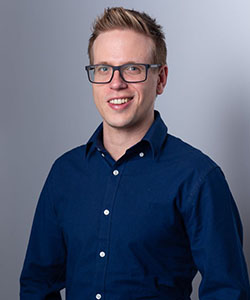
The rest was self-catalyzed. I bought a microscope and some basic lab equipment and started tinkering with things at home. In high school, I joined the lab in my hometown and started working on microbiology projects after school and on weekends. Everything was curiosity driven.
For my undergrad thesis I built a qPCR machine [a device that measures the amplification of DNA in a sample in real time] at home from, like, eBay used parts and a digital camera. I realized you can generate lab equipment for $300 that would have cost tens of thousands of dollars at that time. And the machine worked!
HMNews: What drew you to this field in particular?
Nyerges: In high school I came across an article from [human genome sequencing pioneer] Craig Venter’s team about an effort to create the first synthetic bacterial strain, which was to be called Mycoplasma laboratorium. It convinced me that microbiology was about to be transformed and we were entering this phase where we could create living organisms according to our design and rational engineering. This launched my career toward synthetic biology and synthetic genomics — engineering biology in general. Now I can say I’ve spent 20 years working toward being able to design genome-scale functional DNA.
HMNews: How far have things progressed, for the field and for you? What’s your goal now that you’re starting your own lab?
Nyerges: What motivates me is utilizing the synthetic biology and genomics technologies we’ve developed in the past 15 to 20 years and applying them to transform patient care and biotechnology. Right now, as we showed in Nature in 2023, we can create “firewalled” cells that basically can’t exchange genetic information with natural life. There’s a lot more fundamental research and optimization that needs to be done before firewalled cells can be used efficiently in the real world, but I’m working toward this goal, including using them as agents for living therapeutics and for discovering new drugs.
HMNews: Are there specific diseases you hope to have an impact on?
Nyerges: There are two major areas, both of which require different approaches. One is metabolic diseases, such as diabetes. We have some cool new science that we think could address issues that others have encountered in drug discovery and clinical trials for these diseases.
The other area is cancer. Bacterial cells are a validated modality for cancer therapy. For example, an immune-stimulating bacterial strain called Mycobacterium bovis BCG has been used as a frontline therapy for noninvasive bladder cancer since the 1970s. We can use genome engineering and genetic code expansion technologies to tailor how much of an immune response a bacterium provokes. Another area where these technologies could be useful in cancer treatment is in designing peptide therapeutics, like the KRAS inhibitors that have had fascinating results in recent clinical trials.
HMNews: How does your new paper fit into this endeavor?
Nyerges: The main challenge that holds the field back is that the genetic-code engineering required for some of these applications is a lot more complicated than we thought, and this complicated process is harmful for our engineered cells. The more we engineer a genome, the more problems the cell develops. The first-generation firewalled E. coli cells we published about grow so slowly that they will never enter industrial use because they just can’t compete with the productivity of existing strains. Another recently published synthetic genome-driven E. coli strain from another team grows almost 10 times slower than its parent.
Our new paper shows that we’ve missed some of the biological factors that make highly engineered cells sick. We missed that, especially in bacterial genomes, genes and regulatory elements for protein production overlap with one another in many, many random directions, and these overlaps induce issues when you change a DNA sequence, such as destroying gene expression. We discovered an entire dimension of biology we hadn’t thought about before in these organisms.
HMNews: How did you figure out what the problems are — and how they might be solved?
Nyerges: First, we used multi-omics techniques, like ribosome profiling [measuring how a cell makes proteins], to discover what was going wrong with synthetic E. coli genomes designed in the Church Lab and other labs. We found extensive problems — and discovered that all these genomes are suffering from the same issues. These tools gave us a lens to find the hidden meanings that we as a field have been altering without knowing.
Then we used directed evolution to troubleshoot the problems. We took these very sick cells, introduced different mutations, and for more than three years we forced them to evolve to see if anything made them reproduce faster. We took the fittest variants day after day and started them growing in fresh media.
Together, this gave us a complete overview of what needs to be preserved and what needs to be avoided if we want to generate cells with new-to-nature functions for translational applications where high fitness and functionality are critical, like therapeutics or biotech. We then designed a new -omics-guided directed evolution workflow that enables us to debug these cells more than 30 times faster than natural evolution. We provide a single workflow that opens the way to designing heavily rewritten genetic codes and whole genomes that overcome these problems and are safe.
This is why our paper is groundbreaking: It shows that synthetic genome design is doable, but it’s a lot more complicated than we originally thought. We need a much more holistic and data-driven approach that can incorporate the additional elements that we just discovered.
HMNews: Pretty ambitious goals.
Nyerges: Synthetic biology is a fascinating field. With the latest computational tools and -omics technologies, and by learning from natural evolution, I believe we will get to this point soon.
This interview was edited for length and clarity.
Authorship, funding, disclosures
Nyerges is first and co-corresponding author of the Nature Communications paper. Church, who is also a founding core faculty member at the Wyss Institute for Biologically Inspired Engineering at Harvard University, is senior and co-corresponding author. Additional authors include Anush Chiappino-Pepe, Bogdan Budnik, Maximilien Baas-Thomas, Elissa Rhuby, Regan Flynn, Shirui Yan, Nili Ostrov, Min Liu, Meizhou Wang, Qingmei Zheng, Fangxiang Hu, Kangming Chen, Alexandra Rudolph, Dawn Chen, Jenny Ahn, Owen Spencer, Venkat Ayalavarapu, Angela Tarver, Miranda Harmon-Smith, Matthew Hamilton, Ian Blaby, Yasuo Yoshikuni, Behnoush Hajian, Adeline Jin, Balint Kintses, Monika Szamel, Viktoria Seregi, Yue Shen, and Zilong Li.
Funding for this research was provided by the U.S. Department of Energy (grant DEFG02-02ER63445), National Science Foundation (award 2123243), Joint Genome Institute (JGI) DNA Synthesis Program (award number 508712), National Institutes of Health (grants 1K99EB035165-01, 5K99EB035165-02, and 4R00EB035165-03), and EMBO (European Molecular Biology Organization long-term fellowship 160-2019). Chiappino-Pepe acknowledges funding from the Swiss National Science Foundation. DNA synthesis for troubleshooting experiments in this work was also conducted by the JGI, a DOE Office of Science User Facility, supported by the Office of Science of the U.S. Department of Energy, operated under contract DE-AC02-05CH11231 (awarded to The Regents of the University of California and the Lawrence Berkeley National Laboratory).
Nyerges is an inventor on a granted patent related to directed evolution with random genomic mutations (DIvERGE) used in this study (US10669537B2: Mutagenizing Intracellular Nucleic Acids, Patent applicant: Biological Research Center) that has been out-licensed. HMS has filed a provisional patent application related to the construction of Ec_Syn57 in this work (US provisional application 1795 63/560,144, Patent applicant: President and Fellows of Harvard College), on which Nyerges and Church are listed as inventors. Zheng, Wang, Liu, Jin, Chen, Li, and Hu are employed by GenScript USA Inc., but the company had no role in designing or executing experiments. Church is a founder of GRO Biosciences and enEvolv (now part of Ginkgo Bioworks), in which he has related financial interests. Church’s other potentially relevant financial and nonfinancial interests are listed on his website.