At a glance
Rock weathering has been considered as a potential solution to address climate change by capturing excess carbon dioxide from the atmosphere, but it takes thousands of years in a natural system.
In a pilot experiment, engineered bacteria sped up rock weathering by threefold, enabling continuous carbon capture.
Researchers estimate that a massively scaled-up version of the system could significantly increase the amount of carbon dioxide sequestered through weathering, reducing the impacts of climate change on the environment and human health.
As rocks are slowly eroded by wind, rain, and other forces, they release compounds that trap carbon dioxide and remove it from the air. Typically, this process takes thousands of years, but if it could be sped up, it might provide a viable method to help address climate change by capturing and storing excess carbon dioxide.
Researchers in the Blavatnik Institute at Harvard Medical School have now developed a system to accelerate rock weathering using genetically engineered microbes. In a pilot-scale experiment, published Aug. 28 in Nature Biotechnology, the researchers showed that the microbes weathered rocks three times faster than their nonengineered counterparts, facilitating removal of carbon dioxide from air into seawater.
The team estimates that in large-scale bioreactors, engineered microbes could accelerate carbon removal and provide significant improvements over current weathering techniques, which typically involve scattering finely ground rocks in soil or coastal environments and letting natural forces finish the process.
“Some people describe rock weathering as a silver bullet for climate change. The problem is that it’s too slow,” said first author Neil Dalvie, synthetic biology fellow in systems biology at HMS. “We’ve found a way that it could work, and, maybe more importantly, now we have a model to calculate what it would look like to implement this at scale.”
The work, which was conducted in collaboration with researchers at the Wyss Institute for Biologically Inspired Engineering and the Stanford Doerr School of Sustainability, is an important step toward implementing rock weathering at scale and could help mitigate the effects of climate change on the environment and human health.
An affinity for iron
Silicate rocks, which make up the vast majority of the earth’s crust, release magnesium, silicate, and iron as they weather. While magnesium and silicate are soluble in water, iron is not — the iron ends up covering the rock in a layer of rust, which slows weathering.
Scientists have considered that bacteria could help remove this iron. When they are low on iron, many microbes produce molecules called siderophores, which make iron water-soluble. But once the microbes have enough iron — and they don’t need a lot — siderophore production stops.
Dalvie and his colleagues engineered a common marine bacterium, Alteromonas macleodii, to produce siderophores continuously. It was a fairly easy tweak, Dalvie said. The hard part was determining whether the bacteria were effective.

“The bacteria keep growing, the cells keep making siderophores, the rock keeps dissolving — it’s very hard to measure all these things at the same time,” Dalvie said.
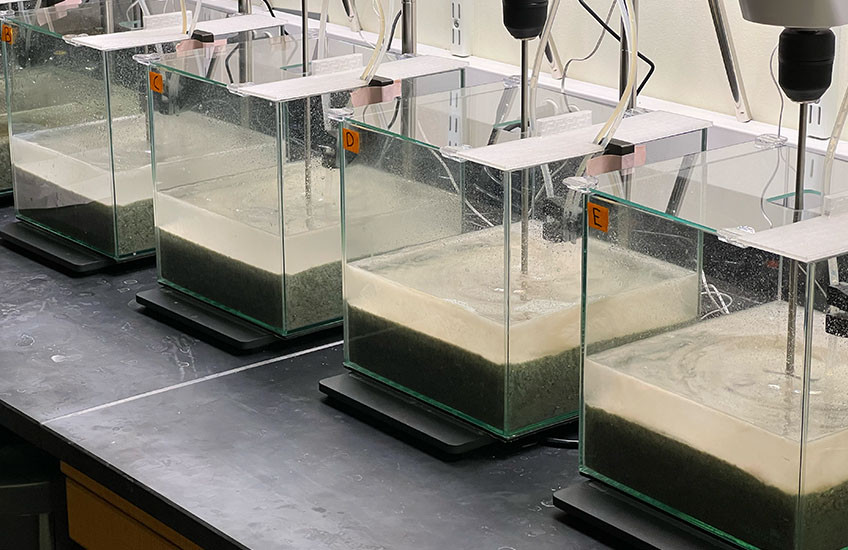
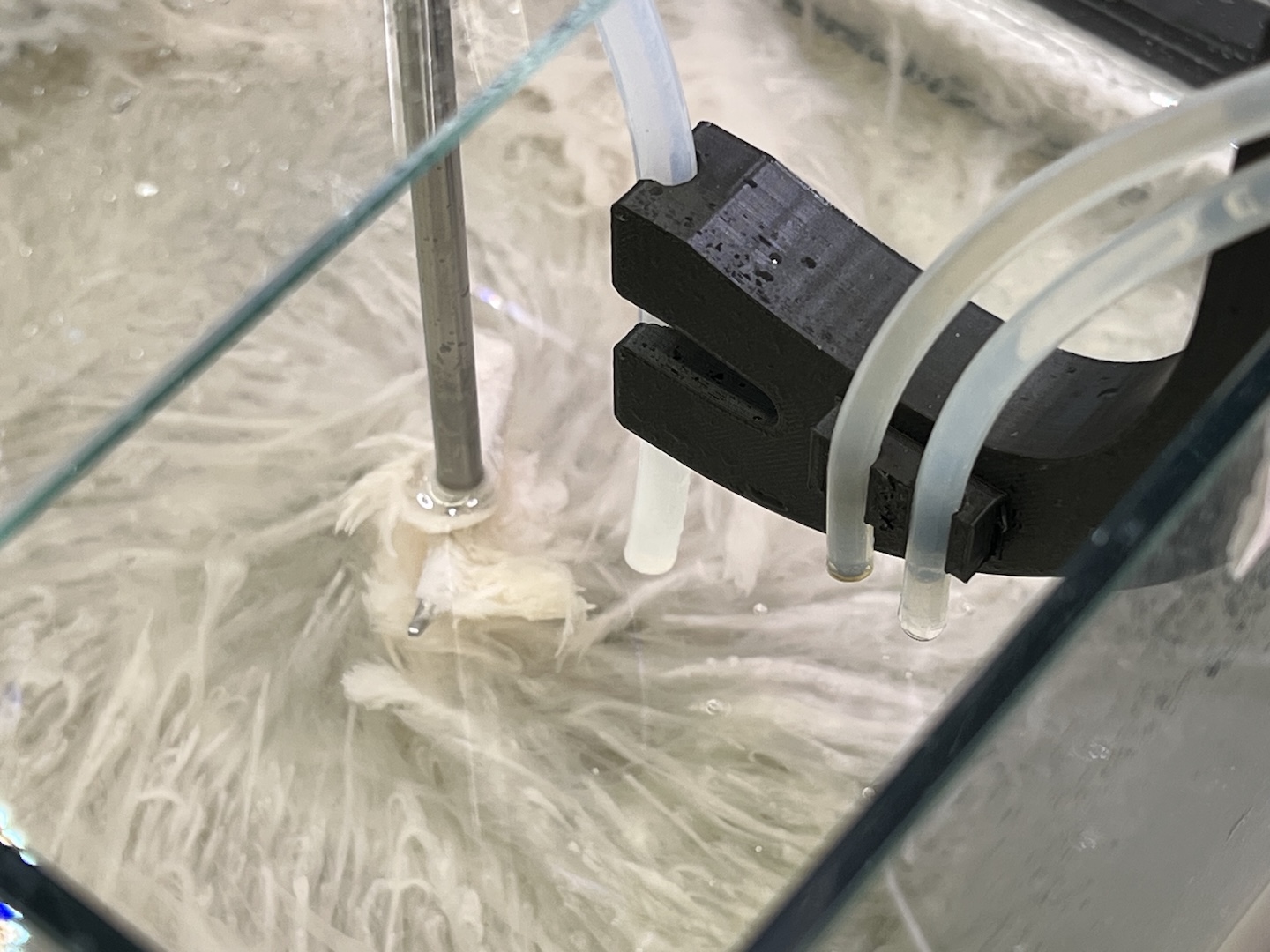
The researchers set up a series of tanks in which seawater from Boston Harbor flowed continuously over a layer of olivine sand — a common silicate rock. They allowed growth of natural bacteria in some tanks as a control and added the engineered A. macleodii to others, along with feedstocks to keep them alive. The weathering system reached a steady state, and the researchers were able to take measurements.
The normal bacteria quickly stopped producing siderophores in the presence of olivine and had limited effect on weathering or carbon sequestration.
The engineered bacteria, on the other hand, caused a threefold increase in rock weathering over plain seawater. In tanks with 4 kg of olivine, the researchers measured that .5 g of carbon dioxide was removed from the air each day.
Scaling up
Global carbon dioxide emissions are measured in gigatons, so any carbon removal method needs to operate at large scales to even begin to make a dent.
Rock weathering, Dalvie said, is scalable. Silicate rock is widely available as waste from mining operations, and the microbe-engineering system can work with unfiltered sea water.
Dalvie and colleagues also showed that an industrial-scale version of the system could remove significantly more carbon dioxide from the environment than it generates. The calculations, which took into account emissions produced to build tanks, procure olivine, pump seawater, add the engineered bacteria, and create a nutrient mix to feed them, showed a 74 percent increase in net carbon capture over weathering systems without engineered bacteria.
Dalvie and his colleagues know there is significant work yet to be done — conducting larger-scale experiments, refining nutrient mixes, creating more efficient bacteria, and ideally accelerating weathering even further. Still, the results demonstrate that rock weathering could be a viable tool for addressing climate change.
“We dig up something like 50 gigatons of rock per year. If you were to take all that waste and dissolve it in systems like this, you would basically offset all our climate emissions,” Dalvie said. “Rock weathering doesn’t require a significant technological breakthrough to be effective. What it needs is serious investment.”
Read more about the work in this Wyss Institute news release.
Authorship, funding, disclosures
Additional authors of this work include Amogh Jalihal, Abigail Fitzgibbon, Jan-Tobias Böhnke, Mohammed Hijaz, Quincey Justman, Steven Davis, Pamela Silver, and Michael Springer.
This work was supported by a Schmidt Science Fellowship, the Synthetic Biology Hive at HMS, the Harvard Climate and Sustainability Translational Fund from the Office of Technology Development and the Salata Institute for Climate and Sustainability, the Wyss Institute Director’s Fund, and a Garden Grant from Homeworld Collective.
Dalvie, Böhnke, Silver, and Springer have filed a patent application on bacterial strains engineered for siderophore production (application no. 63/565,899).