Yoseph Boku knew he wanted to do research to help people with sickle cell disease when he enrolled as an MD student at Harvard Medical School in 2021.
He’d become interested in advocating for this historically neglected patient population as a freshman at Harvard College while mentoring teenagers with the disease through the nonprofit Next Step. HMS offered opportunities to not only learn how to provide the best care for patients with sickle cell disease but also investigate ways to improve that care.
When Boku started clinical rotations in his second year of HMS’s Pathways curriculum, he found that he and his colleagues sometimes struggled with moral distress — the anguish of being unable to provide optimal care because structural barriers stand in the way — while providing sickle cell treatment.
“I felt this really complicated emotion, and I wondered, are others experiencing this too?” he said.
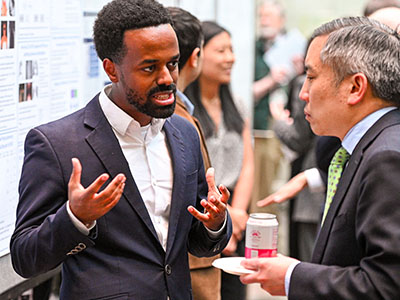
He dug into the medical literature and discovered that no one had characterized moral distress among clinicians treating adults hospitalized with sickle cell disease. Analyzing survey data from the University of Rochester, he became the first to do so.
Now set to graduate in May and start residency training in internal medicine at Massachusetts General Hospital, Boku presented the results of his work alongside more than 60 other Harvard medical and dental students at the 86th annual Soma Weiss Student Research Day.
The event — held this year on March 17 in the Tosteson Medical Education Center (TMEC) on the HMS campus and coordinated by the HMS Office of Scholarly Engagement — brings together faculty, staff, and students from across the Harvard community to celebrate mentored research projects that students complete as part of their degree requirements or as additional investigations.
“It’s a culmination of the wonderful work they’ve put in over months or years,” said Altaf Saadi, faculty director of scholarly engagement at HMS. “For some of them, their mentors and lab members are here to celebrate their research, and their peers get to hear about what they’ve been working on.”
The School’s policy of requiring all MD students to complete a scholarly project, regardless of whether they plan to incorporate research into their careers, underscores the centrality of investigation and innovation in the practice of medicine and demonstrates how medical school at HMS is a multilayer experience, said Bernard Chang, HMS dean for medical education.

“Yes, students gain the fundamental skills to become outstanding clinical practitioners, but we have the resources, the curriculum, and the people to say there is an additional component: studying a topic in depth and contributing to knowledge that will transform how we care for patients in the future,” said Chang, who is also the Daniel D. Federman, M.D. Professor of Neurology and Medical Education at HMS.
A spectrum of student research
The event kicked off with talks from the two recipients of the 2026 Martin Prince Award for Student Innovation and four other selected student scholars. Then the TMEC Atrium filled with organizers, guests, judges, and the 62 students who chose to present posters.
The work on display formed a microcosm of the types of investigation being conducted in the School’s 11 preclinical departments and 15 affiliated hospitals and institutions.
Projects contributed to ameliorating illnesses across life stages, from a pulmonary vein condition in infants, to depression in young adults, to women’s heart health in midlife, to cochlear implantation in older adults.
Some students focused on understanding and addressing the health needs of specific populations, such as firefighters, construction workers, parents of children with medically complex conditions, unhoused people, and rural Alaskan Native communities.
Work took place across the United States and in more than a dozen other countries in North America, Africa, and East Asia.
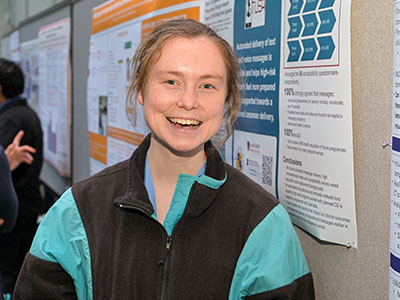
Third-year Pathways MD student Emilie Baxter spent her first-year summer break at Mbarara Regional Referral Hospital in Uganda, contributing to a pilot study of a mobile health program designed to reduce perinatal deaths by helping women with high-risk pregnancies prepare for planned cesarean sections.
“I was lucky to have the chance to go there,” she said. “For the next half decade, especially with residency, we’ll be at the hospital all day, every day, and the freedom to do things like this won’t be possible.”
Two layers of learning
Baxter said that while she isn’t sure the findings will inform her clinical practice, doing the research taught her other lessons she’ll carry forward.
For instance, she said, “It made me realize that optimization of care is not just about a drug’s effect on the body but also all the social stuff that’s going on in that patient’s life and in the hospital.”
Her experience exemplifies HMS leaders’ conviction that what students learn by doing a scholarly project is as important as the subject they choose to study.
“No matter what they do in the future, even if the project isn’t related, the skills they gain will stand them in good stead,” said Chang.
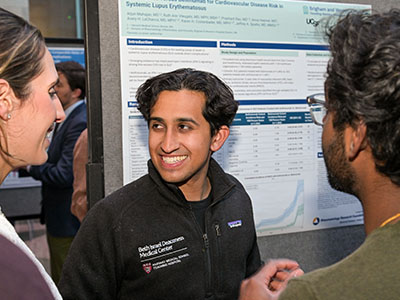
Arjun Mahajan, a third-year Pathways MD student whose projects applied biomedical informatics tools to inform care for autoimmune diseases, agreed.
“I’m still exploring what my long-term career will look like,” he said, “but I can guarantee you the skills that I’ve learned here I will be applying in some capacity to create evidence that helps advance patient care.”
Boku said he was most excited that his secondary analysis revealed that addressing providers’ moral distress might improve care for patients with sickle cell disease. Gleaning valuable insights into research and practice provided a second layer of meaning.
“I realized that qualitative research is a really powerful tool in the fight for health equity,” he said. “It was also a reminder that when we have an uncomfortable feeling on the wards, we should trust our intuition, because it may indicate an opportunity to improve things.”
Nurturing future physician-scientists
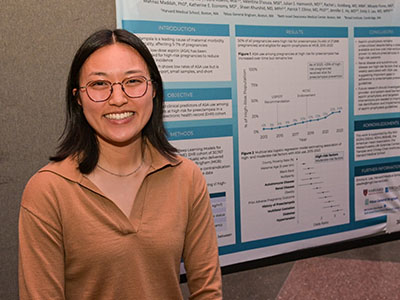
For those like second-year Pathways MD student Emma Lee, who assessed aspirin use in pregnant individuals at high risk for preeclampsia, scholarly research opportunities are part of the attraction of HMS.
“For sure it was a factor in deciding where to go,” she said, recalling how as an applicant she’d been drawn to research but didn’t necessarily want to pursue MD-PhD training.
Others become convinced while pursuing their projects to start — or resume — incorporating research into their career plans.
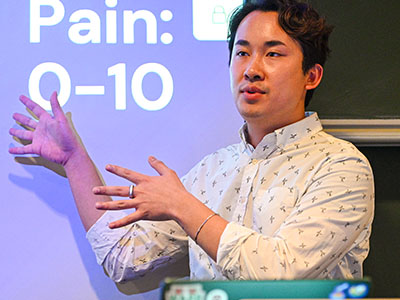
Rory Vu Mather, a sixth-year MD-PhD student in the Harvard-MIT Program in Health Sciences and Technology, had fallen in and out of love with research before and during his training. While developing models to objectively characterize individual patient responsiveness to opioid treatment for post-surgical pain — work that could inform more personalized and effective care plans — he found that the ability to give people hope rekindled his dedication to becoming a physician-scientist.
“I met patients and saw their fear about not knowing how to deal with the pain,” he said. “Something as simple as telling them, ‘Hey, we’re working on this problem,’ has been more impactful than I realized, and so that has moved me forward in research to make medicine better.”
Soma Weiss Student Research Day honors and poster prizes
Best student posters:
Elizabeth D. Hay Prize for Basic Science Research
- Winner: John Kincaid, “Systematic characterization of radiation-induced secondary malignancies in mice”
Judah Folkman Prize for Clinical/Translational Science Research
- Winner: Grace Kromm, “Resting-state functional brain network alterations and cognitive-behavioral associations in young children with autism and language impairment, Down syndrome, and Fragile X syndrome”
- Runner up: Jeffrey Prince, “The association between liver metastases and PD-1 inhibitor therapy outcomes in advanced gastroesophageal adenocarcinoma”
Charles Janeway Prize for International Research or Service
- Winner: Jaeyoon Cha, “Impact of a hospital-based palliative care service on cancer patients and caregivers in Rwanda”
- Winner: Ammar Dharani, “Adaptation of a scale to assess breast and cervical cancer stigma in Rwandan healthcare workers”
Leon Eisenberg Prize for Medicine in Society Research
- Winner: Twisha Bhardwaj, “Examining shifting landscapes of disease definition and language use in the Alzheimer’s specialty clinic”
Martin Prince Award for Student Innovation
- Eric Strand, “SONAR: Auditory information as a modality for enhanced radiologic analysis”
- Jerry Zhang, “From $30,000 to $50: Reimagining negative pressure wound therapy for low-resource health systems”
Student podium presentations
- Annie Abruzzo, “A novel liquid biopsy–driven integration classifier predicts outcomes in HPV-associated head and neck cancer”
- Winston Lie, “Non-invasive testing of myocarditis using CD45-PET/CT”
- Rory Vu Mather, “Using hybrid, mechanism-informed models to characterize individual responsiveness of post-surgical pain to opioid treatment”
- Natalie Swartz, “Identifying cultural concepts of perinatal depression among Maya Kaqchikel Women in San Juan Sacatepéquez, Guatemala”
Images: Steve Lipofsky