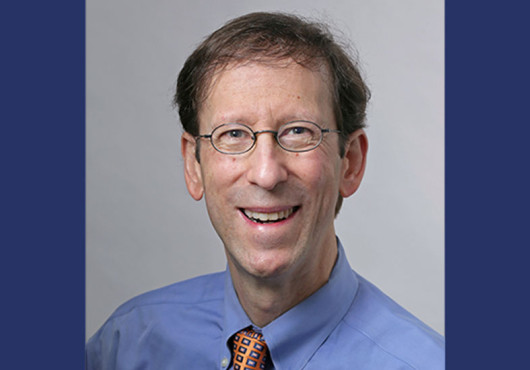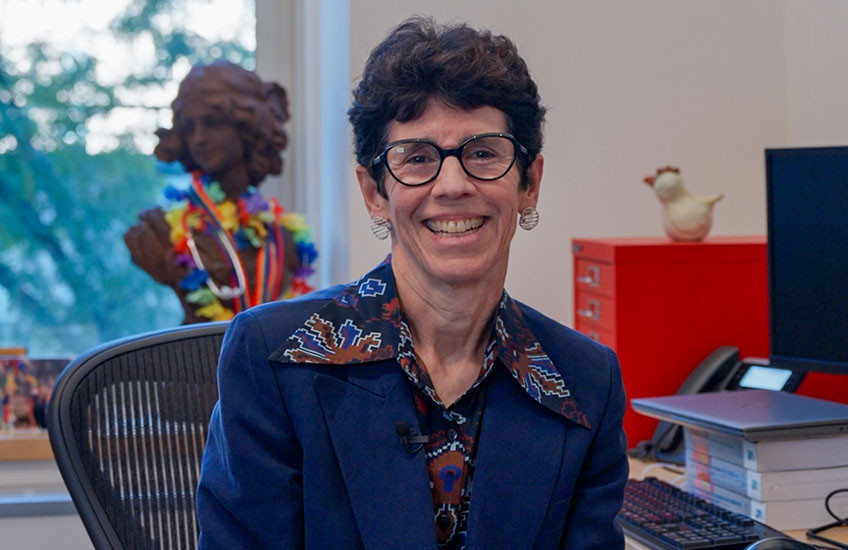
Jennifer (Jenny) Potter assumed the role of Harvard Medical School dean for students in the Program in Medical Education on Aug. 1. She had served as interim dean after succeeding Fidencio Saldaña, who held the role from 2016-2025.
An HMS alumna, faculty member, and administrator, Potter brings a long-time commitment to the School, particularly to the student learning environment.
She and her team in the Office for Student Affairs create programs and spaces that support well-being and empowerment so medical and dental students can make confident decisions about their futures and flourish as they become clinicians.
Potter, who is also a primary care physician and HMS professor of medicine at Beth Israel Deaconess Medical Center, previously served as advisory dean and director of the Castle Society, one of five academic advising communities to which all medical and dental students are assigned, and director of student well-being programs.
She is an internationally recognized expert in sexual and gender minority (SGM) health and a faculty leader in trauma-informed care. She founded the Women’s Health Center at Beth Israel Deaconess; is co-director of the longitudinal curricular element Frontiers of Health Care: Trauma-Informed Care at HMS; and is co-chair of the Fenway Institute, a research and education center focused on SGM communities, where she leads the Division of Education and Training.
Potter received a bachelor’s degree in psychobiology from the University of Massachusetts Boston. After earning an MD from HMS, she completed her internship, residency, and chief medical residency at what was then New England Deaconess Hospital.
Harvard Medicine News spoke with Potter about guiding students as they grow into the physicians, and people, they want to become.
Harvard Medicine News: What most excites you about being dean for students? What’s your favorite part of working with our students?
Jennifer Potter: I’m most excited about the chance to partner with students and help make their time here as meaningful and rewarding as possible. It’s a real joy to watch our students grow and change during such a transformative time in their lives and to find ways to support and uplift them along the way.
HMNews: What would you say are the distinguishing features of the student community here at HMS?
Potter: Our students are incredibly energetic and have a real drive to make a difference. They come from all over the world, bring wildly different interests and life experiences, and arrive with a shared ambition to change the world.

HMNews: What, in your own words, do you do as dean for students?
Potter: I see my role as supporting students throughout the journey of becoming the clinicians and scientists they hope to be. That starts with listening — really listening — to what they’re experiencing, what they need, and what may be getting in their way.
There’s so much to learn in medical and dental school, and the experience can be both exciting and stressful. I want students to feel that they belong here, that they can find their people, and that they have support not only when things are going well but also when they’re facing challenges.
That means building trust, being transparent, and making space for student voice and choice. It means strengthening peer support, respecting students’ different backgrounds and perspectives, and working together to create a community that is inclusive and empowering.
HMNews: What attracted you to the role?
Potter: There’s a story that helps explain why this role feels so meaningful to me. Early in my training, I cared for a woman in her 70s who had just been diagnosed with cancer. She reminded me so much of my grandmother that I had to step out of the room for a moment. I was overwhelmed by an emotion I hadn’t quite expected.
That experience has stayed with me. It reminded me how much medical training asks of us, not only intellectually and professionally but also emotionally. We don’t always acknowledge how difficult it can be to care for patients who remind us of people we love or to encounter illness and suffering for the first time.
I want to help students anticipate some of those experiences, feel less alone when they encounter them, and have the support they need as they learn to care for patients while also taking care of themselves.
HMNews: What kind of challenges do medical and dental students face?
Potter: Students are balancing a lot. They’re learning an enormous amount of information, developing the skills and confidence to care for patients, and figuring out who they want to become as physicians and dentists, all while navigating life as young adults.
There are also so many important decisions they need to make. They’re thinking not only about residency or their next stage of training but also about whether they want to pursue research, advocacy, education, administrative leadership, or other interests.
HMNews: How does student affairs support students as they work through these challenges and decisions?
Potter: Our office is a place students can turn when they need support. We want them to know what resources are available and to feel comfortable reaching out, especially when they’re under stress or facing a crisis. If a student comes in with something difficult, our goal is to give them the space to talk openly, feel heard, and work together to find a path forward.
Trust depends on honesty and transparency. During orientation in August, I walked students through several key institutional policies. We discussed not only what the policies say and where to find them but also the reasoning behind them. Students should understand the framework they’re working within before they’re in a stressful situation and need to navigate it. It’s also crucial to partner with students to make sure our policies and procedures are clear and responsive to their needs.
Some of our most successful interventions started as student ideas. A few years ago, students raised concerns about the cost of mental health care. In response, we developed a subsidy of $500 per student per semester, to help ensure that cost wouldn’t be the thing that stands between a student and the care they need.
Some of the most meaningful support students receive comes from their peers, so we offer peer tutoring and mentor the students who lead an annual peer-to-peer mental health training. Our office also hires students across all curricular phases for the Student Well-Being Ambassador Program, in which students design and deliver wellness initiatives alongside our staff.
HMNews: How do you see student affairs working to create a sense of cohesive community among all the students in our two MD programs, the Harvard/MIT MD-PhD program, and the Harvard School of Dental Medicine?
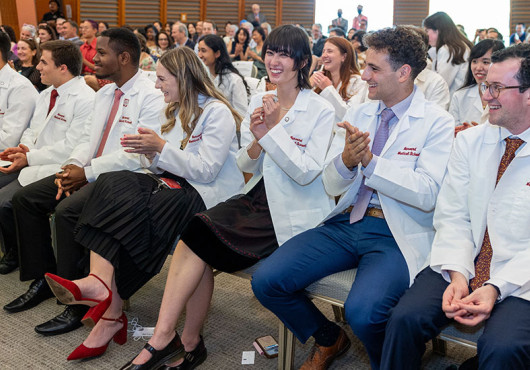
Potter: We bring people together across campus in many ways, including well-being events, Society mixers, and career exploration sessions for students across all class years. In addition, our associate dean for students, Andrea Reid, and our staff host Thriving in Medicine, Lunch with Leaders, and Community Belonging Collective gatherings. These give students the opportunity to hear personal stories from faculty about their work, career journeys, and challenges, while also creating space for students to share what is on their minds. We are also planning an all-student town hall in October, where members of the community can come together to discuss their questions, concerns, and priorities.
HMNews: What do you do with your time outside of the office and clinic?
Potter: I enjoy being with people. I have sung in choirs over the years. I go on day-hiking expeditions with people in the White Mountains and spend time at Squam Lake in New Hampshire. Very often the things I enjoy doing are out in nature — I feel calmed and soothed by water.
I love to binge watch Netflix shows. I also enjoy reading. Lately, I’ve been drawn to soundbite material, like poetry, as well as books that connect to my professional work, such as TouchPoints by Douglas Conant. I also watch YouTube videos that provide practical tips that help me continually improve in my role.
This interview was edited for length and clarity.