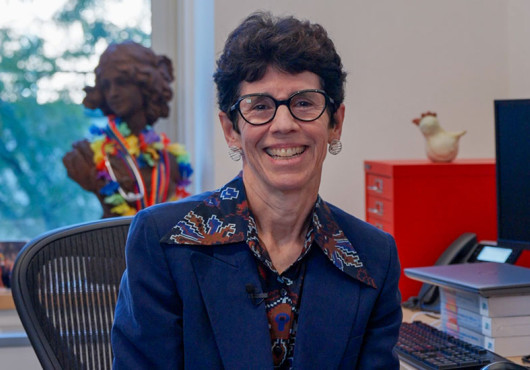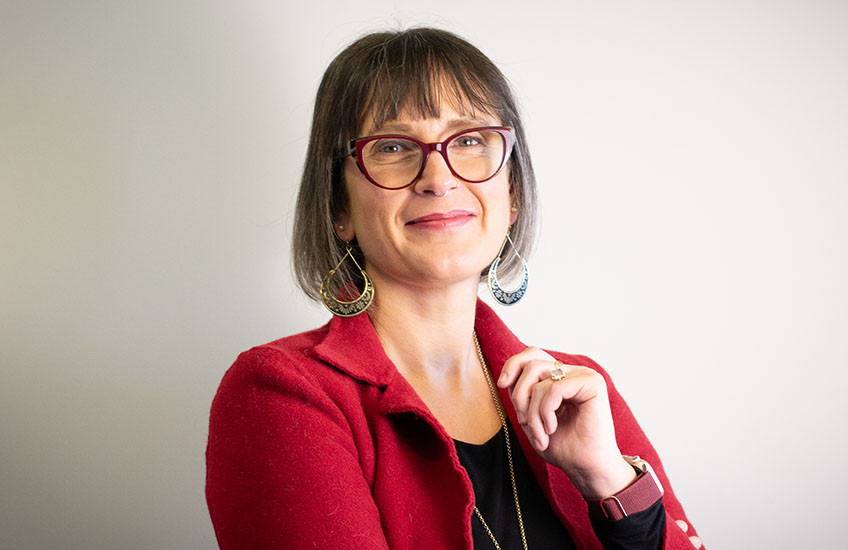
In June, Harvard Medical School welcomed briana Sevigny as director of the medical school learning environment, a new role within the Program in Medical Education.
The position serves as a central and neutral resource for promoting a respectful, inclusive, and non-retaliatory learning environment for medical students, according to program leaders.
Sevigny will ensure policies and processes are in place to handle mistreatment concerns and complaints, including ensuring that they are addressed promptly, fairly, consistently, transparently, and with a high level of discretion.
Partnering with program directors and medical school leadership, Sevigny is introducing initiatives that foster shared learning, responsibility, and accountability to strengthen awareness of conduct matters and promote a safe, productive student experience.
Sevigny — whose first name is styled with a lowercase “b” and who uses she/they pronouns — joins HMS from Tufts University, where she was director of the Office of Community Standards. She has worked with university students for nearly 25 years and has developed student conduct policy and policy training programs, modules, presentations, and curricular advising for the past 16 years. They hold a master’s degree in legal studies from Northeastern University School of Law and a master’s in student development in higher education from Central Connecticut State University.
Harvard Medicine News spoke with Sevigny about how she is shaping the role to ensure the learning environment enables every medical student to thrive.
Harvard Medicine News: What drew you to come work at HMS?
briana Sevigny: I’d gone to school or worked at a state land-grant institution, a liberal arts university, a trade-specific institution, and a faith-based college, but I hadn’t worked at a professional school, although I knew colleagues who worked at Tufts’ medical, veterinary, and dental schools, including Kelsey Simonson, who is now HMS registrar.
One of the things that perhaps I didn’t anticipate about a professional school is a real, innate sense of curiosity. Even if people are experts in their fields, they recognize that there’s still so much left to learn.
The people at HMS were another consideration. I knew a fair number of people who really love working here. Their sense of job satisfaction was a great green flag.
And three, this position gave me a unique and interesting opportunity to blend things that I had a lot of experience with — supporting students, solving problems, leading proactive initiatives, leveraging data to influence response, managing crises — along with things that I had not done before.
I felt I could contribute while continuing to learn, try new things, and be in an environment that supports my growth, not only as a member of that team but also as a human being.
HMNews: What would you like HMS medical students to know about your role?
Sevigny: I’d like us all to create a community that reminds us that we’re responsible to, and for, each other and build a culture of reciprocal learning across the whole institution.
I want students and faculty to feel like my role is a resource rather than something to be fearful of just because it includes addressing mistreatment.
If a student is experiencing stress, conflict, or challenges, even if it’s not connected to HMS, I want to let them know we’re listening; want to support them; and can help them think about how to handle what they’re experiencing, build skills so that they can do that for themselves, and figure out their path going forward.
HMNews: How are you approaching issues of student conduct and mistreatment complaints?
Sevigny: I would like to proactively give people tools to navigate whatever they’re encountering. I won’t be able to prevent mistreatment from happening entirely, unfortunately, but I can strive to prevent it as much as I can. Even if it’s something that they aren’t sure is mistreatment, we can talk about it. People can unburden themselves by coming to me with what’s happened and what they’re looking for. Then we can work together to come up with a plan to support them.
One of my projects is going through published quarterly reports for mistreatment and looking at trends. Are there patterns of students experiencing or witnessing mistreatment in a particular phase of the curriculum, in a particular course, or at a particular location? I want to leverage that information so we can think about what changes, support, and resources we can provide to alleviate concerns.
Retaliation is a component of mistreatment that is still a big concern at medical schools, and we’re focusing a lot of energy around understanding what creates fear of reprisal and then identifying ways to reduce both the fear of it and the actual occurrence of it. This requires more support for students, more education for faculty and instructors, and more tools to interrupt potential causes.
All medical schools must have a mistreatment process because it’s required for accreditation, but how they do it is different. It seems that HMS is somewhat unique in having a dedicated person who’s connected to both student affairs and faculty groups who is not also evaluating students.
HMNews: It sounds like a lot of your responsibilities could overlap with the work of other offices. How does your role fit in?
Sevigny: We are a little bit different, but I can refer students to the appropriate office for the situation if it’s outside my purview.
I can send students to the Ombuds Office if they are seeking confidential, informal help with conflict resolution or getting connected to the right supports; to the Title IX office if it involves sexual misconduct or discrimination; or to the Office of Disability Services if they need some kind of accommodation.
Another resource is the Harvard-wide anonymous reporting hotline. Students can report things like mistreatment, safety and security concerns, and any kind of misconduct or unlawful behavior. We can ask them a question, they can respond to us, they can check back to provide updates or get updates all without revealing their identity.
Because I have relationships with all these people, I’m putting students in touch with a person, not just a title or an office. Then it is always up to the student to decide whether they access any of these resources, so they maintain control of what they need.
HMNews: You mentioned consulting with faculty and staff. How do you work with them, and what are your goals?
Sevigny: I’m doing a “road show” to groups that support different aspects of the HMS student experience to make sure faculty are aware of my position, since it is brand-new — what it is, how it works, and how they can reach out to me. I’m collaborating with lots of different people to think about modules, coaching, training sessions, or other offerings that provide meaningful and intentional support if an issue arises.
For example, giving feedback is a hard skill for some people to learn. So how do we think about that creatively to make it easier for faculty to do? How do we make it easier for students to learn how to receive it and give it, especially when they’re in a hierarchy?
Or if a faculty or staff member hears about someone else’s actions — like another student, a resident, nurse, patient, or even a colleague — they can support the student through it.
I’m also helping faculty understand what happens if they’re reported. I want them to feel confident that our goal is education, growth, and development for students and faculty alike.
I do think most everyone in the learning environment is really committed to thinking about how we can make things better for our students so that they can become better practitioners.
HMNews: What is something you’d like readers to know about you that’s not in your bio?
Sevigny: I’m really involved in my neighborhood. We have a whole group of people doing civic education but also just connecting to one another. We had a doughnut tasting, a picnic in a park, and line dancing. I planned a block party, which for people who know me, they’re like, yep, that doesn’t surprise me at all.
This interview was edited for length and clarity.