Disagreement is an invariable fact of life, with medicine being no exception, according to Carlos Torres, faculty champion of constructive dialogue programming in the Harvard Medical School Program in Medical Education.
But nowadays, people feel that one person needs to be a winner and the other a loser when they don’t agree on “big issues,” he said.
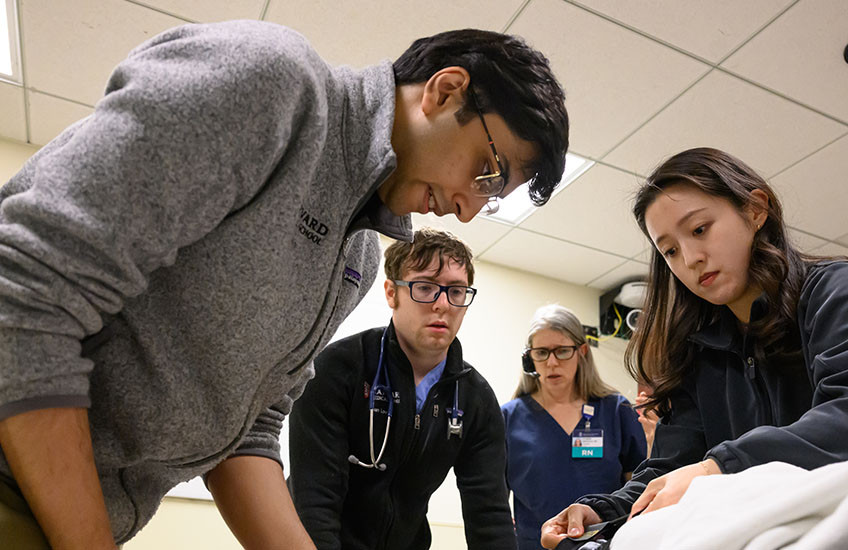
To ensure every student feels comfortable expressing their views while listening to others’ opinions, both during medical school and in their future careers as clinicians, Torres is leading a new effort at HMS to cultivate respectful communication across differences: a series for all first-year medical and dental students called Constructive Dialogue.
Launched this fall and hosted by the Office for Student Affairs, the classes are designed to strengthen the learning community and are grounded in the School’s shared community values, which include the beliefs that each individual’s perspectives, talents, experiences, and contributions propel the HMS mission and that “we are better together.”
The series supplements communication competencies taught in the classroom and the clinic and modeled by speakers at discussions hosted by groups such as the HMS Office for Culture and Community Engagement.
The goal of introducing constructive dialogue skills early in students’ training is to strengthen their ability to work on health care teams, especially when they encounter friction over differences of opinion.
An opportunity to learn from disagreement
Disagreement is an important catalyst for learning and growth, said Torres, and a core aspect of professionalism is being able to build trust while navigating disagreement with curiosity, humility, and respect.
“Instruction in how to engage constructively with disagreement and conflict is not a distraction from learning science or clinical skills but rather a foundational skill that needs to be nurtured and practiced,” he said.
It’s especially important to learn these skills at the start of medical school so “by the time we face critical patient-care situations in the hospital, they will be second nature,” said first-year Pathways MD student Corrie Branche.
“We’re told that teamwork and communication are really important, but it’s not often that we actually get a proper education on what that looks like,” she said.
“Constructive dialogue is not flashy or glamorous, but it’s a necessity for navigating our present times,” agreed Brian Li, a first-year Pathways student in the Harvard/MIT MD-PhD Program.
A foundation in constructive dialogue and civil discourse
Constructive dialogue is a form of conversation “where people with different perspectives try to understand each other — without giving up their own beliefs — in order to work together,” according to the Constructive Dialogue Institute (CDI), an organization that offers research-backed training in communicating across differences.
The Constructive Dialogue classes at HMS were developed and facilitated by faculty and staff members, as well as second-year students, who attended CDI training sessions earlier in the year.
Entering students began learning before they arrived on campus, completing several online CDI learning modules over the summer.
“The modules established a common vocabulary, which was good because students come here from different circumstances,” said first-year Pathways MD student Cormac Huyen.
Then, during their first month on campus, students attended three in-person sessions that built on that foundation.
The first class featured a presentation on the role personal values play in an individuals’ behaviors, reactions, and interactions with others. Students then separated into small restorative circles to reflect on the values they bring to medicine and to build community.
In the second session, students practiced active listening skills, asking open-ended questions, and paraphrasing responses as a way to build trust.
The final session showcased a live dialogue between two faculty members who hold opposing viewpoints on a topic of significance to the students — in this case, whether and how much students should engage in advocacy while they are in school.
The objective was not to hold a debate but to showcase how civil discourse, in which individuals maintain good intentions and keep an open mind, “creates opportunities for curiosity, learning, and connection” from disagreement, Torres said.
“Constructive dialogue helps you see that you’re not dealing with an argument but with a person,” said Li.
The faculty members demonstrated strategies such as summarizing the other’s statements, defining terms, delving into the issues by asking open-ended questions, and listening respectfully to the other’s opinion.
“Even while they fundamentally disagreed on the question being asked, they still found ways of understanding each other’s arguments,” Branche said.
Facilitators encouraged students to consider how they could apply constructive dialogue techniques while in medical school and in their future clinical practice.
Huyen said he wished participants had gotten the chance to discuss challenging topics themselves so they could practice making connections over disagreement.
Still, he, Branche, and Li said they have noticed classmates talking about and beginning to use the communication techniques they learned. They continue to practice, “like a fish constantly reminding itself that it’s living in water,” said Li.
Extending the lessons to more faculty and students
HMS is creating more programming and resource materials for medical and dental students.
For example, in December, Medical Education Day — a professional development symposium for HMS faculty from across campus and the School’s affiliated hospitals — will center open inquiry and civil discourse.
Laura Garabedian, HMS assistant professor of population medicine at Harvard Pilgrim Health Care Institute, received the new Excellence in Civil Dialogue in Medical Education award that was introduced at the 2026 Daniel D. Federman Medical Education Award Celebration this fall.
Efforts like these support a larger initiative at Harvard University to nurture a culture of open inquiry and constructive dialogue — including the fostering of reasoned disagreement, a spectrum of ideas, and robust intellectual exchanges — designed to inform and challenge community members as part of a rigorous education.
Excellence through the free and respectful exchange of ideas helps attain higher education’s goals of pursuing truth and advancing knowledge to “improve society, spur innovation, and fortify democracy,” according to a 2024 working group report.
The authors recommended enhancements to curricula and policies that will “help create more dynamic learning communities.”
Better care for the individual patient
Huyen believes connecting more deeply matters because it allows people to find where they “see eye to eye so they can take on problems together.”
To provide the best care possible, doctors and dentists in training must appreciate that their colleagues and patients come from all kinds of backgrounds and have different ways of life.
Branche said that to alleviate suffering, it’s essential to understand someone else’s thought processes and respect them when they share vulnerabilities.
“You can’t help somebody if you don’t know what they’re going through,” she said. “And you can’t fully know what they’re going through until they feel comfortable enough to tell you their full story.”