For years, researchers have suspected that a hormone called relaxin could be an effective treatment for certain cardiovascular diseases. It helps counteract scarring (fibrosis), prevents veins and arteries from hardening, and promotes structural changes in the heart and blood vessels during pregnancy to support the mother’s heart.
But drug developers have had a hard time turning relaxin and similar compounds into medicines, in part because they — like many hormone-based treatments — are small and the body filters them out of circulation too quickly for them to be effective.
That started to change in 2017, soon after a discovery in the lab of Andrew Kruse, professor of biological chemistry and molecular pharmacology in the Blavatnik Institute at Harvard Medical School.
“Andrew came to us,” recalled Grant Zimmermann, director of business development at Harvard Office of Technology Development (OTD), “and said, ‘I think I know how to fix this.’”
Clues from studying a relaxin receptor
Kruse and his lab members had been investigating the structural biology of relaxin and one of the cell receptors it binds to. He calls it a “very unusual member” of the family of receptors his lab specializes in, known as G protein-coupled receptors, or GPCRs.
Revealing the structure of the receptor would help researchers understand how relaxin binding occurs and how that induces changes in the body — forming a more solid foundation for designing treatments that work the same way.
However, native relaxin is complicated to produce in the lab because it has a two-chain structure, according to Sarah Erlandson, who led the project when she was a Harvard Kenneth C. Griffin Graduate School of Arts and Sciences PhD student in the Kruse Lab. She and colleagues were able to convert relaxin from the naturally occurring two-chain molecule to a one-chain molecule using protein engineering.
Creating a single-chain design made it possible for the team to then attach an antibody to relaxin, which allowed it to stay in the body longer.
There wasn’t one moment that illuminated how consequential that discovery would be, said Erlandson, who is now a senior scientist at Takeda Pharmaceuticals.
Instead, the work involved the sort of continuous iterating that often defines scientific research and development.
“I remember our growing excitement as we made progress on the engineered protein,” she said. “That’s when it started to feel like we could have a tangible impact on relaxin therapeutics.”
What they had designed as a tool to study structural biology, she and Kruse realized, could have significant therapeutic potential.
Taking the next step toward drug development
OTD protected the related innovations and got to work on strategies to further advance the research toward commercialization opportunities.
Zimmermann brought the project to his colleagues at the Blavatnik Biomedical Accelerator (BBA) at Harvard University. That team immediately saw promise in the research and provided funding through pilot and development grants, along with business development support.
Relaxin represents a prototypical example of the type of innovations that the BBA funds, said Zimmermann. The accelerator specifically looks for technologies with a clear path to clinical development that need a boost to attract potential industry partners that can advance innovations through sponsored research or license it for commercial use.

The BBA helped fund pharmacokinetic evaluations in mice of the relaxin molecule’s use and validate the research to the point that Kruse was able to form a startup and license the technology. He launched Tectonic Therapeutic to further advance the research to the clinic.
“All of these things were really critical for us to be able to out-license this molecule, to show that it actually had some real promise,” Kruse said. “The Blavatnik Accelerator is really what allowed us to go from a pure research compound to something that was ultimately a clinical candidate.”
Kruse also received guidance from and ultimately partnered with Timothy Springer, the Latham Family Professor of Biological Chemistry and Molecular Pharmacology at HMS and Boston Children’s Hospital. Springer’s lab studies protein-based therapeutics, and he has helped found numerous biotech companies.
What began as a lunchtime conversation about progressing academic discovery into a company grew into a collaboration. Springer helped co-found Tectonic, worked with Kruse on fundraising pitches, and provided pivotal early funding along with his technical expertise.
A Tectonic shift
Since licensing the relaxin technology, Tectonic — with Kruse as an adviser and Springer on the board of directors — has conducted additional engineering on the molecule devised in Kruse’s lab and created a larger platform to develop treatments targeting other GPCRs.
About 30 percent of all approved drugs target GPCRs, but those represent only a small fraction of all known GPCRs, said Tectonic CEO Alise Reicin.
“There is a lot of biology there that could be important in drug discovery and development, but many of those GPCRs, for a variety of reasons, were considered hard to drug or undruggable,” said Reicin.
Targeting these untapped GPCRs with unique biological engineering, the team thought, could unlock new treatments.
For cardiovascular disease, the company’s focus is a relaxin receptor called RXFP1. This GPCR is involved in numerous processes throughout the body, including making tissues, including veins, stretchier and softer. Kruse’s lab solved the atomic structure of RXFP1 in 2023.
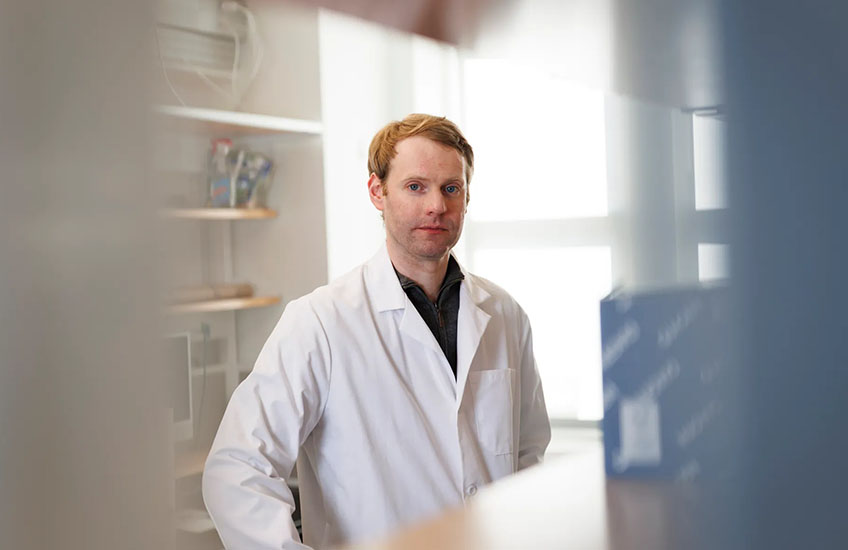
Tectonic’s relaxin treatment, known as TX45, is now in a phase 2 clinical trial — the phase focused on evaluating a drug candidate’s effectiveness in a few hundred participants who have the condition the drug is designed to treat.
The condition in this case is heart failure with preserved ejection fraction, also known as HFpEF. It is caused by a stiffening of the heart’s left ventricle that makes it much more challenging to distribute blood to the body. More than 3 million people in the United States, or about half of all people with heart failure, live with HFpEF. It has few approved therapies and high mortality rates.
In January 2025, Tectonic received data suggesting its relaxin therapeutic could work in a subset of patients: those with pulmonary hypertension — high blood pressure in the arteries of the lungs and right side of the heart — associated with HFpEF.
In the fall, they received a similar dataset in patients with pulmonary hypertension associated with reduced ejection fraction heart failure (HFrEF). These patients typically have lower exercise tolerance and a higher rate of premature death compared with heart failure patients without pulmonary hypertension.
In the coming year, the company also plans to begin testing TX45 as a treatment for pulmonary hypertension associated with interstitial lung disease, a group of disorders involving progressive scarring and inflammation in the lungs.
Collaboration leads to progress for patients
For patients, trial success would mean a potential new treatment for challenging and, at times, fatal conditions.
“I think there’s lots of reason for optimism that this story is going to play out in the way we envisioned all those years ago,” said Zimmermann.
Creating a path from a university lab to a biomedical accelerator to a biotechnology company has made the difficult work possible.
“I’m a big believer that it’s the academic-pharma-biotech partnership that has driven innovation in all of the great drug-development programs over the last few decades that have improved the lives of patients,” said Reicin.
Adapted from an article in the Harvard Gazette.