This is one in a series of stories about Harvard Medical School and Harvard School of Dental Medicine graduation celebrations for MD, DMD, master’s, and PhD graduates.
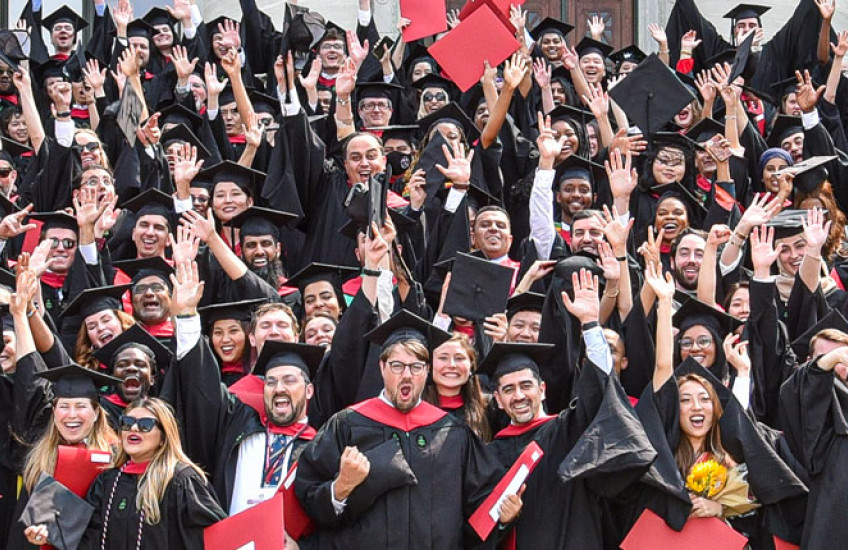
On a late May day that perfectly captured the transition from spring to summer, with clouds and comfortable breezes giving way to bright sun and balmy heat, Harvard Medical School master’s degree graduates gathered under a grand white tent on the HMS Quad to complete a significant transition of their own.
A record number of graduates from nine different programs joined friends, family, and faculty to celebrate completing master’s degrees at HMS — an important professional step as they pursue diverse careers in science and medicine that will be devoted to researching and communicating, helping and improving.
“You are the sense-makers, the dreamers, and the storytellers who will redefine health care for the second half of the 21st century — and you are the healers who will tend to our society every step of the way,” said HMS Dean George Q. Daley in his opening remarks at the master’s degree programs graduation ceremony on May 24.
In her keynote address, Rebecca Brendel, director of the master of bioethics program and associate director of the HMS Center for Bioethics, described a biomedical community that is finally emerging from the pandemic and must now turn its attention to what comes next.
“As you graduate today, you stand with the world at a crossroads,” she said. “We must be sure to ask ourselves not only where we can go, but where we ought to go. We have a once-in-a-lifetime opportunity to advance our work and the human condition as we rebuild.”
The celebration begins
Before the ceremony, graduates slowly made their way across the Quad, stopping to snap proud photos with friends and family in front of the Harvard Medical School name carved into the white marble facades that flank the Quad entryways.
Mitra Khany, who received her master of science in healthcare quality and safety, was especially excited and grateful to be with classmates on campus after having to attend many classes over Zoom during the COVID-19 pandemic.
Khany entered the program as an anesthesiologist intent on improving the quality and safety of patient care. Through her work, she had realized that when one anesthesiologist takes over for another during surgery, patient details are typically shared verbally, often resulting in missing information. To address this issue, Khany developed a tool while at HMS that conveys key patient information between care teams in a standardized way.
Cheryl Wong, who graduated with a master’s in biomedical informatics, came into her program with an advanced degree of her own: a degree in veterinary science.
She used her time at HMS to gain expertise in a new field, which she combined with her past training to develop better ways of organizing information on animal models used for research.
For her final master’s project, Wong built a database of mouse tumor models that labs commonly use to study cancer immunology. After HMS, Wong plans to continue pursuing a research career.
Jordan Hartmann, who earned his master of medical sciences in immunology, saw his program as an opportunity to explore his interest in medicine while gaining more research experience. His research at HMS focused on the fine-scale details of how SARS-CoV-2 interacts with the immune system.
“There was something special about digging into the virus that caused this huge global health crisis, and looking at it from a different perspective and a fresh angle,” he said.
Hartmann will continue his studies this summer as a medical student at the University of Texas Medical Branch.
The Quad was abuzz with energy as the graduates lined up outside Gordon Hall, pulling robes on over dresses and suits and enthusiastically greeting classmates.
Snippets of languages from around the world could be heard among the chatter as the graduates fixed each other’s stoles and hoods and posed for selfies. A curly-haired blonde dog decked out in a miniature cap and gown sat in line, patiently waiting for the signal to process inside the tent.
Challenges become opportunities
This year’s master’s degree classes earned their degrees against the looming backdrop of the COVID-19 pandemic — which, as Daley noted in his speech, “has been a brutal reminder that our world is only as healthy as the infrastructures and policies that govern it.”
Daley urged the graduates to use what they have learned at HMS about the social determinants of health and the interconnectedness of the health care system to treat not just individuals, but entire societies.
“That is my charge to you, as you leave this campus to enact change worldwide: Discover what it means — from where you sit — to treat society at large,” Daley said.
Brendel echoed Daley’s remarks on the hard lessons taught by the pandemic.
A return to “normal” is not possible because “we must not forget the ways in which the COVID-19 pandemic has left traces in our hearts,” Brendel said, referencing sentiments described by Albert Camus in his novel The Plague, set in the aftermath of a pestilence-riddled city in France.
Rebuilding after the COVID-19 pandemic is a daunting task, Brendel acknowledged, calling on the graduates to embrace their training and rise to the challenge as newly minted leaders in their fields.
She urged them to uphold the pillars of integrity, honesty, and reliability in their research, and to be transparent about the limitations of their work — essential steps for ensuring science remains credible in the public eye.
But more than that, Brendel encouraged the graduates to “lean into the traces — the indelible imprints of the pandemic in our hearts, as the broader decisions we make as a society go beyond data and facts to the realms of values, judgments, relationality, and shared commitments.”
This includes thinking about how to make scientific gains broadly available to society in service of human progress, health, and justice, she said, adding that it also means knowing how to make choices about scientific discovery that benefit many, and not just a select few; and how to address the stark disparities in health and life that the pandemic laid bare.
In the post-pandemic world, she concluded, “the challenges are great, but the opportunities are endless.”
Prepared and poised to lead
Since 2016, HMS master’s program enrollments have more than quadrupled in size — a testament to the growing number of students seeking specialized training in biomedical and health fields.
This year, 279 students from 42 countries graduated from the nine different programs, which, in Daley’s words, “represent nine distinct and powerful lenses through which to view the health care sector.”
Graduates earned degrees in bioethics; biomedical informatics; clinical service operation;, health care quality and safety; media, medicine, and health; as well as master of medical sciences degrees in clinical investigation, immunology, medical education, and global health delivery.
Thesis and capstone projects were even more varied than the programs themselves, as the graduates took on topics ranging from new strategies for delivering cell- and virus-based therapies for cancer to improving training of family medicine residents for outpatient procedures.
Students in the School’s first class of the media, medicine, and health program learned how to use storytelling to make a difference in health, culminating in projects that explored theatrical intervention to improve mental health equity for Black girls, a novel approach to teaching screening for oral cancer, and humor-based health interventions to curb distracted driving, among others.
Last year, the global health delivery program celebrated its 10th anniversary, a significant milestone that marks a decade of educating students about building health equity around the world.
Those students used newfound knowledge to tackle issues such as racial and ethnic disparities in treatment for substance use disorders, infant mortality among Maya Kaqchikel people in Guatemala, and socioeconomic factors affecting treatment for hip dysplasia in Boston.
“Each of you has chosen to pursue careers that will shape the future of science and health care, improve patient outcomes, and push the boundaries of our understanding of the world,” Rosalind Segal, HMS dean for graduate education, told the graduates in her welcome address.
“Your unwavering commitment to making a difference in the lives of others is truly inspiring.”
To close out the speeches, master’s student council president Constantine Psimopoulos borrowed an idea from Martin Luther King Jr., urging his classmates to use everything they have learned to continue bending the arc of the moral universe towards justice.
This process, he said, is not just about eliminating disease and sickness to improve health, but also about pursuing well-being, happiness, and self-actualization for everyone.
“As HMS graduates, we need to do more, collectively, to educate all people, far and wide, on how to care and respect one another, and eventually how to strive towards peace, understanding, and an unassailable respect for human dignity,” he said.
Psimopoulos concluded with an ambitious call to action that was greeted by loud applause and a standing ovation from his classmates.
“Let’s go and change the world outside of HMS; be the agents of change of the cosmos, against racism and all faces of oppression,” he said.
Images: Steve Lipofsky
Science & Medicine, Delivered
Harvard Medicine magazine in your inbox