In 1948, the Universal Declaration of Human Rights declared that all people have a right to medical care, yet more than seven decades later there are still millions around the world who don’t have access to some of the most basic medical treatments.
Ten years ago, the Harvard Medical School Department of Global Health and Social Medicine launched a new master’s degree program, the Master of Medical Sciences in Global Health Delivery (MMSc-GHD), designed to help frontline caregivers, health care administrators, and policy leaders from around the globe research the root causes of health inequity and design and test solutions to deliver the promise of modern medicine to all those in need.
Since last spring, the department has been celebrating the 10th anniversary of the arrival of the program’s first class of four students, in spring 2012, by hosting a series of events throughout the 2022-2023 academic year highlighting the accomplishments of the program’s alumni.
“The delivery of medical care in settings of extreme privation is still a novel concept,” said Joia Mukherjee, associate professor of global health and social medicine in the Blavatnik Institute at HMS.
Science & Medicine, Delivered
Harvard Medicine magazine in your inbox
“Until very recently, prevention-only was promoted as the only feasible option for the world’s poor. It was unheard of to try to care for people with cancer or mental illness or other complex diseases in resource-limited settings,” said Mukherjee, who has been director of the MMSc-GHD program since its inception. “Our students and alumni are using the tools of social medicine — history, political economy, anthropology — to understand and mitigate the social forces that underpin ill health. They are designing programs to provide equitable care.”
Mukherjee explained that the study and practice of social medicine — upon which the global health and social medicine department was founded 150 years ago — is essential to achieving equity. Impoverished countries, communities, and people face many barriers to prevent, detect, and treat illness. Overcoming these challenges requires a multidisciplinary approach and a committed, collaborative relationship with the communities that providers are hoping to serve.
Mukherjee draws on her 23 years of experience as chief medical officer for Partners In Health (PIH), an international organization founded by the late Paul Farmer, which is focused on health care delivery to those in greatest need. PIH has repeatedly achieved things that prevailing wisdom had deemed impossible, such as delivering state-of-the-art care for patients with HIV in rural Haiti, or fighting multidrug-resistant tuberculosis in the urban sprawl of Lima, Peru.
Mukherjee and colleagues designed the MMSc-GHD program based on their experiences working with community partners in countries including Haiti, Liberia, Peru, and Russia to find ways to deliver care for diseases like HIV, drug-resistant tuberculosis, depression and other severe mental illnesses, as well as diseases that require surgical treatments.
Department faculty also have also drawn upon their experiences building deep connections with academic medical institutions like the University of Global Health Equity in Rwanda and University Hospital in Mirebalais, Haiti, and their efforts to partner in research and training collaborations.
These collaborations involve all aspects of care, covering infectious and noncommunicable diseases, diseases that require surgical care, and mental health needs across Europe, Asia, Oceania, Africa, and the Americas. Global health faculty emphasize the importance of using social science methods to document successes and publishing the results to create a library of evidence that illustrates how their methods worked.
Faculty teach MMSc-GHD students to use this same approach as they mentor students to develop their thesis projects. Through these projects, MMSc-GHD students contribute to scholarship in global health by developing new approaches to improve health care delivery and equity.
“That’s the work that our students have been doing for the last 10 years.” Mukherjee said.
Bridging the gap
In the first year of the two-year program, students take classes at HMS and across Harvard University, with an emphasis on producing research that bridges the gap between biological and social sciences, and on courses that involve program design and strategies for leading change. In the second year of the program students conduct a mentored research project in the field.
The goal of the program is to train new scholars, Mukherjee said, empowering them with the ability to create new knowledge about how best to tackle real-world problems in health care delivery.
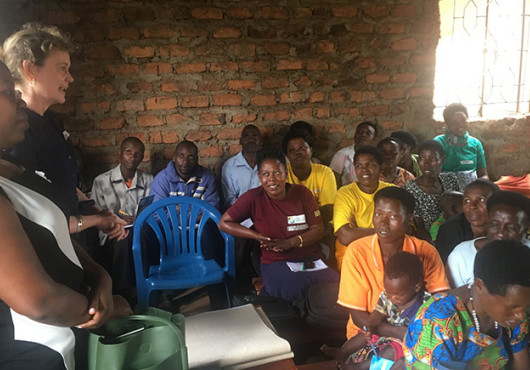
Students often conduct their research in a community where they already have established roots and relationships, with the concrete goal of using their new knowledge to solve a problem that the community identifies as a particular need.
Thanks to the program, Mukherjee said, there’s a growing global workforce of frontline caregivers, administrators, and leaders who now possess crucial skills that will help them study, design, and analyze health systems that can deliver equitable health outcomes.
Over the past 10 years, 125 students from 38 countries have matriculated into the program to learn what faculty leaders describe as a “new science of global health delivery.”
Today, 89 MMSc-GHD alumni work to alleviate human suffering in 30 countries, in some of the most challenging medical, social, and economic circumstances in the world. Students and alumni of the program have contributed to 149 peer-reviewed publications, many as first and senior authors.
Program alumni also work in leadership positions in overseas ministries of health and in large international development and health care nongovernmental organizations, where they are well positioned to make significant changes in the way global health care is delivered, program leaders said.
Still other students and grads are using the work from their mentored research projects as a launching pad for their own smaller, independent health care organizations, founded on the principles of social medicine, collaboration, and equity.
The program collects many alumni stories and regularly invites alumni to share their experiences in the program and their accomplishments after graduation. These alumni talks have covered a wide range of topics from new strategies to treat diseases like tuberculosis, to approaches to improving health systems at the country level to addressing the effects of climate change in the South Pacific. The MMSc-GHD alumni panels in 2022-2023 are an extension of these events to celebrate the 10th anniversary of the program’s launch.
Just as this alumni work is spread around the world, it is also spread across the spectrum of health care delivery. Projects range from alumni building maternal health clinics that include both safe delivery services and mental health support for mothers to work providing palliative and end-of-life care for cancer patients.
Jafet Arrieta, a physician from Mexico who earned her MMSc-GHD in 2015 — who also has a doctoral degree in public health from the Harvard T. H. Chan School of Public Health — is currently senior director and improvement advisor at the Institute for Healthcare Improvement, an organization focused on improving health care worldwide.
At a recent panel discussion, Arrieta highlighted the importance of training multidisciplinary thinkers able to speak the languages of medicine and public health and the languages of economics, history, and politics.
“In order to effect change at a large scale, we need to be able to hold hands with our patients, visit them in their homes, accompany them in their communities,” Arrieta said. “And we also need to be able to sit at the table with senators, with ministers of health, with presidents.”
By studying in the MMSc-GHD program, students learn about the importance of viewing problems through the eyes of patients, how to develop programs to address those problems, and how to lead the charge to improve health care delivery. MMSc-GHD alumni apply that knowledge to improve health care in diverse settings across the globe every day.