When the Francis A. Countway Library of Medicine was dedicated on May 27, 1965, the Harvard Crimson noted it was the largest university-affiliated medical library in the world and perhaps — according to the headline — “the world’s best.”
Looking to the library’s future, the reporter mused that, “eventually, Countway readers will be able to obtain instant photocopies of scientific texts and articles from other regional scientific libraries throughout the country. Computerized filing systems will enable … students to locate the most obscure references.”
Today’s Countway Library has moved far past photocopies and computerized filing systems. Following transformative renovations from 2019 through 2023, it is still leading the way for medical libraries and ready to serve patrons for decades to come.
“The health sciences, technology, and information environment is rapidly changing, and new types of spaces are needed to meet the demands of 21st-century scholarship,” Elaine Martin, former director and head librarian of Countway, said in 2021.
As the internet and other technologies have changed how people access information, Countway’s mission has shifted from strictly housing the library’s extensive collection of print resources to creating a dynamic space for Longwood community members to study, collaborate, and gather.
Their goal today is to enhance Countway’s reputation as a top-notch academic health sciences library with new services and programming, said interim director Len Levin, whom Martin recruited in 2017 to help bring Countway into the future.
Historic transformation
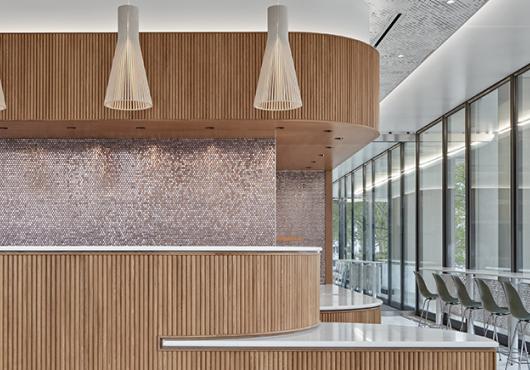
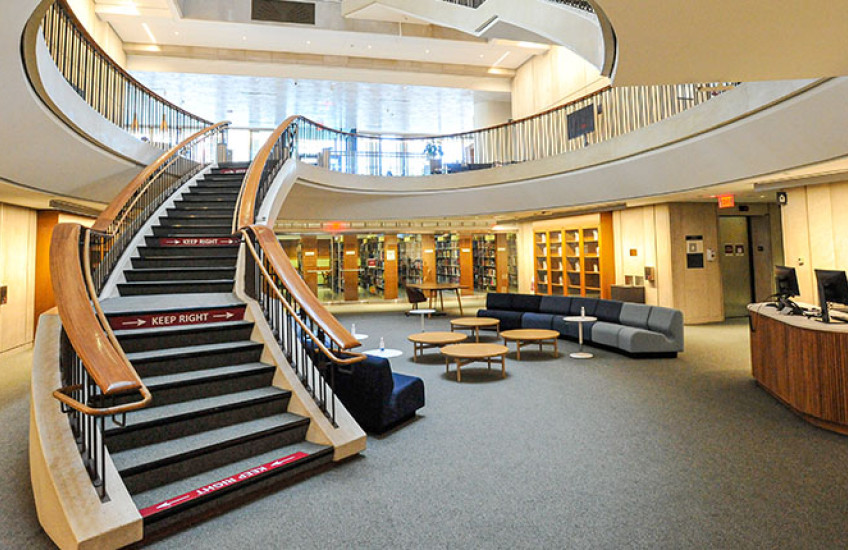
The renovation added new reading rooms, new spaces for collaborative work, a café, more natural light and views of campus, a new entrance on Huntington Ave., a makerspace work area with a 3D anatomy and physiology visualization table, and other changes that made the library more accessible and created more opportunities for research, collaboration, and community.
“Countway is, I think, the quintessential gathering space of 21st-century academic medicine,” HMS Dean George Q. Daley said at the 2023 renovation celebration. “It’s inclusive, it’s interdisciplinary, and it’s integrated. It brings our community together in countless ways.”
Digital storage and access of library resources have changed how patrons use libraries and shifted focus from the stacks. Reflecting on changes he’s seen in library services over his 30-year library career and his time at Countway, Levin points to the decreased centrality of print collections.
When he first started at Countway, Levin recalls the library still collected print copies of more than 100 periodicals. As each volume of a periodical was completed, a dedicated staff member would package them and send them to be bound so they could be added to the Countway’s collection.

Now, although Levin stresses that Countway still very much collects print materials, it is much easier and more efficient for library patrons to access periodicals electronically.
Print journals and photocopiers were prominent when Scott Podolsky, professor of global health and social medicine in the Blavatnik Institute at HMS and director of the Center for the History of Medicine at Countway, was a student at HMS in the ’90s. While he remembers fondly how searching among the stacks for print books and journals could lead to serendipitous findings and new avenues of research, he said the shift to electronic resources has been a boon in many ways.
“Digitization and digital access have been remarkable and transformative,” Podolsky said, “in terms of both remote access and the forms of scholarship it can enable, from full-text searching for historians to the use of emerging AI tools.”
A place to gather
Jessica Murphy — manager of research and instruction, special collections, and archives — has seen the library and the way people interact with it change since she started at Countway in 2007.
“The library is a dedicated space for students, a safe space for study and work,” Murphy said. “Research still happens in person, but we have quite a lot that we do remotely as well. It allows us to collaborate much more.”
The COVID-19 pandemic accelerated changes that were already underway and drove home the central role Countway plays in the lives of its patrons. Levin recalled one patron in particular who came to Countway in January 2021, when the library reopened after the first phase of the renovation, and was very moved.
“She broke down in tears, saying that she lived alone and just about everything else was closed to her,” Levin said. “Coming to us, even in the midst of continued masking and social distancing, gave her a rare opportunity to be with others.”
Visits to the library now far surpass pre-pandemic numbers. Before 2020, according to Levin, Countway had around 600 visitors per day. Those numbers have doubled since the renovation.
“We are now seen on the Longwood campus not just as the building with the books but as a campus center where services and programs are offered for the whole person,” Levin said.
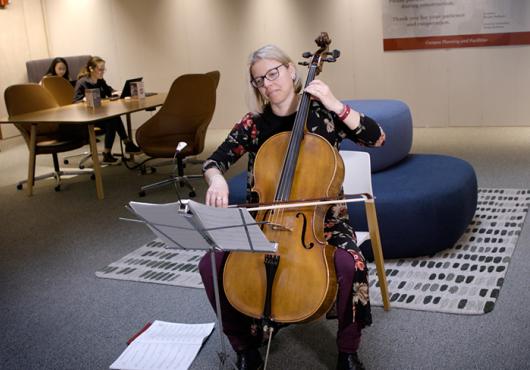
From workshops on research practices or public speaking to zine production, meditation sessions to the Countway Cuddles pet therapy sessions — featuring six dogs and Hermie, the therapy guinea pig — Countway programming provides a variety of reasons for patrons to visit.
Looking ahead
The library regularly assesses and offers new technologies. Patrons have the chance to learn about them from publishers, database providers, Countway librarians and archivists, and other exhibitors at the annual Countway Resource Fair.
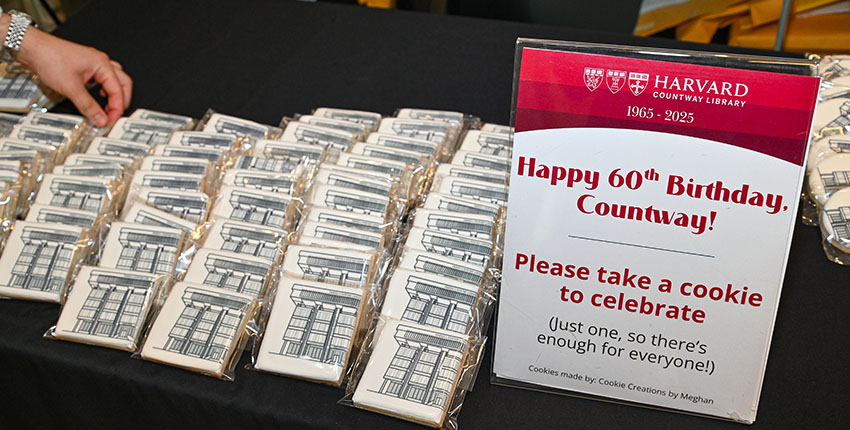
This year’s fair, held in September, also offered the chance to celebrate Countway’s 60th anniversary, including cookies decorated with a line drawing of the building’s exterior and a giant birthday card to sign featuring photos of the library through the years.
Meredith Solomon, manager of outreach and public services, said attendees appreciated learning about research and educational tools, such as the Anatomage 3D anatomy table.
As they look to the future, staff remark on how the renovated library straddles the past and present of medical scholarship.
“When I leave my office,” Levin said, “the scent of coffee from our first-floor café tempts me to go down and grab a cup. It heartens me to see so many people gathering over coffee or a snack in this new area.”
At other times, Levin needs to go to L2, the lowest floor, where the print collections are kept. A different smell there reminds him of the past.
“There’s the comforting smell of old books,” he said, “a pleasant smell — nothing dangerous or any indication there’s anything wrong with the books — that speaks to the generations of accumulated knowledge of millions of pages of text in languages from across the world, spanning the past three centuries.”
Countway is a place where what came before in medicine is preserved and made available and where what is happening in medicine right now occurs in lively conversations around a table in the café, Levin added.
Whatever the future of medical libraries holds, Countway will continue to provide patrons with the resources they need in a space they can treasure.
“All of the people who come through this building will at some time be part of HMS’ story,” Murphy said. “Everyone contributes a little something that makes this school as distinct as it is. The library exemplifies the school’s mission.”