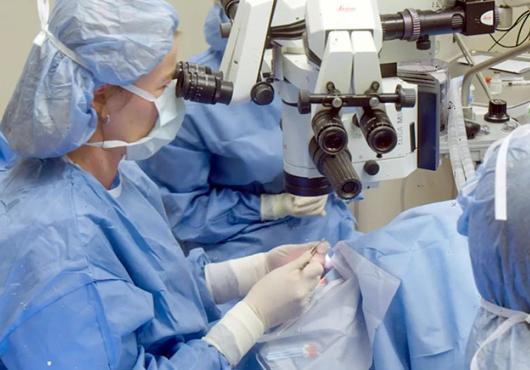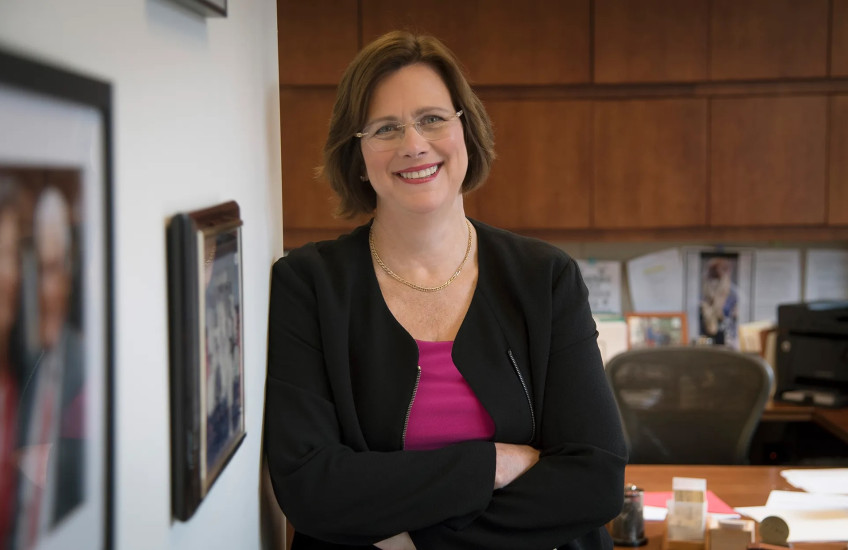
Joan Miller says retinal surgeons tend to be a pretty open-minded bunch.
“We’re willing to try new surgical techniques,” she said. “We’re always trying to push the envelope and the technology. It’s just a very innovative specialty.”
Miller is a good example. She is credited with developing two major treatments for age-related macular degeneration (AMD), the most common cause of vision loss in people over the age of 50. Her treatments are administered to millions of patients worldwide each year.
That brand of independent thinking has been a hallmark of a distinguished career as a researcher, clinician, and leader for Miller, the Harvard Medical School David Glendenning Cogan Professor of Ophthalmology and chair of the Department of Ophthalmology at Massachusetts Eye and Ear.
But she didn’t start at the cure. Her work, which has been partly funded by the National Institutes of Health, started with an interesting new idea: What if treatments for cancer could be repurposed to treat retinal disease?
Curiosity-driven science
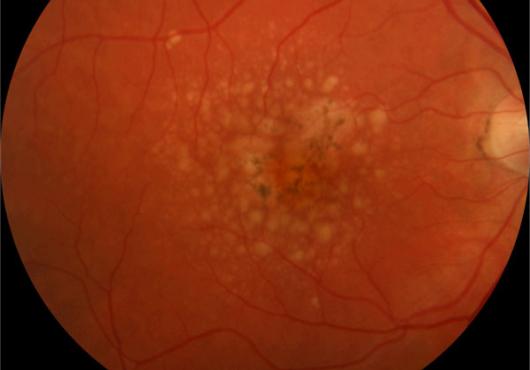
One form of AMD, known as wet macular degeneration, is caused by abnormal blood vessels that grow in and under the retina and damage tissue. When Miller finished her training at HMS in 1991, the common treatment was to cauterize the vessels.
“It turns out, particularly where abnormal blood vessels develop in these retinal diseases like wet macular degeneration, that the drivers are very similar to what happens in cancer,” she said.
So she adapted a technique called photodynamic therapy, which at the time was in clinical trials for the treatment of metastatic skin cancer. Her approach called for a special dark-green dye to be injected into a vein in the arm. When the dye reaches the eye, a low-powered laser is focused onto the area. That activates the dye, damaging the abnormal vessels but leaving the macula (a vital area at the center of the retina) untouched.
The treatment was approved by the FDA in 2000 and was the first shown to slow vision loss in AMD.
“To have it work so well and then be used so routinely, and to make such an impact on patients’ lives, was really very rewarding,” she said.
Research leads to impact for patients
But Miller wanted to understand precisely why the abnormal vessels developed in the first place.
The cause was identified as vascular endothelial growth factor (VEGF), a signaling protein that promotes the creation of vessels. Miller showed that VEGF was secreted when the retina was deprived of oxygen, leading to the formation of abnormal blood vessels.
Her research had a tremendous impact, as it led to the development of anti-VEGF therapies now administered to millions of adults and children with sight-threatening retinal diseases — not only wet AMD — worldwide.
Someone who made an impact on Miller’s own life was Alice McPherson, the nation’s first female retinal surgeon. Miller remembers meeting McPherson (who died in 2023 at the age of 97) at conferences and feeling “all aglow,” wanting to pepper her with questions about her career.
Pathway to leadership
Now, Miller has accumulated her own impressive list of firsts: the first female physician to be a professor of ophthalmology at HMS, the first woman chair of the HMS Department of Ophthalmology, and the first woman chair of ophthalmology at Mass Eye and Ear.
Women were a distinct minority during Miller’s undergraduate days at MIT and in ophthalmology during her early years in the field. But she said she never felt as though she encountered issues due to her gender — until she moved into leadership as a department chair in 2003.
“People didn’t hear what I said, or they didn’t like how I said it,” she said.
As she navigated new political waters, she eventually realized she was now a role model for medical students, postdoctoral researchers, and more junior faculty members. It also gave her the opportunity to make some positive changes based on her own life experience.
Miller had had three children during her medical training and didn’t have the flexibility that she might have liked. Being a parent in a demanding job is also difficult, she said, but she hoped to make things more manageable for those coming up behind her.
“I think we were ahead of ourselves in terms of making leave doable and supported and not a financial burden,” she said. “And as chair, I was also very much attuned to allowing people — more frequently women, but also men — flexibility in their pathways if they wanted to be able to do less clinically for certain periods or start off just clinically and then add in research. That’s been really nice to do.”
She said she would not have been able to combine research and surgical practice the same way in Canada, where she did her undergraduate studies.
New beginnings
Miller is planning a new chapter in her life and career.
She is stepping down as chair of ophthalmology at Mass Eye and Ear after a 22-year tenure to focus on seeing patients and research.
She hasn’t lost any federal research grants in the recent cuts, but in one grant renewal, her team was asked to remove an international collaborator. She has long valued her collaborations with colleagues in other parts of the world, including a 10-year collaboration with researchers in Portugal.
“I would hate to see that get broken up because we are so much better together, collaborating and learning from experts in other countries,” she said.
Miller says the U.S. system of federal funding for basic research was key to her life’s work. After college, she stayed in the country for medical school because she felt it was a good place to take on important problems.
“I have really prospered and benefited from the environment that I’ve lived in professionally in Boston,” she said.
Finding satisfaction
Miller regularly gets letters from retina patients thanking her for her work on the “other things.”
“You work on something in a laboratory, and most of the time it doesn’t work, so you’re always a little skeptical,” Miller said. “But to have it work so well and then be used so routinely, and to make such an impact on patients’ lives, was really very rewarding.”
Adapted from an article in the Harvard Gazette.