At a glance
Surgeons restored corneal surfaces in the injured eyes of 14 patients in a small clinical trial.
Stem cells from each patient’s healthy eye were cultivated in a lab to grow healthy tissue that could be surgically grafted into the patient’s damaged eye.
The procedure remains experimental and is not currently offered at any U.S. hospital.
A procedure that takes stem cells from a patient’s healthy eye and transplants them into the patient’s damaged eye safely restored corneal surfaces in 14 people who were followed for 18 months in a small clinical trial. The results of the study, led by researchers and surgeons at Harvard Medical School and Massachusetts Eye and Ear, were published March 4 in Nature Communications.
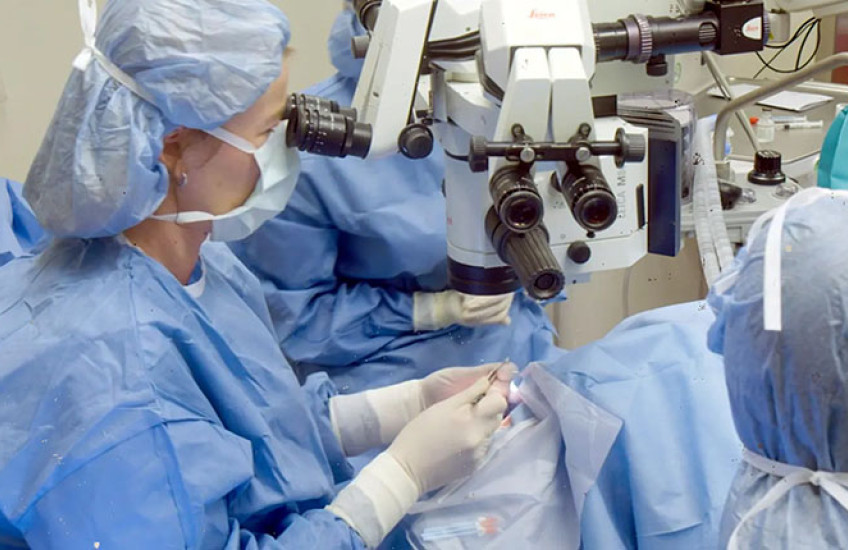
The stem cell treatment for blinding cornea injuries — called cultivated autologous limbal epithelial cell (CALEC) transplantation — was developed at Mass Eye and Ear. It consists of removing stem cells from an injured patient’s healthy eye with a biopsy, expanding them into a cellular tissue graft in a novel manufacturing process that takes two to three weeks, and then surgically transplanting the graft into the patient’s damaged eye.
The procedure remains experimental and is currently not offered at Mass Eye and Ear or any U.S. hospital. Additional studies will be needed before the treatment is submitted for federal approval.
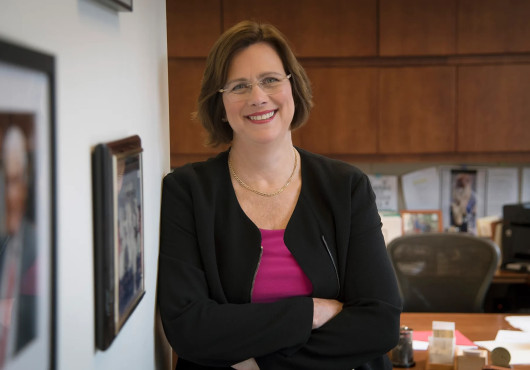
“Our first trial showed that CALEC was safe and the treatment was possible,” said principal investigator Ula Jurkunas, associate director of the Cornea Service and HMS professor of ophthalmology at Mass Eye and Ear. “Now we have this new data supporting that CALEC is more than 90 percent effective at restoring the cornea’s surface, which makes a meaningful difference in individuals with cornea damage that was considered untreatable.”
The cornea is the clear, outermost layer of the eye. Its outer border, the limbus, contains a large volume of healthy stem cells called limbal epithelial cells, which maintain the eye’s smooth surface.
People who suffer a cornea injury, such as a chemical burn, infection, or other trauma, often experience persistent pain and visual difficulties. These injuries can also deplete the limbal epithelial cells, which can never regenerate. Without limbal stem cells, the surface of the eye can’t heal, and the permanently damaged surface can’t undergo a corneal transplant, the current standard of care for vision rehabilitation.
This need led Jurkunas and Reza Dana, the HMS Claes H. Dohlman Professor of Ophthalmology and director of the Cornea Service at Mass Eye and Ear, to explore a new approach for regenerating limbal epithelial cells. After nearly two decades of work, following preclinical studies and collaborations with researchers at Dana-Farber Cancer Institute and Boston Children’s Hospital, the researchers managed to consistently manufacture CALEC grafts that met stringent quality criteria needed for human transplantation. The first patient was treated in 2018 at Mass Eye and Ear.
The researchers caution that this approach is suitable solely for patients with damage to only one eye.
“Our future hope is to set up an allogeneic manufacturing process starting with limbal stem cells from a normal cadaveric donor eye,” said Jerome Ritz of Dana-Farber’s Connell and O’Reilly Families Cell Manipulation Core Facility, where the stem cell grafts are manufactured. “This will hopefully expand the use of this approach and make it possible to treat patients who have damage to both eyes.”

Researchers showed that the procedure completely restored the cornea in 50 percent of participants at their three-month visit, and that the rate of complete success increased to 79 percent and 77 percent at their 12- and 18-month visits, respectively. With two participants meeting the definition of partial success at 12 and 18 months, the overall success was 93 percent and 92 percent at 12 and 18 months. Three participants received a second transplant, one of whom reached complete success by the end visit. An additional analysis of the procedure’s impact on vision showed varying levels of improvement of visual acuity in all 14 patients.
CALEC displayed a high safety profile, with no serious events in either the donor or recipient eyes. One adverse event, a bacterial infection, occurred in one participant eight months after the transplant, due to chronic contact lens use. Other adverse events were minor and resolved quickly following the procedures.
The trial is the first human study of a stem cell therapy to be funded by the National Eye Institute, a part of the National Institutes of Health, and was the first stem cell therapy in the eye in the U.S. Other research collaborators include Jia Yin at Mass Eye and Ear, Myriam Armant at Boston Children’s, and the JAEB Center for Health Research.
“While we are proud to have been able to bring a new treatment from the lab bench to clinical trials, our guiding objective was and always will be for patients around the country to have access to this effective treatment,” Jurkunas said.
The researchers said that the results of the study warrant additional trials that can help lead to FDA approval. Future CALEC studies should include larger numbers of patients at multiple centers, with longer follow-ups and a randomized-control design, the researchers said.
Adapted from a Mass Eye and Ear news release.
Authorship, funding, disclosures
Additional authors include Aaron R. Kaufman, Lynette K. Johns, Mohit Parekh, Sanming Li, Alex Gauthier, Allison Ayala, Maureen Maguire, Lassana Samarakoon, Helene Negre, Kit L. Shaw, Diego E. Hernandez Rodriguez, and Heather Daley.
This research is funded by the National Eye Institute of the National Institutes of Health (award numbers UG1EY026508, UG1EY027726, and UG1EY027725). Preclinical development of the CALEC manufacturing process was supported by the Production Assistance for Cellular Therapy (PACT) Program of the National Heart, Lung, and Blood Institute at the NIH (contract HHSN268201000009C).
CALEC is patent-pending. Jurkunas and Dana have financial interest in OcuCell, a company developing living ophthalmic cell-based therapies for treating eye disease. Armant serves on the scientific advisory board for OcuCell. Ritz receives research funding from Kite/Gilead, Novartis, and Oncternal, and serves on Scientific Advisory Boards for Astraveus, Garuda Therapeutics, Smart Immune, Tolerance Bio, LifeVault Bio, and TriArm Therapeutics. The remaining authors declare no competing interests.