At a glance
New research in fruit flies suggests that a decreased desire to eat protein can serve as the earliest known warning sign of the severe wasting condition known as cancer cachexia.
Driving the change are two tumor-secreted molecules that disrupt an appetite regulator in the brain, the team found.
If the findings translate to humans, they could aid in early detection and intervention, which are critical for preserving quality and length of life for people with cancer cachexia.
The future of federally funded research at Harvard Medical School — supported by taxpayers and done in service to humanity — remains uncertain. Learn more.
A majority of people with advanced cancers endure cachexia, a muscle-, fat-, and organ-wasting condition that is currently incurable and can be life-threatening. Detecting and intervening early can slow progression, but poor understanding of how cachexia first arises in the body makes it difficult for doctors to identify the warning signs of impending wasting other than an overall loss of appetite (anorexia).
Working in a fruit fly model of cancer cachexia, researchers in the lab of Norbert Perrimon at Harvard Medical School have now found an earlier signal: a markedly decreased interest in consuming protein-rich food, which precedes anorexia.
The team discovered that the change in food preference occurs when two tumor-secreted factors disrupt an appetite regulator in the brain. Interrupting the actions of these factors returned protein consumption to an expected level in the flies, preventing subsequent weight loss and reducing risk of death from cancer cachexia.
All three components of this molecular system have human counterparts associated with cancer cachexia progression, and many patients with the condition share symptoms seen in the flies, including meat aversion, inflammation, and insulin dysregulation. This suggests that loss of appetite for protein-rich foods could also be a reliable early warning sign of cancer cachexia in humans — and that developing drugs to interfere with one or more components could help stave off wasting.
“We found that the tumor-compromised flies had the tendency to eat less amino acid-rich food, even prior to anorexia,” said study first author Afroditi Petsakou, who conducted the work as an HMS research fellow in genetics in the Perrimon Lab. “This aligns with what we know from cancer cachexia patients who seem to not want to eat protein.”

The study, supported in part by federal funding, is published in Nature Communications.
“By identifying the tumor-derived signals that drive a loss of interest in protein-rich foods, we may be able to detect and intervene in the disease much earlier, when there is still an opportunity to improve outcomes,” said Perrimon, the James Stillman Professor of Developmental Biology in the Blavatnik Institute at HMS, senior author of the study, and member of a Cancer Grand Challenges research team dedicated to understanding and developing personalized treatments for cachexia.
The onset of organ wasting
Petsakou and colleagues precisely tracked the onset of organ wasting using a Drosophila fruit fly model of cancer cachexia previously developed in the Perrimon Lab. They found that, similar to mammals, anorexia preceded organ wasting. Anorexia started on day five and organ wasting on day six. They then tracked the behavioral and molecular progression from day one to watch for notable changes ahead of anorexia.
The work revealed that the inflammatory protein upd3 and the insulin-reducing protein ImpL2, two factors produced by tumors, effectively made the fly’s need for amino acid-rich food invisible to itself. The human equivalents of these factors — interleukin-6-like (Il-6) and insulin growth factor binding protein (IGFBP), respectively — have known links to cancer cachexia.
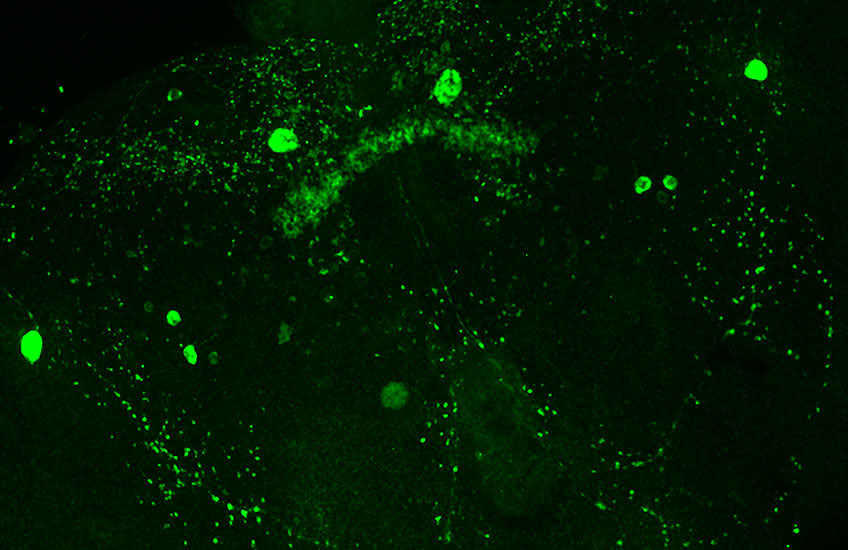
The authors propose that upd3 increases the permeability of the protective layer around the brain known as the blood brain barrier, essentially opening the door wide for ImpL2 to slip in and prevent neurons from producing the appetite-stimulating neuropeptide NPF (NPY in humans). As NPF levels decreased, so did the flies’ interest in consuming protein-rich food.
“That starts by day four, which aligns with the change in the behavioral preferences,” Petsakou said. “Once you have that, it worsens the disease. But if you stop that, then you see that organ wasting symptoms like weight loss are delayed.”
Unimpeded, the chain of events led to premature death in 70 percent of the flies. When the chain was broken, only 40 percent of the flies died.
Importance of protein
A tumor requires amino acids to grow. Once it exhausts the supply coming from the host’s diet, it takes from muscles, fat, and organs to get what it needs. Healthy animals can sense when their bodies lack a given nutrient. But for some as-yet-unknown reason, gut tumors in flies secrete upd3 and ImpL2 to blunt this sense.
“If we have low blood sugar, we will have a craving for sugar. Similarly, if our body needs more amino acids, we will want meat. Food-specific cravings are evolutionarily conserved behaviors that align our internal needs with our food choices,” said Petsakou, who is now an assistant professor in the Department of Developmental and Molecular Biology at Albert Einstein College of Medicine.
“The fly in the organ wasting model still eats amino acids,” she continued. “It’s just that there is a misalignment of how much the fly needs versus how much their appetites tell them to get. That is what creates the amino-acid malnutrition.”
Since dietary protein slows muscle and organ wasting, cancer cachexia patients are urged to consume amino acid-rich sources like nutritional shakes — a difficult thing to ask of someone who has no appetite-based desire to do so.
Previous studies have disagreed on whether disruption of NPY’s appetite-regulating activity contributes to cancer cachexia. The Perrimon team’s results suggest reevaluating its role and pursuing additional studies that determine whether the NPF/upd3/ImpL2 findings translate from flies to humans. If they do, researchers could test NPY as a potential early indicator that a cancer will progress to cancer cachexia and see whether preserving or restoring NPY levels improves appetite for protein and alleviates wasting.
The complexity of cachexia
Cancer cachexia is multifaceted, though. Understanding protein ambivalence is just once piece of a complex puzzle.
Another line of investigation in the Perrimon Lab touches on the metabolic imbalance that takes place during organ wasting. The Petsakou Lab will also pursue clues the new study provided about sex differences in cancer cachexia, including changes in other early feeding-related signals.
Meanwhile, Petsakou and Perrimon continue to advocate for the value of fruit flies in uncovering fundamental principles that underlie disease and may inspire new treatment strategies.
“Drosophila is an ideal model for complex questions,” said Petsakou. “You can unravel with great precision multilayered basic mechanisms that help decipher more complex systems, such as those in mice, and later on, in humans.”
Authorship, funding, disclosures
Additional authors are Elizabeth Filine, Matthew Li, Yuchen Chen, and Alice Zheng of the Perrimon Lab.
This study was supported in part by the Cancer Grand Challenges partnership funded by Cancer Research UK (CGCATF-2021/100022) and the National Cancer Institute (OT2CA278685-01). Additional support was provided by Good Ventures through the Life Science Research Foundation and the Harvard Stem Cell Internship program. Perrimon is also an investigator of the Howard Hughes Medical Institute.
Confocal imaging was conducted at the MicRoN core at HMS.