At a glance
Study finds age-associated differences in tumor composition and gene activity, laying a foundation for investigating why colorectal cancer can be more aggressive in younger adults.
Researchers at Harvard-affiliated Massachusetts General Hospital, Brigham and Women’s Hospital, Dana-Farber Cancer Institute, and Broad Institute of MIT and Harvard collaborated on the largest study of its kind.
Colorectal cancer diagnosis rates among people younger than 50 rose 2.9 percent in the last decade, according to the American Cancer Society.
Harvard Medical School researchers from the Gene Lay Institute of Immunology and Inflammation at Massachusetts General Hospital and Brigham and Women’s Hospital, Dana-Farber Cancer Institute, and the Broad Institute of MIT and Harvard, have uncovered biological clues to why colorectal cancer can behave more aggressively in younger people.
Published Oct. 29 in Nature Medicine, the study, the largest of its kind, lays a foundation for understanding age-associated differences in colorectal cancer and exploring future treatments.
The American Cancer Society reports that in the United States, colorectal cancer diagnosis rates among people younger than 50 rose 2.9 percent per year from 2013 through 2022 and identifies colorectal cancer as the leading cause of cancer death in this age group. Younger patients are also more likely to be diagnosed at advanced stages, underscoring the need to better understand the biology of early-onset disease.
“The need to understand why colorectal cancer is affecting younger adults at increasing rates is urgent,” said co-senior author and project co-director Ana Anderson, the HMS Albert H. Coons Professor of Neurology in the Field of Immunologic Diseases at Brigham and Women’s , a core faculty member of the Gene Lay Institute, and an institute member at the Broad Institute. “That starts with understanding the biology of the disease across the entire lifespan. By looking beyond conventional age cutoffs, we’ve uncovered biological patterns that earlier studies may have missed and created a foundation for the field to investigate them further. While we’re still at the beginning of understanding what these differences mean, our work gives researchers a new direction to pursue in tackling this urgent problem in human disease.”
The research team, led by first author Caroline Porter, senior professional scientist at the Broad Institute’s Klarman Cell Observatory, studied specimens from surgeries at Brigham and Women’s that were stored in Dana-Farber’s gastrointestinal biobank.

The team analyzed 189 tumors from patients ages 29 to over 90, including 54 diagnosed before age 50 and 135 diagnosed at age 50 or older. Using a technique called single-nucleus RNA sequencing, the researchers measured gene activity in more than 850,000 cancer cells and other cells in the tumors. The technique, which works with frozen tissue, enabled the team to build a detailed map of tumor cells by studying archived samples with extensive clinical record data.
Rather than dividing the tumor samples into two data sets and comparing the younger and older age groups, the researchers looked for factors that changed gradually with age, accounting for tumor location, stage, sex, and prior treatment in their analyses. This approach revealed subtle differences that likely would have been obscured by a simple two-data set comparison.
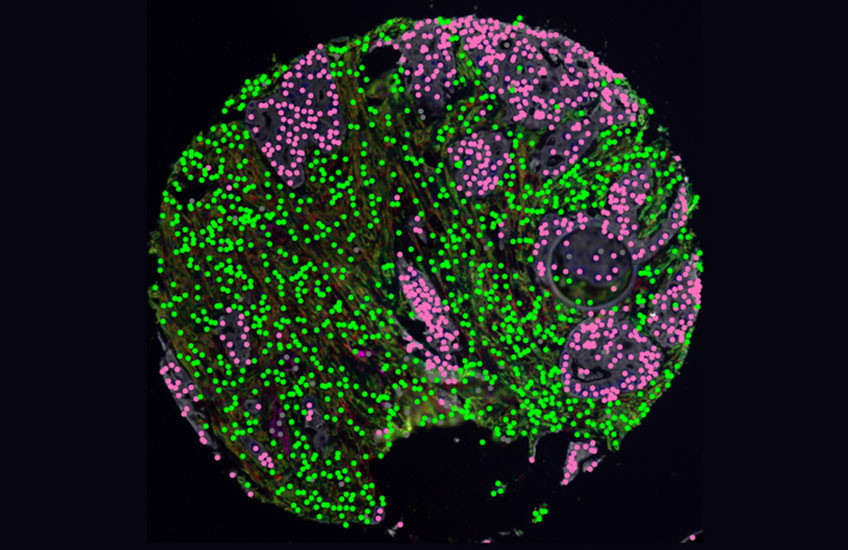
Among tumors of the most common colorectal cancer subtype, younger patients’ tumors had a significantly higher proportion of connective and supporting cells relative to cancer cells. A higher proportion of connective and supporting cells has been linked to chemotherapy resistance in several types of solid cancer. The team confirmed this pattern using gene-activity data from 564 other tumors and computer analysis of stained tissue images from another 712 tumors.
Younger patients also had higher activity of long non-coding RNAs, molecules that can regulate genes without making proteins. Some appeared repeatedly across different types of cancer cells. Many are dark RNAs, whose functions remain largely unknown. The team also saw gene activity suggesting stronger signaling between cells that can help cancer cells move and invade nearby tissue in younger patients.
“Our study is an advance from previous work in that we analyzed tumors from a large number of patients and used single-cell approaches to find novel features unique to tumors from young patients,” said co-senior author Ramnik Xavier, the HMS Kurt J. Isselbacher Professor of Medicine in the Field of Gastroenterology and a gastroenterologist at Mass General, a core institute member at the Broad Institute, and vice director of the Gene Lay Institute. “This work sets the stage for future mechanistic studies on how these cell programs interact with chemicals from the diet and from gut microbes to cause early-onset colorectal cancer.”
Although the findings provide key insight into colorectal cancer in young individuals, they do not yet provide proof that these differences cause more aggressive disease. Because the researchers’ methods captured relatively few immune cells, a question remains about whether differences in immune responses in these tumors exist across ages. Future studies will explore how these changes may affect cancer growth and spread, and whether they offer opportunities for prevention or treatment.
“Through Dana-Farber’s Young-Onset Colorectal Cancer Center, we see how profoundly this disease can affect younger patients and their families, often during the busiest and most formative years of life,” said co-senior author Kimmie Ng, HMS professor of medicine and director of the Young-Onset Colorectal Cancer Center at Dana-Farber. “This collaborative work with Mass General Brigham researchers from the Gene Lay Institute and researchers from the Broad Institute gives us important new insight into the biology of these tumors. The findings provide a valuable road map for further investigating the distinct features of young-onset colorectal cancer. Our ultimate goal is to discover novel strategies for prevention, diagnosis, and treatment for our young patients.”
Adapted from a Mass General Brigham news release.
Authorship, funding, disclosures
Additional authors include Shane P. Murphy, Jules Cazaubiel, Toni M. Delorey, Liat Amir-Zilberstein, Orr Ashenberg, Liubou Klindziuk, Elizabeth Andrews, William Tan, Kosuke Matsuda, Atsushi Kondo, Satoko Ugai, Tomotaka Ugai, Shuji Ogino, Emily Finan, Jacques Deguine, Ewa Sicinska, Lauren K. Brais, Jennifer S. Thalappillil, and Marios Giannakis.
Anderson is a member of the scientific advisory boards for Compass Therapeutics, Zumutor Biologics, and Cytospire Therapeutics: Anderson’s interests were reviewed and managed by Brigham and Women’s and Mass General Brigham in accordance with their conflict-of-interest policies. Ogino served as a consultant for Sanofi Pasteur. Xavier is a co-founder of Convergence Bio, a scientific advisory board member at Nestlé and Magnet Biomedicine, and a board director at MoonLake Immunotherapeutics: These organizations had no role in the study. Deguine is a member of BioRender’s scientific advisory board. Giannakis receives institutional research funding from Janssen Pharmaceuticals and Sunbird Bio, has consulted for Nerviano Medical Sciences, and has received honoraria from OncLive and PER. Ng consults for or serves on advisory boards for Bayer, Pfizer, CytomX, Jazz Pharmaceuticals, Revolution Medicines, Agenus, Johnson & Johnson, AbbVie, Sanofi, GlaxoSmithKline, Flagship Pioneering, AstraZeneca, Amgen, CRICO and Manta Cares; receives institutional research funding from Pharmavite and Janssen Pharmaceuticals; and serves as an associate editor at JAMA: Ng’s interests were reviewed and managed by Dana-Farber in accordance with its conflict-of-interest policies.
This study was funded by the Gene Lay Institute, Helen Gurley Brown Foundation/Dana-Farber Project P Fund, Patrick Beauregard Fund, Poorvu-Jaffe Fund for Young-Onset Colorectal Cancer Research, the Thau Fund, the Eigner Fund for Young-Onset Colorectal Cancer, the Klarman Cell Observatory at the Broad Institute, National Institutes of Health (R01 CA205406, P30 DK043351, R01 CA285851, P01 CA87969, UM1 CA186107, P01 CA55075, UM1 CA167552, U01 CA167552, R01 CA151993, R35 CA197735), and the American Cancer Society Clinical Research Professor Award (CRP-24-1185864-01-PROF).