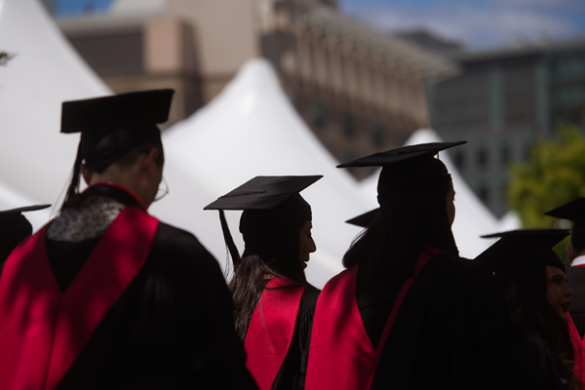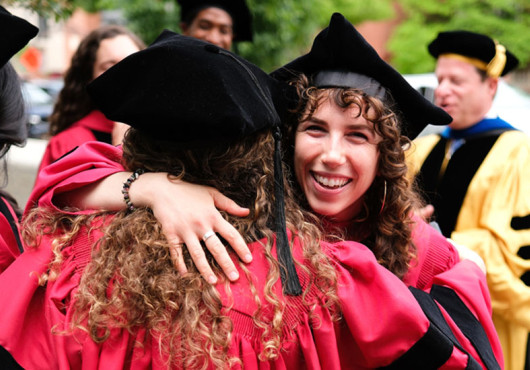
The Harvard Medical School Quad was filled with excitement as family, friends, and colleagues joined more than 300 graduating master’s students to celebrate the culmination of their studies in fields such as bioethics, medical education, and health care quality and safety.
Speakers at the Master’s Convocation on May 27 reflected on how the graduates would use the knowledge they’ve gained at HMS to address some of the most pressing health-related challenges facing the world today.
In his welcoming remarks, HMS Dean George Q. Daley stressed students’ roles as innovators within their chosen fields and the relationship between innovation and limitation.
“We are all living in a time of substantial resource constraints,” Daley said. “Science and academia at large are being threatened with catastrophic funding cuts. Essential, life-saving research is being canceled altogether. And public health practices have been riddled with misinformation and confusion.”
“But no limitation can quell bravery and humility, both of which are necessary ingredients for change,” he said.
Speakers also acknowledged worldwide suffering caused by lack of access to proper health care. Yet they remained hopeful about the graduates’ ability to address these challenges.
“You’ve all chosen to pursue careers that will shape the future of science and health care, improve patient outcomes, and push the boundaries of our understanding of the world,” said Rosalind Segal, HMS dean for graduate education.
“I know that you will all embrace the opportunities and challenges that lie ahead with intelligence, passion, creativity, curiosity, and resilience,” she said.
Keynote speaker Eric Rubin, HMS professor of medicine at Brigham and Women’s Hospital and editor-in-chief of the New England Journal of Medicine, reflected on the role of scientists as changemakers and how, through medical research, diagnoses that were once a death sentence can, within a generation, become curable.
Rubin reflected on a childhood friend who died of retinoblastoma, a type of tumor that now has a cure rate better than 95 percent. He noted that deaths from heart disease have plummeted and that genetic diseases such as sickle cell anemia are closer than ever to having cures that are financially and logistically accessible to all.
“Seeing successes like these is part of why we want to engage in medical science,” Rubin said.
Speaking on the rise of artificial intelligence and its use in medical research, Rubin said that while AI is useful when it comes to data processing, science is a creative endeavor.
“Scientific inquiry is very personal,” he said. “It means that your thoughts are going to be unique and your way of approaching a question is going to be unique. And that makes us, as scientists, the most valuable part of contributing to the advances that we’ve been talking about.”
Leading through challenge
This year, 303 students from more than 40 countries graduated from 10 master’s programs at HMS, including the first cohort to earn master of science in clinical research degrees.
Students completed capstone projects addressing topics such as using speech as a digital biomarker of the severity and progression of Parkinson’s disease, evaluating community-based management of tuberculosis in Sierra Leone, and helping care providers better understand the chronic illness experience of people with long COVID.
Rahul Gundamraj, a graduating Master of Medical Sciences in Biomedical Informatics student, used the AlphaFold Protein Structure Database to look for novel rare disease genes. He came to HMS to be on the cutting edge of his field after doing undergraduate work in biomedical engineering and computer science at the University of Virginia.
“I wanted to learn the state-of-the art in bioinformatics, and this program is at the forefront of the field, as Harvard generally is in bioinformatics and pushing the envelope of discovery,” Gundamraj said.
Sri Vidya Niharika Gullapalli, a graduating Master of Medical Sciences in Immunology student, researched human mast cell plasticity for her capstone project. She reflected on all the friendships she made and mentorship she found in her professors, while acknowledging that she almost didn’t even apply to HMS.

“HMS is the best in the world for immunology,” Gullapalli said. “I didn’t think I’d get in. But my mother said I would, and she sent in my application.”
Héctor Ferrando Gómez, who is also graduating with a master of medical sciences in immunology, researched regulatory T cells in the central nervous system. He said he has most valued and will miss the community he’s found at HMS.
“I’ve never been anywhere else in the United States,” said Gómez, who is from Spain, “but I’m sure there’s nowhere else in the world where there are so many people doing so many interesting things. Every conversation sparks something.”
Eleonora Orloff, a graduating student in the Master of Science in Clinical Service Operations program who developed a project to improve pediatric eye care at a clinic in the Bronx, also said she valued the friendships and connections she made.
“It’s an inspiration,” Orloff said. “Now that I know all these people [through the program], we’ve started to work on some projects together. Nobody knows where it will take us.”
The celebration begins
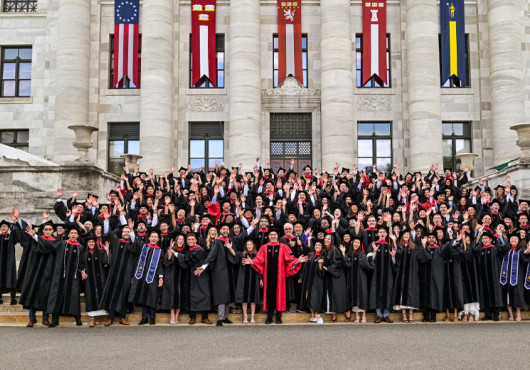
Before the ceremony, graduating students gathered on the steps of Gordon Hall to have their picture taken with their program cohort. Some students from remote or hybrid programs joyfully met each other in person for the first time.
The day was hot, if not quite stifling thanks to a breeze, and many students moved inside after their photos to enjoy the air conditioning. Some posed with friends on the interior steps, near a statue of Hermes.
They then filed in alphabetical order into the large white tent on the Quad where celebrants were gathered. The cohorts seemingly competed to see who could cheer the loudest as Daley named each program in turn.
Discovery and humility
A theme arose about the importance of humility in the face of discovery and accomplishment.
Daley reflected on the career of William Foege, an epidemiologist and former CDC director who died in January at age 89. Daley pointed out that despite having a global impact that earned him the Presidential Medal of Freedom in 2012, Foege is not a household name, the way former NIH scientist Anthony Fauci or physician-writer Atul Gawande might be.
Daley told of Foege’s efforts to eliminate smallpox in India. As the country neared its goal of eliminating the disease within its borders, Foege returned to the United States to help ensure that credit would be given to the thousands of people in India who did the bulk of the work rather than to external supporters.
“In times of limitation, we need you all to exhibit the bravery and humility that it takes to radically change the world,” Daley said.
Student speaker Ruisi Chen in the Master of Science in Media, Medicine, and Health program emphasized the importance of keeping in mind the needs and suffering of others.
“Our technical capacity has never been greater,” Chen said. “We can sequence genomes in hours. We can image a brain in real time. We can engineer cells and model diseases. On this very street, we have four of the world’s great hospitals. And still, suffering remains all around us: in this city, in this country, and across the world.”
While acknowledging the obstacles her classmates face as they try to improve human health, Chen struck a hopeful and humble tone.
“As we go out into the world, as we design new therapies and train new models, as we sit with patients for as long as they need us, as we challenge the policies and the funding that failed them, I hope we always remember the people who brought us here and the people who are still waiting for what we know to reach their lives,” she said.
Images: Steve Lipofsky
Answering the Call to Improve Health
Celebrating the accomplishments of the Class of 2026