The future of federally funded research at Harvard Medical School — supported by taxpayers and done in service to humanity — remains uncertain. Learn more.
When Minsu Kim graduated from college with a biology degree and became a research assistant in the lab of Wei-Chung Allen Lee in 2019, she didn’t know anything about electron microscopy or connectomics — the mapping of connections between neurons that is the lab’s main focus — or working with fruit flies, one of the lab’s model systems for studying the brain.
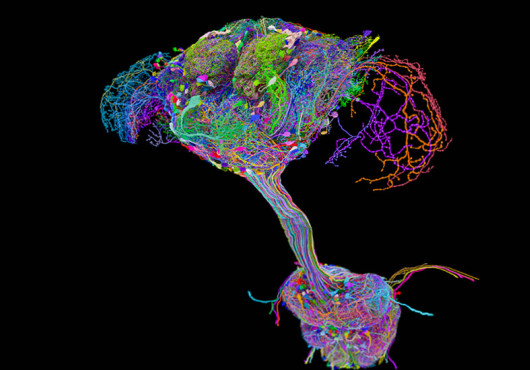
Fast-forward three years, and she played an instrumental role in creating the first complete connectome of a fruit fly central nervous system. Lee, associate professor of neurobiology in the Blavatnik Institute at Harvard Medical School and HMS professor of neurology at Boston Children’s Hospital, and the international FlyWire team made the connectome freely available online with the goal of advancing neurobiology research in labs around the world.
Now, Kim is a Harvard Kenneth C. Griffin Graduate School of Arts and Sciences doctoral student in the Molecules, Cells, and Organisms program at Harvard University. For her PhD, she is continuing to study fruit flies in the lab of Benjamin de Bivort, professor of organismic and evolutionary biology at Harvard, guided in part by the connectome she helped develop.
In a conversation with Harvard Medicine News, she talked about what she learned at HMS and what’s exciting about probing neural circuits and behavior.
Harvard Medicine News: Given that you weren’t familiar with connectomics or fruit fly research, why did you join the Lee Lab?
Minsu Kim: I wanted to get more research experience before applying to graduate school, and I was looking for a lab where I would have some agency over the project I was working on. Wei’s lab was fairly new at the time — about five years old — and it was the only lab that gave me the opportunity to have individual conversations with every single lab member during the interview process. It made me feel like Wei was being thoughtful and careful about who joined the lab and that he genuinely cared about my career goals and interests, rather than just seeing me as an extra pair of hands.
HMNews: What challenges did you face in the beginning?
Kim: For the first six months, I was continuing a former graduate student’s project that involved molecular techniques new to the lab. So while I had independence, it was tough to get traction, which was frustrating, and I started to wonder how I could make the most impact.
I ended up talking to Rachel Wilson [Lee’s own mentor and collaborator and the Joseph B. Martin Professor of Basic Research in the Field of Neurobiology at HMS], who suggested I switch to connectomics. We discussed how building a connectome of the entire central nervous system of a fruit fly would be incredibly valuable to the field and was something I could meaningfully contribute to in my two or three years as a research assistant. I pitched the idea to Wei, who agreed to let me switch projects — right before the COVID-19 pandemic hit.

As everything started to ramp down, it was decided that only one person could come into each lab. Because everyone else in our lab had computational work they could do from home, I became that person. I came in alone every day to prepare fruit fly samples that we needed to build the connectome. Actually, the de Bivort Lab, where I am now, provided the flies, so a postdoc would leave a tray in a designated spot, and I would come pick it up. It was a bizarre experience, but the work I was doing was technically challenging, so I liked having my own space without distractions to get it all done.
After the pandemic, I continued working on the samples with other people in the lab, including sectioning, imaging, and alignment, which were essential steps toward creating our map of all the neurons and their connections.
HMNews: What won you over about studying connectomics?
Kim: What first drew me in was the idea that you could reconstruct all the neurons in the nervous system and map all their connections at the level of individual synapses. Later, one moment that really stands out to me was when the sample I had been working on for over a year finally became available online. I remember scrolling through a freshly aligned preliminary dataset, clicking in different spots, and watching 3D reconstructions of beautiful neurons appear on the screen.
Once we had the full connectome, I spent time exploring the dataset — it’s kind of addictive seeing how one neuron connects to the next. Like any scientific endeavor, connectomics is challenging, but I think that is part of what makes it so satisfying and rewarding when the data finally come together.
I also really appreciate the collaborative nature of the connectomics community. Building a connectome currently requires the expertise and time of many people, and it was exciting to witness that collective effort firsthand. Now that our connectome is a publicly available resource along with previously existing ones, anyone can use it to explore their own questions. Through Wei, I had the unique opportunity to work with researchers approaching the same dataset from different angles, which made the impact of our work feel very real.
HMNews: What are some of the broader skills you learned at HMS?
Kim: I learned so many things! There were technical skills like coding and other computational tools. More fundamentally, I learned a lot by watching Wei and other mentors work through problems and make decisions. They helped me get better at making assessments about when to start exploring and see where a project goes and when to be more deliberate about the details and timeline. It’s something I’m still developing.
Wei’s lab was also a fun and collaborative environment that encouraged me to reach out to people and ask questions. I had opportunities to practice talking about my science outside the lab, including at conferences, and gained broader exposure to connectomics and fruit-fly systems neuroscience, which helped me shape what I wanted to study in grad school.
HMNews: What was your mentor/mentee experience like with Lee?
Kim: Wei treated me like any trainee in his lab; we met once a week, which I think is rare for a research assistant. If I was stuck on something and he didn’t have the answer, he would try to connect me to someone who did. For example, when I was working on my initial molecular project, he connected me with a professor at Brandeis University and actually went to Brandeis with me for the meeting. He is always willing to help you find a solution to your problem. He also works on stuff in the lab himself, especially the microscope that is so important for building connectomes. Sometimes the scope would break, and he would come in at 3 a.m. to fix it.
Wei also makes a lot of effort to build a positive lab culture. He would regularly bring up ideas for social events. He knows everyone works hard and he tries to reward that, which I appreciate. I don’t know how many other principal investigators would bike to one of the best bakeries in Brookline and bring back boxes of pastries for weekly lab meetings.
HMNews: What steered you toward the de Bivort Lab when you started your PhD in 2022?
Kim: Building the connectome and looking at the structural intricacies in the nervous system made me want to understand how that structure supports neural function and animal behavior.
Ben’s lab studies individuality in fruit flies. Even when flies are genetically identical and raised under the same conditions, they still behave differently from one another. For example, some flies consistently prefer to turn left while others prefer to turn right when exploring their environment. My graduate work focuses on understanding the neural basis for these individual differences. Together with other graduate students, we identified a specific brain structure that can predict how strong a fly’s turning preference is. Separately, I’m testing whether small variations in how the nervous system wires itself during development could explain how individual flies come to have a preference in the first place, and I’m using some interesting neurons I identified from our connectome as a starting point.
HMNews: What do you like about science, and where do you hope your research will lead?
Kim: I like that science lets you ask a range of questions and answer them in a quantifiable or mechanistic way, and I appreciate the rigor that it requires. I also like how different questions, techniques, and findings can come together to build a greater understanding of a system. For example, scientists developed expansive genetic tools that can now be used to manipulate single neurons, and Wei and many others built techniques to automate the construction of connectomes. These advances have given the field a more comprehensive understanding of how the nervous system regulates behavior in fruit flies and are revealing general principles of behavioral control that may inform the study of more complex nervous systems, including humans. That kind of collective progress is what I appreciate about science.
This interview was edited for length and clarity.