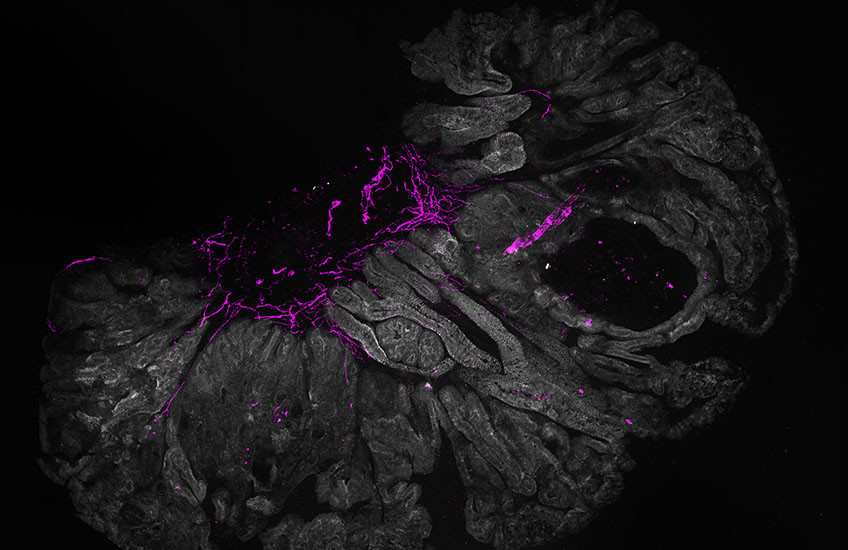
At a glance
Newly funded international team including Harvard Medical School scientists will investigate interactions between cancer and the nervous system, which can protect against or promote disease.
Findings promise to illuminate one of the most complex problems in cancer research and could lead to strategies to prevent, treat, or alleviate symptoms of cancer.
Team will focus on interoception — whether the brain’s ability to sense and control the body’s internal state includes monitoring and influencing tumor formation and progression.
An international, interdisciplinary research team that includes two Harvard Medical School professors has been selected to receive an award from Cancer Grand Challenges, a global funding initiative that enables efforts to take on some of the most complex problems in cancer research today.
The award, of up to $25 million over approximately five years, will support the team’s work to advance our understanding of the complex, dynamic interactions between the nervous system and cancer, with the ultimate goal of finding ways to harness the body’s power to fight this group of diseases that kills an estimated 10 million people worldwide each year.
Co-founded in 2020 by Cancer Research UK and the National Cancer Institute in the United States, the Cancer Grand Challenges initiative identifies obstacles that impede scientific progress and that no individual researcher, institution, or country can solve alone; invites scientists worldwide to assemble teams and propose innovative solutions; and awards funding to the most promising teams.
Five newly awarded teams were announced March 4, representing a total investment of up to $125 million.
Isaac Chiu, professor of immunology in the Blavatnik Institute at HMS, and Stephen Liberles, professor of cell biology at HMS, are members of Team InteroCANCEption.
Another newly funded team, Team CAUSE, includes Emily Balskus, the Thomas Dudley Cabot Professor of Chemistry at Harvard University, and will address the challenge of identifying mechanisms behind unexplained mutational signatures in cancer.
“Together, we’re creating opportunities for bold team science that could redefine what’s possible for people affected by cancer,” said David Scott, director of Cancer Grand Challenges.
Probing connections among the nervous system, immune system, and cancer
Under normal circumstances, nerve cells (neurons) play an important role in maintaining the body’s health, keeping vital systems in balance and providing crucial information for the immune system’s response to dangers.
In some cases, neurons may protect against tumor growth or enhance the body’s immune response to cancer cells. But in other cases, neurons can mistakenly curb immune response; promote the growth of tumors; and contribute to treatment resistance, pain syndromes, and psychological dysfunction.

To date, scientists know very little about the mechanisms that facilitate this two-way communication between tumor cells and neurons, including those in the brain.
Team InteroCANCEption brings together scientists in different specialties from eight institutions across the United States, United Kingdom, Switzerland, and Portugal to generate answers through the burgeoning field of cancer neuroscience.
“We’re really trying to harness the interactions between neurons and cancer cells to tune the body’s ability to fight cancers,” Chiu said.
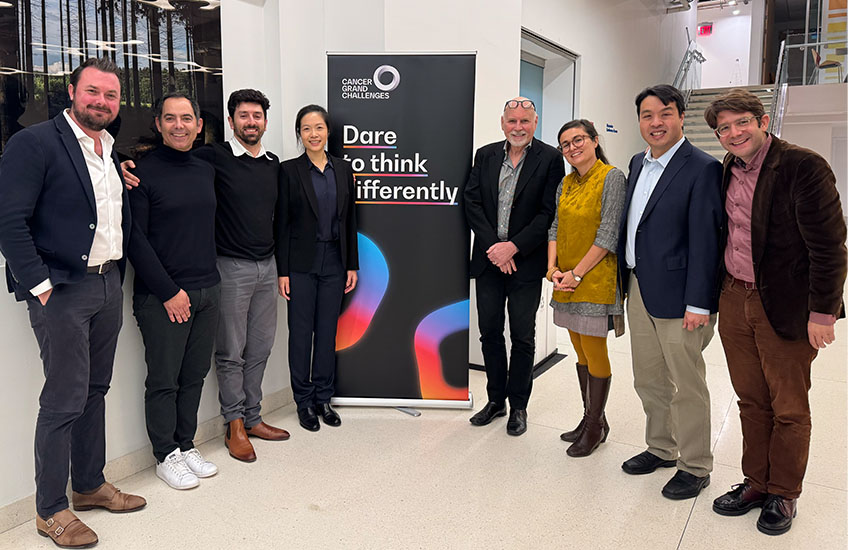
The team is led by Leanne Li of The Francis Crick Institute in London, England. Her research combines cancer biology and neuroscience to investigate how cancer communicates with peripheral nerves (those outside the brain and spinal cord) and the rest of the body.
The team members at HMS focus on the mechanisms of interoception: the body’s ability to sense and control its internal state.
Chiu studies the molecular machinery that underlies communication between the nervous and immune systems. This communication helps regulate pain, defends against pathogens, and is involved in neurodegeneration.
Chiu’s approach has yielded sometimes surprising results, including identifying a toxin produced by the dreaded bacteria anthrax that can silence multiple types of pain in animals. Other recent studies have illuminated nervous-immune interplay in the flu, meningitis, and itch.
Related Stories

Liberles studies sensory neurons in the vagus nerve, a major body-brain communication highway that controls functions such as breathing, heart rate, blood pressure, and digestion. His lab aims to identify the different neuron types in this nerve and to understand how they work on a molecular level.
Recent studies from Liberles’s group have focused on neurons that cause gasping when less oxygen is available, alert the brain when infection is present, control nausea, and influence attraction to food odors when hungry.
Liberles and Chiu have collaborated before joining the InteroCANCEption team, including on a discovery that the nervous system can suppress the immune system’s ability to overcome deadly lung infections.
Seeking answers in interoception
The InteroCANCEption team will investigate whether, in addition to monitoring and managing the body’s internal organs and autonomic operations, interoception allows the brain to monitor tumor formation and influence cancer progression.
The researchers’ first challenge will be understanding how the brain communicates with a cancer.
One area they plan to explore is whether local neuroimmune interactions in tumors suppress the body’s anti-tumor response. A second is whether and how inflammation remodels neuronal circuits in ways that impact tumor development. The researchers are also eager to investigate the protective or harmful roles of specific neuron populations in different cancers and how neuronal responses may contribute to cancer symptoms such as cachexia and shortness of breath.
Eventually, the team members want to find ways to prevent cancer from hacking the nervous system for its own ends. They aim to determine whether changing brain activity in precise ways, such as through medicines or neuroprosthetic devices, could slow cancer growth, boost the immune system’s cancer-fighting abilities, or reduce cancer symptoms.
“Understanding the molecular pathways that allow these cells to communicate — directly or indirectly through the immune system — may provide new strategies for disease treatment,” Liberles said.
This team is funded by Cancer Research UK and the National Cancer Institute.
Liberles and Balskus are HHMI Investigators.