For physicians, scientists, and patients, neurodegenerative diseases, which affect millions of people in this country and hundreds of millions across the world, remain a formidable foe. An array of treatments can help alleviate symptoms and slow progression, but a cure has remained elusive.
Now, researchers at Harvard Medical School and Boston Children’s Hospital have identified proteins involved in the innate immune system that could be at the root of a range of neurodegenerative conditions.
Get more HMS news here
The findings, based on experiments in mice and human nerve cells and published March 13 in Neuron, point to new pathways for slowing neuronal dysfunction and treating amyotrophic lateral sclerosis (ALS), a fatal motor neuron disease.
Specifically, the researchers found that inactivating a molecule in the brain linked to inflammation prevents cellular damage in human neurons and delays the progression of ALS in mice.
Seeking better health?
Heart health. Nutrition. Brain health. And more.
“We revealed an innate immune molecule playing a role in neurodegeneration, which presents a new avenue of thinking about neuronal health,” said Isaac Chiu, associate professor of immunology in the Blavatnik Institute at HMS and a co-principal investigator on the project.
“The unmet need for therapies for neurodegenerative diseases is huge, and our work opens up a whole new pathology that we could address,” said Judy Lieberman, HMS professor of pediatrics and chair of cellular and molecular medicine at Boston Children’s and a co-principal investigator on the project.
The role of inflammatory proteins in the brain
When cells recognize danger, for example, an infection, immune molecules sound an alarm that recruits immune cells to the site of damage to eliminate it and orchestrate tissue repair. Sometimes, the immune response involves a family of proteins called gasdermins, which trigger cells to die through a highly inflammatory process called pyroptosis. One type of gasdermin, gasdermin E, is expressed in the brain most highly in nerve cells. But no one knew what this protein was actually doing.
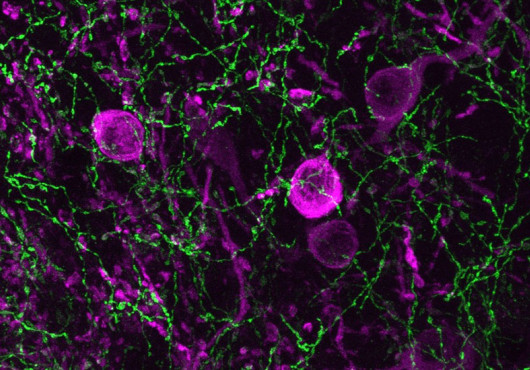
The research team, led by Lieberman and Chiu, first examined how gasdermin E affects neurons. The team developed models of neurons from mice and from human samples and looked at the effects of gasdermin E on axons, or the parts of neurons that send electrical signals. The researchers found that when neurons detect a hazard, gasdermin E drives damage to the powerhouses of the cell, known as mitochondria, and the axons. The axons degenerate, but the cells don’t die.
“If you look at a plate of neurons, you see a jungle of axons. But if you look at a plate where gasdermin E is activated, you see retractions of these cellular processes,” explained Himanish Basu, an HMS postdoctoral researcher in Chiu’s lab and first author on the study.
This retraction happens in motor neurons derived from patients with ALS, a progressive disease that starts with muscle twitching and weakness and eventually progresses to muscle atrophy and full-blown paralysis.
“Our work is an example of how immunology can help explain neurodegeneration on a mechanistic level, and what drives axon loss and neuronal injury,” said Dylan Neel, a graduate student in Chiu’s lab and co-first author on the study.
Gasdermin E in ALS
To better understand the relationship between gasdermin E and neurodegeneration, the team created models of ALS motor neurons by transforming stem cells from people with ALS into neurons. The researchers found that gasdermin E is present at high levels in these neurons. When the researchers silenced gasdermin E in these neurons, the axons and mitochondria of these cells were shielded from damage.
The team then wanted to test whether the effects they saw in cells could translate to improvements in symptoms related to neurodegeneration. The researchers silenced gasdermin E in a mouse model of ALS and found that this delayed the progression of symptoms and led to protected motor neurons, longer axons, and less overall inflammation. These findings suggest that gasdermin E drives changes to neurons that may contribute to disease progression.
“Inflammation is a double-edged sword and could be either protective or destructive based on context,” said Chiu.
Though some drugs can block the effects of other gasdermin proteins, it is still unclear whether gasdermin E can be specifically targeted with drugs. But this work is an important first step towards developing new approaches for treating ALS.
“We describe a pathway and molecules that you can target for treating many neurodegenerative diseases,” Lieberman said.
Authorship, funding, disclosures
Additional authors included Georgia Gunner, Matthew Bergstresser, Richard Giadone, Haeji Chung, Rui Miao, Vicky Chou, Eliza Brody, Xin Jiang, Edward Lee, Michelle Watts, Christine Marques, Aaron Held, Brian Wainger, Clotilde Lagier-Tourenne, Yong-Jie Zhang, Leonard Petrucelli, Tracey Young-Pearse, Alice Chen-Plotkin, and Lee Rubin.
The work was supported by NIH grant R01DK127257; CZI Neurodegeneration Challenge Network; R01CA240955 (to J.L.); Cancer Research Institute fellowship R01AG055909, R01NS115139, U19 AG062418, P50 NS053488, and F31NS122292 with additional support from the Parker Family Chair/AHA/Allen Brain Health Initiative.
Chiu receives sponsored research support from AbbVie/Allergan Pharmaceuticals and is on the scientific advisory board for GSK and LIMM Therapeutics. Lieberman is a co-founder and scientific advisory board member of Ventus Therapeutics.