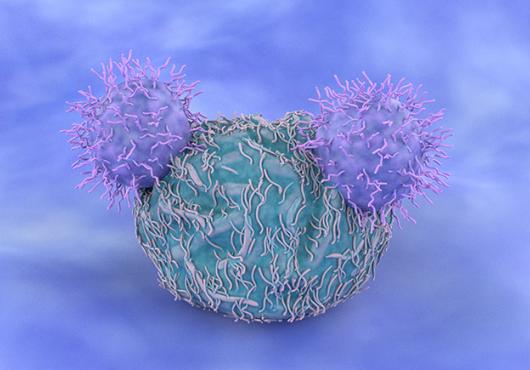
Chimeric antigen receptor (CAR) T-cell therapy, which reprograms an individual’s immune cells to seek out and destroy certain cancer cells, has revolutionized treatment for blood cancers such as lymphoma. But in some patients, the treatment can cause serious side effects.
New research led by Harvard Medical School investigators at Massachusetts General Hospital, Dana-Farber Cancer Institute, and the Broad Institute of MIT and Harvard has shown that patients’ inherited genetic makeup can influence whether they benefit from CAR T-cell therapy or experience toxicity from the treatment.
The results, published July 24 in Science Immunology, provide valuable insight into CAR T cells that could help improve patient management and the design of future treatments.
“These findings have important implications for understanding how CAR T cells behave in patients since each CAR T-cell product is unique to the person from whom it is manufactured,” said first author Mark Leick, HMS assistant professor of medicine at Mass General.
Variant effects
Leick and his colleagues sequenced the entire genomes of more than 200 patients with aggressive lymphoma from two major clinical trials of CAR T-cell therapy. They found that in one of the trials, patients with T cells containing variants that silenced a gene called STXBP2 tended to experience toxicity related to CAR T-cell therapy.
In experiments conducted in cell cultures, the researchers found that donor T cells engineered to express these variants and/or to lack STXBP2 triggered inflammation.
The team also found that in both clinical trials, variants in a gene called ADAMTSL3 correlated with protection from treatment-related toxicity. Additionally, variants in the gene PTPN22 were strongly associated with enhanced CAR T-cell expansion, a key determinant of the therapy’s efficacy.
Improving future treatments
While additional studies are needed — with larger cohorts containing more individuals with non-European ancestry — the results suggest that variants in these different genes can shape the safety and therapeutic activity of CAR T-cell and other immune cell therapies. The work demonstrates the value of incorporating genetic analysis into CAR T-cell trials and offers possible opportunities to enhance personalized CAR T-cell therapies.

The findings may also be useful for screening donors for future allogenic CAR T-cell therapies, which rely on T cells from a healthy person to manufacture therapies for multiple patients.
“This may have implications for identifying the right donor for CAR T cells, where a single donor can provide T cells for hundreds of patients, and for the design of augmented CAR T cells, based on a deeper understanding of how human genetic variation impacts CAR T-cell behavior,” said co-senior author Marcela Maus, HMS professor of medicine at Mass General.
Adapted from a Mass General Brigham news release.
Authorship, funding, disclosures
Saud AlDubayan is co-senior author with Maus. Additional authors include Baihe Sun, Filippo Birocchi, Kathleen M.E. Gallagher, Alexandra Bratt, Seunghun Han, Grace Martin, Harrison J. Silva, Rebecca C. Larson, Tyler M. Chinsky, Hoyin Chu, Christopher R. Reilly, Michael C. Kann, Bryan D. Choi, Sabrina Camp, Riaz Gillani, Merle Phillips, Tamina Kienka, Stefanie R. Bailey, Charlotte E. Graham, Max Jan, Nicholas S. Moore, Nora Horick, Justin Budka, Simone Filosto, Chad M. Williams, Ali Hosseini Rad, Rhine R. Shen, and Eliezer Van Allen.
This work was funded by Kite Pharma.
Budka, Filosto, and Shen are Kite Pharma employees. Maus is an inventor on patents related to adoptive cell therapies, held by Mass General (some licensed to ProMab Biotechnologies, Luminary Therapeutics, and Altido Therapeutics) and the University of Pennsylvania (some licensed to Novartis); receives grant/research support from Bristol Myers Squibb, Kite Pharma, Miltenyi Biotec, and Sobi; holds equity in Altido Therapuetics, Caronilex, and Umoja Biopharma; is on the board of directors for Umoja Biopharma; and is a compensated consultant for A2 Biotherapeutics, Alexion, Astellas, AstraZeneca, Bristol Myers Squibb, Cabaletta Bio, Chugai, Healio, KSQ Therapeutics, LUMICKS, and TriaCyte.
Choi, Maus, and Leick are inventors of patents related to the use of engineered cell therapies. Choi received commercial research grants from ACEA Biosciences and reports financial interest in and consulting for Altido Therapeutics, which is developing CAR T cells as therapeutics for multiple indications on the basis of the CAR-TEAM technology developed at Mass General. Gillani has equity in Google, Microsoft, Amazon, Apple, Moderna, Pfizer, and Vertex Pharmaceuticals; Gillani’s spouse is employed by Carrum Health. Leick is a contributor to patent filings on CAR T-cell technology that are held by Mass General and is a consultant for BioNTech, Cabaletta Bio, and Adaptimmune. Jan is a scientific advisor to and has financial interests in Lightcast Discovery Ltd. and is an inventor on patent applications related to CAR T-cell therapy held by Mass General and the Broad Institute. Gallagher has a consulting agreement with and equity in Altido Therapeutics.