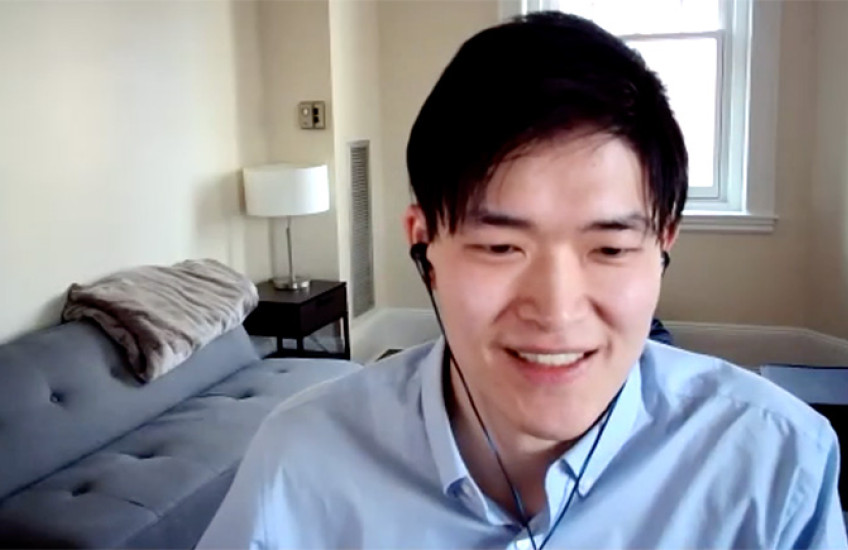
“The concert was the last ‘family outing’ we had together … and will forever be a fond memory of his last days with us.”
The quote, from an individual whose father died in February, powerfully demonstrates the impact of Harvard Medical School student Grant Riew’s research project, “Harnessing the therapeutic aspects of music to treat loneliness with virtual bedside concerts.”
The project involved pairing musicians with hospitals and other health care facilities for virtual bedside concerts during the pandemic to help relieve patients’ feelings of isolation and distress.
Riew is one of the more than 30 HMS students who presented their work at the 81st Soma Weiss Student Research Day on March 16.
related stories

The annual showcase, sponsored by the HMS Scholars in Medicine Office, is named in memory of Soma Weiss, a dedicated School mentor and champion for student research who helped organize the first student research day at HMS in 1940. He died unexpectedly in 1942.
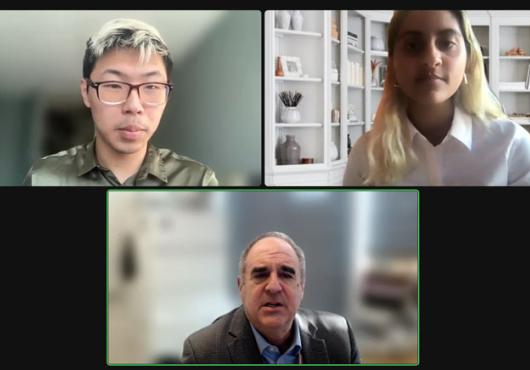
“A lot of innovation is driven by fresh minds looking at the world in fresh ways,” said Dean for Medical Education Edward Hundert as he welcomed viewers to the virtual event. “That’s why HMS student research is such a vital part of the mission of our School.”
Marquee presentations
Faculty praised Riew’s project for bringing solace to patients, families, and health care workers alike. Phillip Devlin, HMS associate professor of radiation oncology at Brigham and Women’s Hospital, found Riew’s work particularly poignant because during the pandemic families have not been able to be with their loved ones as they die.
“That, on its own, is a prize of great worth,” he said.
Riew, along with three other students, was selected to give an oral presentation to an all-event gathering before attendees broke out into smaller groups to attend individual poster sessions.
The other student speakers were James Diao, who presented on reconsidering the use of race in clinical calculators of kidney function, work recently published in JAMA. Bina Kassamali’s study involved a geospatial analysis of the possible role that environmental pollutants play in disease development, considering this as an environmental justice issue because low-income and minority neighborhoods tend to be near toxic environmental hot spots.
Rachel Reardon, who worked with other medical students to create free web-based curricula for elementary-, middle-, and high school and college-level learners that have now been accessed by 6,000 users and translated into French, Spanish, and Japanese.
Patricia D’Amore, the Charles L. Schepens Professor of Ophthalmology at HMS and Mass Eye and Ear, and Jeffrey N. Katz, director of the HMS Office of Scholarly Engagement, emceed the oral presentation session.
Congregating at the poster sessions
A cornerstone of this long-running event is the opportunity for students to illustrate their research visually via posters, explain their projects, and answer questions about their methods and findings posed by faculty, peers, staff, and the event’s poster judges.
This year, those attending the event could drop into online chat rooms. Mimicking the in-person gatherings that happen when congregating around a student’s poster in the Tosteson Medical Education Center atrium, attendees could view the students’ posters and engage in live video chat with students and others in the chat room.
Posters were categorized as either clinical or translational research or medicine in society research. The latter category includes projects in medical humanities, health policy, community engagement, and health services. About 20 posters were presented in each category.
Recognitions and awards
The event kicked off with Hundert awarding the Martin Prince Scholarship for Student Innovation and ended with the awarding of poster prizes.
Prince, an HMS alumnus, feels “strongly about fresh ideas leading to innovation,” said Hundert as he named Bailey Ingalls, a Harvard-MIT Program in Health Sciences and Technology student, as the scholarship recipient.
Ingalls’ research, “Development and characterization of a PLGA drug delivery platform that can be modified for predictable burst and sustained release kinetics,” is particularly relevant because of the pandemic, he said. “Imagine if we had a one-shot vaccine that delivers doses over time.”
Ingalls thanked Prince and the School for the support.
“It’s such a privilege to be a part of an institution that supports the students and believes in us like this,” she said.
Hundert called for a virtual hand for all those involved in putting on the event, including HMS staff members Kari Hannibal and Marcie Naumowicz and the emcees and faculty judges.
2021 Soma Weiss Student Research Day Poster Winners
Judah Folkman Prize for Clinical/Translational Science Research
Anthony Almazan
Association between gender-affirming surgeries and mental health outcomes
Bina Kassamali
Environmental justice, pollutants, and period prevalence of two rare diseases: A geospatial analysis
Leon Eisenberg Prize for Medicine in Society Research
The Covid-19 Student Response Team (both posters were from the same group of students)
Read more about the HMS student-developed medical school curriculum here.
Derek Soled and Shivangi Goel
Formation of the COVID-19 medical student response team
Kendall Carpenter, Abigail Schiff, Katherine Shaffer, and Derek Soled (Group Project)
Student-led development and maintenance of an online open-access medical student COVID-19 curriculum