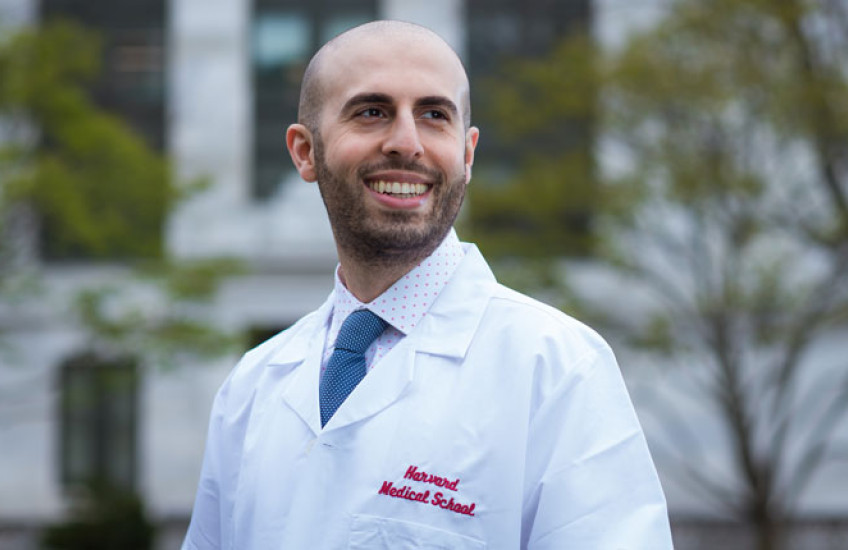
Sheer excitement is an understatement when it comes to describing the joy that Ryan Sameen Meshkin felt upon matching to a residency near Boston where he will be able to continue serving after graduation from Harvard Medical School with his MD this May.
Meshkin’s next career move—a four-year residency in ophthalmology at Massachusetts Eye and Ear—will keep him close to Chelsea, Massachusetts, the community where he lives and serves as part of a grassroots community-building program, inspiring young people to reach their full potential through service to their neighborhood.
Meshkin’s life of community involvement began in his hometown of Portland, Oregon. Raised in the Bahá’í faith, which teaches the importance of service to society, he strives to apply these teachings in his life through action.
“I believe in the elimination of prejudice and the promotion of the oneness of humanity,” Meshkin said. “These Bahá’í beliefs inform my vision for how I aspire to serve my community as an ophthalmologist.”
At age 14, Meshkin seized the opportunity to participate in the Junior Youth Spiritual Empowerment Program, a worldwide Bahá’í program that aims to give children and youth a voice by enhancing their power of expression, allowing them to analyze the constructive and destructive forces of society, and taking responsibility to contribute to the betterment of their community.
“It had a profound impact on my life and purpose,” he said.

Now 27, that experience continues to inspire Meshkin’s service with young people today.
“Together, we are striving to embrace a twofold moral purpose: the betterment of one’s own character and the transformation of society,” he said.
Meshkin’s ancestral roots trace back to Iran where his parents were born. Persecuted for their Bahá’í religion, their respective families fled to America and now live in Portland.
Since his youth, Meshkin has been actively seeking ways to serve, particularly through educational efforts that advance health.
Together with peers in Portland’s junior youth empowerment program, he helped create a service project to address the city’s growing rate of diabetes by teaching the community about the importance of healthy eating.
By the time Meshkin entered college at Virginia Commonwealth University’s Honors College, he knew he wanted a career that blended medicine and education.
Celebrating the 2022 Graduates
Read more profiles of some of Harvard Medical School’s remarkable graduates and watch livestreams of ceremonies for master’s, MD/DMD, and PhD graduations.
Specific ambitions began to take shape in the summer of 2016, between his junior and senior years, when he had the opportunity to work at Johns Hopkins University with a mentor in ophthalmology—Allen Eghrari, a clinician and researcher who serves on the cornea faculty of the Wilmer Eye Institute in Baltimore, Maryland.
“Witnessing how Dr. Eghrari cared for patients was inspiring,” Meshkin said. “The spirit of compassion that he brought to interactions with corneal transplant patients, before and after surgery, particularly affected me. He even made personal visits to patients in the community days after surgery.
“This spirit of selfless service and absolute commitment to the well-being of his patients set a high bar for the standard of patient care I intend to offer as an ophthalmologist,” he added.
Upon entering HMS, Meshkin expected to spend the next four years following the established curriculum, carrying him to graduation and a prospective residency in ophthalmology.
Rerouted rotation
But when the COVID-19 pandemic erupted, the School had to pivot. Rotations in ophthalmology were temporarily suspended. In the midst of this upheaval, Meshkin saw an opportunity to help, cultivating his dual passion for education and ophthalmology.
To ensure that medical students had access to an ophthalmology rotation, he created and directed a virtual rotation, which subsequently received accolades from the Association of University Professors of Ophthalmology (AUPO), he said.
That positive feedback spurred him to propose a video-based curriculum to teach medical students ophthalmic surgical principles, for which Meshkin and his team received an AUPO medical student education research grant in 2021.
“Collaborating with educators nationwide affirmed my desire to educate the next generation of ophthalmologists,” he said.
By this time, Meshkin had moved to Chelsea, Mass., where he devoted the year between his third and fourth years of medical school to understanding social factors contributing to disparities in eye health.
Walking home one day with a mentee from the Chelsea youth empowerment program, he said, he learned that the boy was struggling in school because he had to provide supportive care for his father, who had advanced diabetic retinopathy.
Hearing the call
For Meshkin, it was a call to action. Collaborating with a team of ophthalmologists at Mass Eye and Ear under the direction of Alice Lorch, HMS assistant professor of ophthalmology at Mass Eye and Ear, he helped secure two grants totaling $400,000 to expand eyecare services in local community health centers, beginning with diabetic retinopathy screenings. To date, these screenings have identified numerous people in need of specialty care.
“Eyesight is often considered the most cherished sense,” Meshkin said. “When something goes wrong, a patient’s life is completely disrupted.”
In an effort to close the disparity gap in eye care, he envisions a bright future for innovations in ophthalmology, including a shift to telemedicine and mobile vision clinics to meet the needs in underserved communities.
“The way we practice today is profoundly different than 10 years ago, and I can only anticipate more advances are coming,” he said.
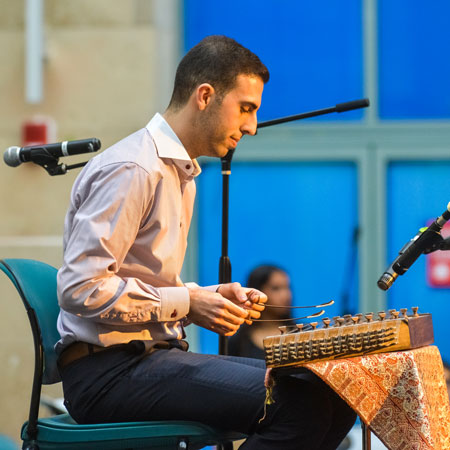
Meshkin actually has another passion, one focused on the sense of hearing. He is also an accomplished musician, playing the santour, a Persian hammered dulcimer.
This connection with his culture began at age 9 when he heard the santour played at a recital. An accomplished touring musician, he has played in venues around the U.S.—including the annual FABRIC show at HMS—using the language of music to promote cross-cultural unity and an appreciation for human diversity.
Meshkin’s HMS graduation will mark a dual family celebration. Last spring, he married Mona Meshkin, who is graduating from University of New England College of Dental Medicine this year. She will pursue her dental residency at Massachusetts General Hospital, adjacent to Mass Eye and Ear, and the couple is breathing a sigh of relief that they won’t be separated during the next phase of their training.
Although he has already ventured along many pathways—community service, medicine, and education—Meshkin credits his Bahá’í beliefs with providing a steady compass for his journeys.
“If a person places his core beliefs at the center, and sees everything else through that lens, all the pieces come together,” he said.