At a glance
Researchers have developed a platform that promises to speed the discovery of drugs that modulate protein-protein interactions, which underlie nearly all healthy biological processes and can contribute to disease.
The platform, called FIND, uses a technology called DNA nanoswitches previously developed by the lab of Wesley Wong.
Study demonstrates FIND’s ability to uncover molecules that lead to new medicines or research tools for studying disease.
Proteins in the body often work by binding to other proteins. These protein-protein interactions underlie nearly all healthy biological processes, and when they go awry, they can contribute to disease.
Some of the most successful drugs on the market — including inhaled albuterol for asthma and GLP-1 agonists for diabetes — act on protein-protein interactions, and researchers have been keen to develop more of this type of therapeutic. But the complexity of the molecular interactions and the scale of the screening required have made such drugs challenging to discover.
Researchers at Harvard Medical School, the Wyss Institute for Biologically Inspired Engineering at Harvard University, and Boston Children’s Hospital have now developed a drug discovery platform, called FIND, that promises to speed the search.
As reported Nov. 5 in Science, FIND searches large libraries to identify molecules that affect protein-protein interactions rather than molecules that simply bind to a single target protein. This gives FIND an advantage over conventional binding-based screening.
In the federally funded study, the researchers used FIND to discover small molecules and nanobodies (small antibody-like proteins) that promoted particular protein-protein interactions with relevance for different disorders.
The platform “offers an entirely new ultra-high-throughput approach to discovering drugs that modulate the myriad types of biological mechanisms that regulate cellular function but currently are out of reach for conventional discovery tools,” said Donald Ingber, Wyss founding director, the HMS Judah Folkman Professor of Vascular Biology at Boston Children’s, and the Hansjörg Wyss Professor of Biologically Inspired Engineering at Harvard John A. Paulson School of Engineering and Applied Sciences.
From a single DNA nanoswitch to a molecular switchboard
FIND, short for Functional Interaction-based Nanoswitch Discovery, builds on DNA nanoswitches, a technology previously developed by the lab of senior author Wesley Wong, HMS associate professor of pediatrics and biological chemistry and molecular pharmacology at Boston Children’s and associate faculty member at the Wyss Institute.
Wong’s group first developed DNA nanoswitches for single-molecule measurements and then adapted it into a gel assay in 2015. He and co-first authors Clinton Hansen, HMS instructor in pediatrics at Boston Children’s, and Mark Lipstein subsequently advanced the technology for drug discovery with other colleagues. Their “Lab-on-a-Molecule” project was supported by Northpond Labs, the research-and-development affiliate of Northpond Ventures, through its strategic alliance with the Wyss Institute.
DNA nanoswitches are programmable devices made from long strands of DNA. They switch between a linear shape, in which two potential protein partners attached to the nanoswitch are not bound to each other, and a looped shape, in which the two proteins bind and bring two points on the DNA together. Compounds that promote this interaction increase the fraction of looped nanoswitches.
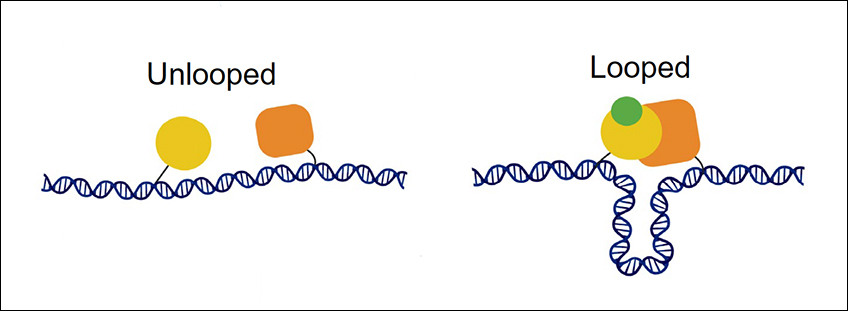
The team separated these shapes using gel electrophoresis, a standard laboratory method for distinguishing pieces of DNA with different sizes and structures. Looped nanoswitches moved more slowly through the gel than linear ones, allowing them to be collected separately.
To develop FIND, the team attached a candidate drug molecule to each nanoswitch using a flexible linker along with a nucleic acid barcode that identified the candidate.
“Each candidate stays linked to the result of its own experiment,” said Lipstein, who worked on the project as a Harvard Kenneth C. Griffin Graduate School of Arts and Sciences PhD student in the Wong Lab and then as a postdoctoral fellow. The team could then separate the nanoswitches by their response and sequence the barcodes to identify the molecules that were selected.
The approach differs from many conventional drug screens, which test compounds individually in multi-well plates, with instruments measuring changes in purified proteins or cells. Pooled screens of encoded compound libraries can search much larger collections, but these methods have typically only identified molecules that bind to a single protein target.
“Our idea was to build each experiment onto a single DNA molecule, so that many experiments could run in parallel in one tube,” said Wong, who also co-leads the Wyss Institute’s Molecular Robotics Initiative. “This gives us a high-throughput way to search for molecules that change how proteins work together.”
Finding new leads
As one example, the researchers applied FIND to PPAR-gamma, a diabetes drug target that helps regulate insulin sensitivity and fat storage. From a DNA-encoded library of 400 million small molecules, they identified compounds that promoted the receptor’s interaction with a fragment of its partner protein CBP. These compounds also increased lipid accumulation in cultured cells, consistent with PPAR-gamma activation.
FIND was thus able to uncover new compounds that modulate complex protein-protein interactions with the potential to be further developed into medicines.
The researchers also used FIND to discover a nanobody that modulated the interaction between SARS-CoV-2’s spike protein and its receptor on human cells. This demonstrated the platform’s utility for finding new research tools for studying disease.
In addition, the team validated the new approach by recovering a known activator of the beta-2 adrenergic receptor (the receptor targeted by albuterol) that had been added to a mixture of barcoded controls.
“We can directly search for molecules that have the effect we want on a disease-related protein-protein interaction,” said Hansen. “The molecules we find could become starting points for developing new medicines or useful research tools for understanding diseases.”
The technology has recently been licensed to a newly formed startup co-founded by members of the research team.
Adapted from a Wyss Institute news release.
Authorship, funding, disclosures
Additional authors on the study include Sarah Erlandson, Tobias Schwalbe, Sylvie Bernier, Peter Gmeiner, and Andrew Kruse.
The work was supported by the National Institutes of Health (grants R01CA260415, R35GM119537, and F31GM128233), Takeda Pharmaceuticals, an Arnold and Mabel Beckman Foundation Beckman Young Investigator Award, a Smith Family Award for Excellence in Biomedical Research, the Deutsche Forschungsgemeinschaft (DFG grant Gm 13/10), the Elite Network of Bavaria, the Wyss Institute, and Boston Children’s.
Hansen and Wong have filed patent applications for various aspects of this work (e.g., 9,914,958 and 11,396,650). Wong is a co-founder of Merge Bio Therapeutics. Hansen and Lipstein are co-founders and now employees of Merge Bio Therapeutics. Kruse is a co-founder and consultant for biotechnology companies Tectonic Therapeutic and Seismic Therapeutic and for the Institute for Protein Innovation, a nonprofit research institute.