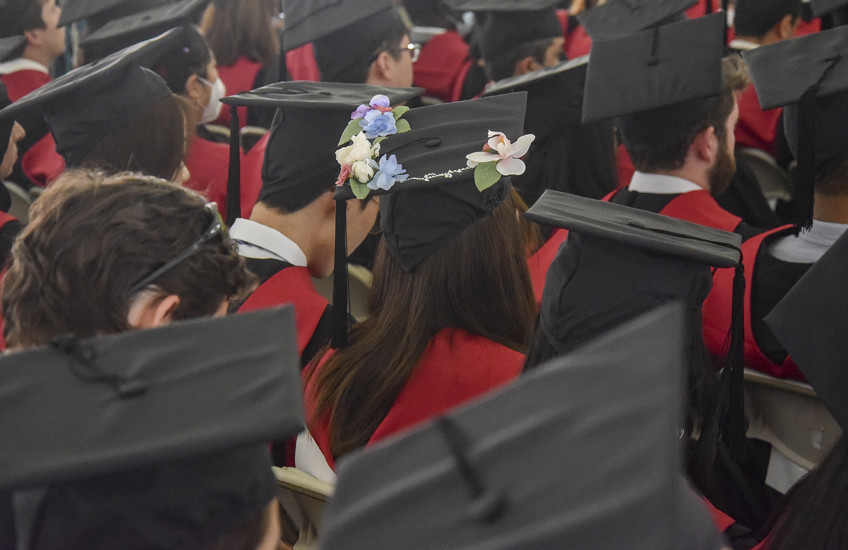
The sidewalk and lawns of the Quadrangle at Harvard Medical School bustled with people, some in academic regalia and many wearing or carrying flowers, as 170 master’s degree candidates gathered on May 25 for their first in-person graduation ceremony at the School in two years.
A rich array of blossoms enlivened the grads’ brightly patterned silk blazers and dresses, earrings or necklaces, and festive bouquets were affixed alongside fabric butterflies on mortarboards.
For many of the master’s graduates, faculty, family, and friends, the flowers may have represented a quiet but deep expression of celebration. The newly minted leaders from HMS’ eight master’s programs, which include bioethics, clinical service operations, biomedical informatics, health care quality and safety, and master of medical sciences degrees in clinical investigation, immunology, and medical education, were marking the culmination of several years of work under challenging circumstances.
It was a particularly joyous moment for grads who were meeting colleagues in person for the first time. The school moved to remote learning in 2020 with the advent of the COVID-19 pandemic, and many students completed coursework virtually, working on mentored research projects from their homes in other cities and countries.
“It’s remarkable that we were able to build such a strong sense of community remotely, but it’s so important to see your colleagues face to face,” said Siham Elhamoumi, a program and alliance manager at the Broad Institute of Harvard and MIT, who received her master’s in bioethics.
“I’m really excited, really happy to meet colleagues in person for the first time,” she said.
The celebration was tempered with an acknowledgment of the challenging times that students—and all people—have faced during the months and years of their studies, as the pandemic claimed millions of lives around the globe.
But the ceremony was also buoyed by calls to view the challenges as opportunities — opportunities to improve health care, deepen scientific and cultural understanding, and to work for health equity and justice.
Crisis as opportunity
“You have faced some of the toughest moments in recent history on our planet, moments that have tested all of humanity’s bodies, hearts, and spirits,” said master’s graduation keynote speaker Aletha Maybank, who serves as chief health equity officer and senior vice president of the American Medical Association.
To heal individuals affected by the many public health, political, and social crises unfolding over recent years, and to build a healthier, more equitable, and more inclusive world, Maybank encouraged the graduates to think of these challenging years as occasions to bring about much-needed change, both within the institutions of medicine and across society.
“First, you must remember, we are all born equal, and health is our human right,” Maybank said.
“You have the opportunity to reimagine, dismantle, decolonize, redesign, and reconstruct the health and public health systems through a vision that reclaims a much broader understanding of health,” she told the grads.
Maybank outlined a number of steps that graduates might consider in pursuit of these goals, including building diverse collaborations and seeking a deep, rich understanding of the history and lived experiences of the people they serve.
Maybank also urged graduates to embrace all of the emotions that are likely to arise in the course of this work.
“Give yourself permission to feel and experience joy, to cry, to laugh, and to love,” she said.
“Empathize and feel. This is not a weakness. It is being human and allowing yourself to show up as a full human being, capable of doing amazing things.”
A hopeful vision
HMS Dean George Q. Daley congratulated the graduates and noted that their new degrees were powerful tools for improving health and well-being for all.
“Your master’s degree is a powerful lens through which to better understand the social determinants of health, and it is an unrivaled tool in stirring hope for the future,” Daley said.
Before beginning their HMS studies, many of the graduates worked in in higher education, private enterprise, ministries of health, and nongovernmental organizations, serving in a variety of capacities across biomedical and public health organizations as physicians, nurses, pharmacists, and administrators.
HMS master’s student council president Diego Ramonfaur, a clinical research fellow in the Brigham and Women’s Hospital Division of Cardiovascular Medicine Research who earned his MMSc in clinical investigation, celebrated the diverse backgrounds of the 2022 master’s graduates, who come from every inhabitable continent.
He reminded them of their great responsibility to pursue new knowledge, to do good, to care for their neighbors, and to lead by example.
Other speakers at the ceremony included Rosalind Segal, HMS dean for graduate education, Johanna Gutlerner, HMS senior associate dean for graduate education, and faculty leaders of the graduate programs who highlighted the accomplishments of the graduates and bestowed the diplomas.
Celebrating the 2022 Graduates
Read more profiles of some of Harvard Medical School’s remarkable graduates and watch livestreams of ceremonies for master’s, MD/DMD, and PhD graduations.
Honoring Farmer’s legacy
Daley and other leaders and students also took time to remember and honor the legacy of revered HMS faculty member Paul Farmer, who died suddenly and unexpectedly on Feb. 21.
A visionary leader in the movement for global health equity, and the head of the HMS Department of Global Health and Social Medicine, Farmer was also one of the leaders of the MMSc program in global health delivery.
After showing a memorial video highlighting some of Farmer’s many accomplishments, there was a brief moment of silence to honor Farmer and the people killed in the Uvalde, Texas, mass shooting of the day before.
Farmer would be thrilled to see what the graduates had accomplished, and eager to see what they would achieve going forward, said Joia Mukherjee, associate professor of global health and social medicine and director of the MMSc Program in Global Health Delivery
Mukherjee said she and Farmer were inspired to develop the master’s program by a moment of deep need, following the catastrophic 2010 earthquake in Haiti.
The goal was to bring together expertise from people who were living the mission of delivering health care to the people who need it the most, under the most challenging circumstances, Mukherjee said, and to train them to become scholars and educators in their own right.
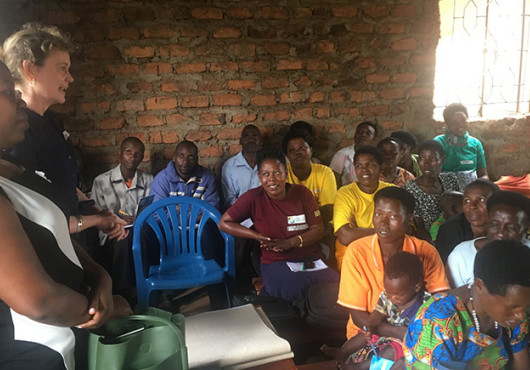
“Each and every one of our global health delivery students did work that Paul would be so proud of,” Mukherjee said, citing projects ranging from maternal health, youth mental health, analyses of the barriers to preventing the spread of COVID-19 among citizens and refugees in Rwanda, and a study aiming to improve care of surgical-site infections and antibiotic resistance in rural Liberia.
She also noted that the HMS master’s global health program is being used as a blueprint to build global health delivery education programs in Rwanda, Haiti, and around the world.
Farmer often spoke passionately about the need for an integrated approach to medicine, public health, and science that made global health equity a priority and emphasized that everyone, everywhere has both the capacity and the responsibility to work to make the world a healthier, more just place for all people.
It is a sentiment that observers noted is echoed across the HMS master’s programs and in the work that master’s students, graduates, and alumni have been producing.
Odunayo Kolawole Talabi, who received his MMSc in global health delivery, said that he was thrilled to be earning a degree from Harvard, something that very few people from his rural Nigerian hometown could ever hope to achieve.
He said that just as Farmer’s life had inspired him and many of his colleagues to pursue careers in global health equity, Farmer’s passing had only fueled their passion to carry on his work.
“We are so determined to live his dreams, and to make sure that these things that he fought for live on,” Talabi said.
He added that Farmer’s lessons weren’t unique to global health practitioners, but could be applied to anyone who made a commitment to think beyond their own job or research, considering how their work impacts those around them, and approaching that work with the goal of caring for others.
“Infusing love into whatever it is you do—this is the most important thing that I’m taking away from meeting Paul, and from my time at Harvard,” Talabi said.
Deepening knowledge
Across the eight master’s and MMSc programs, graduates’ thesis and capstone projects explored a remarkable breadth of topics, speakers said, all of them infused with the goals of deepening biomedical knowledge or improving medical education to build better methods and systems for caring for others.
Biomedical ethics program graduates explored the possibility of using fact-checking technology to combat medical misinformation on social media, and analyzed the ethics of data sharing in studies of pathogen genomics in light of wide-scale pandemics such as Ebola virus disease.
Biomedical informatics graduates explored ways to improve data collection on social and economic status, both of which are important determinants of health and illness, and they built machine learning tools aimed at capitalizing on the intuition that experienced surgeons develop over years of practice.
There were also master’s projects that explored how to improve pediatric cancer care, how patients flow quickly and safely through COVID vaccination clinics in Pakistan, and helping MassGeneral Brigham hospitals stabilize fluctuating numbers of patients efficiently.
“With such a widespread post-baccalaureate footprint, HMS has been contributing—year after year—to a growing cornucopia of trainees who become trusted scientific and health leaders in their respective communities,” Daley said, addressing the graduates.
“You, our master’s graduates, will apply your newfound knowledge in clinical service operations, biomedical informatics and more to pressing health issues here in the United States and around the globe, creating a powerful ripple effect that will transform health care for the better,” he said.