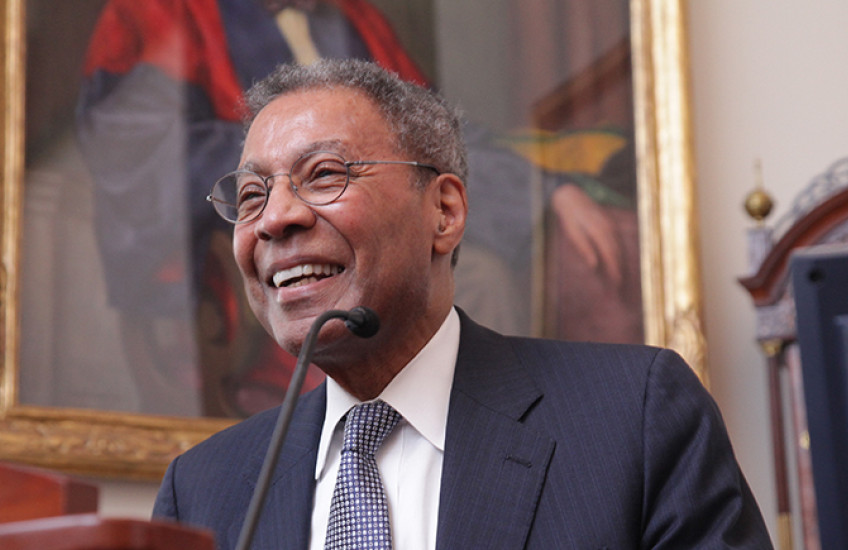
Alvin Francis Poussaint, professor of psychiatry, emeritus, at Harvard Medical School, died on Feb. 24 at age 90 after a short illness. He died peacefully at home in Chestnut Hill, Massachusetts, with his wife and family by his side.
Poussaint was a respected authority on race relations and a range of other social issues, well-known in the United States and abroad for his work to improve public understanding of Black children and families, mental health and suicide, school violence, and substance abuse. He wrote and spoke about the importance of nonviolent parenting and advocated for positive images of minorities in the media.
At HMS he worked for more than 50 years to increase diversity in medicine and reduce health disparities by bringing more members of underserved populations into the medical field.
As faculty associate dean for student affairs and as founding director of the HMS Office of Recruitment & Multicultural Affairs, Poussaint was instrumental in building diversity and inclusion at HMS and the Harvard School of Dental Medicine. From the time he joined the School in 1969 until his retirement in 2019, he recruited and mentored nearly 1,400 students of color and established supplemental educational programs to help students from underrepresented groups achieve successful careers in medicine.
“Dr. Poussaint was a legendary figure at HMS and beyond. He was an influential psychiatrist, scholar, and advocate for equitable access and opportunity,” said George Q. Daley, dean of the faculty of medicine at Harvard University. “He was a prodigious and careful thinker who married meticulous, evidence-based social science with insightful, pragmatic commentary.”
“His passing sharpens our awareness of the continued need to reduce health disparities by bringing more members of underserved populations into the medical field. May we honor his memory through our unwavering commitment to justice, equality, and health and well-being for all,” Daley added.

Poussaint formed a subcommittee at HMS in 1970 that provided pre-matriculation science courses for interested first-year students. It later became the Poussaint Pre-matriculation Summer Program.
He played a key role in minority recruitment and development programs for residents and faculty. The annual Alvin F. Poussaint, MD, Visiting Lecture, established in 2005 at HMS, features national experts speaking on topics important to advancing the health of minorities and increasing the number of health care professionals in populations underrepresented in medicine.
He also served at the HMS-affiliated Judge Baker Children’s Center, now called the Baker Center for Children and Families, from 1978 to 2010. While there, he directed the Media Center starting in 1994 and was a co-founder of the Campaign for a Commercial-Free Childhood, now known as Fairplay.
Poussaint was the author of Why Blacks Kill Blacks (1972) and co-author of Raising Black Children (1992), Lay My Burden Down (2000), and Come On, People: On the Path from Victims to Victors (2007). He reached untold numbers of people not only through his books but also by serving as a television script consultant for nationally broadcast programs, writing more than 100 articles in lay and professional publications, advising government agencies, and lecturing at colleges across the country.
“Dr. Poussaint’s life and work had an immeasurable impact on the profession and practice of medicine in this country, the social movements for civil rights and human rights, the representation of people of color within our institution and in medical education more broadly, and our collective understanding of the impact of racism on the health and lived experiences of Black Americans,” said Bernard Chang, HMS dean for medical education.
Biography
Born May 15, 1934, in East Harlem, New York, Poussaint was the seventh of eight children. He traced his desire to become a doctor in part to a bout of rheumatic fever he suffered as a child that left him hospitalized for months. Additional motivation came when his mother died of cervical cancer when he was in high school.
When Poussaint was accepted into the elite and predominantly white Stuyvesant High School, he rose to the challenges not only of rigorous academics but also of racism — dual skills that continued to serve him well while earning a bachelor’s degree from Columbia University in 1956 and an MD from Cornell University Medical College in 1960 as the only Black student in his class.
Poussaint completed a psychiatry residency at the UCLA Neuropsychiatric Institute, where he became chief resident in psychiatry. He also earned a master’s degree in psychopharmacology at UCLA.
During the height of the civil rights movement in June 1965, Poussaint moved to Jackson, Mississippi, where he served as southern field director of the Medical Committee for Human Rights. He spent two years providing medical care to civil rights workers and helping desegregate hospitals and health care facilities throughout the South.
It was in this capacity that he participated, alongside more than 100 volunteer health care workers, in the historic 54-mile march from Selma to Montgomery, risking his life in the process of coordinating and administering medical care to protestors, many of whom were attacked and beaten while marching.
He later became a founding member of Operation PUSH (People United to Serve Humanity) and served as chair of the board of directors of PUSH for Excellence.
Poussaint moved to Boston in 1967 to direct a psychiatry program in a low-income housing development through Tufts University Medical School.
Two years later, he was recruited to HMS as associate dean for student affairs and as an associate professor of psychiatry at Massachusetts General Hospital. He was later promoted to professor of psychiatry. He served as a clinician at the Massachusetts Mental Health Center and Boston Children’s Hospital.
Honors and awards
In 2014, HMS honored Poussaint with a Diversity Lifetime Achievement Award.
Poussaint’s work earned a variety of awards, including the 2010 Association of American Medical Colleges’ Herbert W. Nickens Award, which honors outstanding contributions to promoting justice in medical education and health care. He won a New England Emmy award in 1997 as co-executive producer of the television special Willoughby’s Wonders, a children’s educational show about an urban soccer team, highlighting skills of teamwork, inclusion, and cooperation.
In addition to receiving numerous honorary degrees, Poussaint was named a distinguished life fellow of the American Psychiatric Association, a fellow of the American Association for the Advancement of Science, a life member of the American Academy of Child and Adolescent Psychiatry, and a member of the American Academy of Arts and Sciences.
Legacy
Poussaint’s successor as director of the HMS Office for Recruitment and Multicultural Affairs, Andrea Reid, said, “We continue to learn from his example, especially his ability to create a safe space for students to be fully themselves, to share their concerns and needs, and to recharge for the challenges that faced them throughout medical school and beyond.”
“I, personally, benefited from his tutelage and blessing as I assumed the mantle of ORMA in 2020,” she said. “I am forever indebted to him.”
Added Chang, “Those of us who had a chance to know him personally will always remember the kind, just, and thoughtful approach he took to everything he did.”
Poussaint completed an oral history interview as part of the Francis A. Countway Library of Medicine exhibit Perspectives of Change: The story of civil rights, diversity, inclusion and access to education at HMS and HSDM. Researchers interested in accessing the interview files on-site can contact the Center for the History of Medicine at Countway Library.
Poussaint is survived by his wife of 32 years, Tina Young Poussaint, HMS professor of radiology and head of the Department of Radiology at Boston Children’s; son Alan; daughter Alison; sister Dolores Nethersole; and numerous nieces and nephews.