
Tracing the Ethical Boundaries of Medicine, Law, and Psychiatry
Student Perspective | February 17, 2026
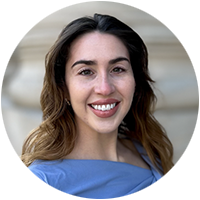
For Julia Etkin, bioethics is not a single discipline but a meeting point of symbiosis where medicine, law, psychiatry, and public policy converge to shape how human flourishing is understood. A Dean’s Scholar in the Master of Science in Bioethics program at Harvard Medical School, Etkin has used the program to build an academic path that bridges ethical theory with real-world regulatory and clinical challenges.
Etkin completed her undergraduate studies at Union College, where she graduated summa cum laude with a degree in science, medicine, and technology in culture, with minors in political science and law and humanities. As an undergraduate, she gravitated toward interdisciplinary work that allowed her to examine medicine not only as a clinical or scientific practice, but also as a social and regulatory enterprise.
After graduating in 2023, Etkin pursued postgraduate research at Yale School of Medicine, where she worked with the Yale Collaboration for Regulatory Rigor, Integrity, and Transparency. There, she focused on questions related to the U.S. Food and Drug Administration (FDA), including advisory committee transparency, accelerated pathways, pre-approval access, and the scope of regulatory authority. That experience sharpened her interest in how therapeutics move from development to approval and how ethical considerations shape those processes.
When she began the Bioethics program at Harvard, Etkin simultaneously joined the Multi-Regional Clinical Trials (MRCT) Center of Brigham and Women’s Hospital and Harvard as a Research Assistant II. At the MRCT Center, she worked on revising an ethics toolkit for clinical research protocols in low- and middle-income countries and emerging frameworks for health data. The dual roles quickly became mutually reinforcing. “My work was informing my studies, and my studies were informing my work,” she explains.
Etkin was drawn to the Master of Science in Bioethics in part because it is housed within Harvard Medical School. “I appreciated that this program has a medical grounding,” she says, noting that many bioethics programs are based primarily in law or public health schools.
Required clinical ethics coursework in the first year reinforced that orientation, while mentorship from Rebecca Weintraub Brendel, MD, JD—director of the HMS Center for Bioethics and Etkin’s capstone thesis advisor—helped her refine her interests in psychiatry and neuroethics. “She really honed in on my interest in psychiatry, too, which has always been a tangential underpinning in my work. I haven’t had the room to explore it robustly until being in the program,” Etkin explains.
That exploration is central to Etkin’s capstone project, which she describes as a culmination of her academic interests. Her research examines how Risk Evaluation and Mitigation Strategies (REMS) under the FDA might be reimagined for psychedelic-assisted therapies. Using MDMA-assisted therapy for PTSD as a paradigmatic case, she explores how regulatory frameworks shape emerging treatments that directly affect consciousness. “I’m thinking about what it means to regulate altered states of consciousness,” she says, “and what that means for health, law, and ethics.”
Etkin’s capstone work is supported by her role as the 2025–2026 recipient of the Petrie-Flom Center for Health Law Policy, Biotechnology, and Bioethics Student Fellowship at Harvard Law School. Through the fellowship, she receives cross-disciplinary mentorship from I. Glenn Cohen, JD; Susannah Baruch, JD; and Brendel, and has taken coursework at the law school, including FDA Law during the January term.
Mentorship has been a defining feature of Etkin’s experience. She meets weekly with Brendel to discuss not only research progress but also broader developments in psychiatry, health policy, and reimbursement structures for emerging therapies. “We talk about what’s happening in the world and what it means for regulation and clinical practice,” Etkin says. “I feel incredibly lucky in that relationship.”
Among her coursework, research ethics has been particularly influential. Taught by Lauren Walker, JD, from the Office of the General Counsel at Brigham and Women’s Hospital, the course strengthened Etkin’s interest in the ethical boundaries of research and state authority. She continues to draw on that foundation in both her academic writing and professional work.
While much of Etkin’s collaboration has occurred through fellowships and research centers, she values the intellectual exchange within the Bioethics classroom itself. “Everyone brings varied backgrounds and experiences,” she says. Being situated at Harvard Medical School, she adds, often brings a clinician’s perspective into ethical debates, enriching discussion and challenging assumptions.
Looking ahead, Etkin plans to pursue doctoral studies and is increasingly drawn toward psychiatry as a field that integrates her interests in phenomenology, consciousness, health law, and policy. Her work on psychedelics, she explains, has helped clarify where those threads come together, from the ethics of mental health care to the societal legacy of drug policy and disparities in psychiatric treatment.
For prospective students, Etkin’s advice is to remain open. “Go into the program with an open mind and an open heart because you never know who you’re going to connect with in class or outside of class,” she says. The interdisciplinary nature of bioethics, combined with the breadth of the Harvard community, can reshape interests in unexpected ways. “This program gave me the space to realize what I was really interested in,” she reflects, “and helped set the landscape for my career ahead.”
Written by Bailey Merlin