Romania’s Abandoned Children
Charles Nelson, Nathan Fox and Charles Zeanah
Harvard University Press
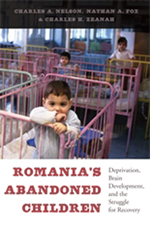 Charles Nelson, HMS professor of pediatrics, along with his colleagues Nathan Fox, professor in the department of human development at the University of Maryland and Charles Zeanah, professor of psychiatry and behavioral sciences at Tulane University, explore the neurological deprivations of institutionalized children in Romania’s Abandoned Children.
When Nicolae Ceauşescu’s communist regime fell in 1989, it left more than 170,000 children orphaned. Most of the abandoned children were raised in overcrowded orphanages and received only basic care.
A decade later Nelson, Fox and Zeanah launched the government-backed Bucharest Early Intervention Project to determine how detrimental institutional life could be for children. Romania’s Abandoned Children documents the project’s findings and the devastating effects on children who are deprived of responsive care, social interaction, stimulation and psychological comfort.
Romania’s Abandoned Children highlights the effort to help the millions of parentless children living in institutions throughout the world.
Eugene Braunwald and the Rise of Modern Medicine
Thomas Lee
Harvard University Press
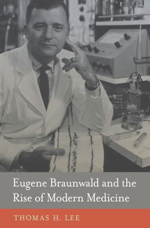 Thomas Lee, HMS professor of medicine, offers insights and firsthand experiences about Eugene Braunwald, a cardiologist whose work greatly expanded the understanding of heart disease.
Braunwald decided to pursue a career in cardiology after studying under Ludwig Eichna during his time as a medical student at New York University. From 1968 until 1972 Braunwald was the founding chair of the Department of Medicine at the University of California, San Diego. Braunwald is currently the Hersey Distinguished Professor of the Theory and Practice of Physic and Faculty Dean for Academic Programs at the Partners Healthcare System at Brigham and Women’s Hospital.
Braunwald is known for changing the culture surrounding American medicine by redirecting cardiology from passive and risk-averse observation to active intervention.
Eugene Braunwald and the Rise of Modern Medicine explores how Braunwald improved modern medicine practices as well as gives an interesting perspective about living and being a doctor in the 1930s.
Adrenaline
Brian Hoffman
Harvard University Press
 Brian Hoffman, HMS professor of medicine, examines the fascinating molecule that fuels the extremes of human experiences in Adrenaline.
Adrenaline was discovered in 1894 and is now being used in the development of powerful new drugs through hormone research. Hoffman introduces the scientists who are best recognized for their work with adrenaline, showing the crucial role that adrenaline has played in pushing modern medicine forward.
In Adrenaline, Hoffman also explores the expression “fight or flight” in response to adrenaline’s ability to cause highs of excitement, anger, and terror in the human body.
Adrenaline reveals the truth behind adrenaline’s scientific importance and importance to the medical field.
Evidence-Based Applied Sport Psychology: A Practitioner’s Manual
Roland Carlstedt
Springer Publishing Company
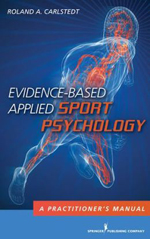 Evidence-Based Applied Sport Psychology: A Practitioner’s Manual, written by Roland Carlstedt, a HMS research associate in psychology in the Department of Psychiatry at McLean Hospital, is a resource full of integrative assessment tools and case studies that explain how to assess athletes, select interventions and assess intervention efficacy using evidence-based practices.
Carlstedt provides numerous procedures throughout the book including psycho-physiological testing, such as heart rate variability and neurocognitive testing.
Carlstedt makes the argument throughout Evidence-Based Applied Sport Psychology: A Practitioner’s Manual for the need to be open to new integrative approaches when it comes to applied practice, from the first assessment of an athlete to the final assessment and reflection of the applied interventions.
Almost Anxious: Is My (or My Loved One’s) Worry or Distress a Problem?
Luana Marques with Eric Metcalf
Harvard Health Publications
 In Almost Anxious: Is My (or my Loved One’s) Worry or Distress a Problem? Luana Marques, HMS assistant professor of psychology in the Department of Psychiatry at Massachusetts General Hospital, describes the spectrum of “almost anxiety” symptoms, from normal situational anxiety to a diagnosable anxiety disorder.
Along with help from medical writer Eric Metcalf, Marques gives guidelines to assess whether your or your loved one’s anxiety is situational or needs further attention.
Throughout the book, Marques offers strategies to change unhealthy feelings of distress. In addition, she illustrates how to gauge the physical, physiological and social impact of anxiety symptoms and helps readers determine when and how to get professional help.
Almost Depressed: Is My (or My Loved One’s) Unhappiness a Problem?
Jefferson Prince and Shelley Carson
Harvard Health Publications
 In Almost Depressed: Is My (or My Loved One’s) Unhappiness a Problem? Jefferson Prince, HMS instructor in psychiatry at Massachusetts General Hospital, and Shelley Carson, associate professor in the Department of Psychology at Harvard University, outline the symptoms of depression, the role stress plays in depression and the many physical conditions that can mimic depression.
Caron and Prince offer step-by-step guidance for making positive changes that can help to alleviate and reverse “almost depression.” They give information on how to assess whether depressed feelings are problematic and how to intervene with a struggling loved one.
The book is divided into two parts. In part I, “almost depression” is described and the authors provide examples based upon their professional experiences. In part II, the authors describe the barriers that are often faced when they are dealing with symptoms of depression and how to overcome those barriers.