“I’m not a real health care economist, I just play one on the op-ed page.”
These were the self-deprecating opening words of Nobel laureate Paul Krugman, the Princeton economist just as renowned for his twice-weekly New York Times column as for his analyses of trade patterns (work that earned him the Stockholm prize).
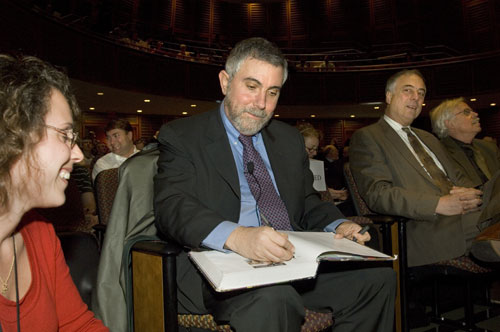
Krugman spoke at HMS on March 10 for the George W. Gay Lecture series, a program the School has been hosting since 1922. The title of his talk was “Whither Health Care?” and the solution he proposed was surprisingly mid-spectrum for such a self-described “left wing” theorist.
For Krugman, this is the perfect time for health care reform, simply because things have gotten so bad. In fact, he believes that one of the reasons reform stalled in Clinton’s first term was that things were simply not bad enough. Now, however, we have reached a moment when our situation has spiraled so far out of control that change is inevitable.
But Krugman’s proposed solution will please no one on the far sides of the Congressional aisle. While he claims that the government needs to guarantee coverage for all, he also is convinced that a single-payer system is politically untenable. Rather, he proposes a system that aims to bridge the gaps, a system that allows people to keep insurance they are satisfied with, but one in which the government cooperates with insurance companies by creating a public insurance pool not unlike Medicare.
Victims of Our Own SuccessWhen bemoaning the escalating costs of healthcare—a trajectory that cannot be sustained—there is no shortage of blame. Thought leaders and politicians have pointed fingers at things like lawyers’ fees and superfluous office visits. But the real cause, according to Krugman, is medical progress. Our proficiency with coronary procedures, joint replacements and even certain cancer treatments has driven costs so high that insurance is pricing people out of the system. The rise in progress leads to fewer people getting it, or rather, to emphasize the dark irony, “Medical progress kills people.”
The employer-based system is falling apart, the HMO experiment solved nothing, and when coverage data for 2009 finally comes in, the numbers will be ghastly.
Like many liberal-minded thinkers on the subject, Krugman personally favors a single-payer system. It would be the most efficient and effective. But even though we already have such a system on a smaller scale in Medicare, a large all-encompassing single-payer approach is politically infeasible. And for those who want change now, compromise is essential. “If you wait for consensus to go the right way,” he said, “you may have to wait a generation.”
Messy But TimelyKrugman recommends the strategy of UC-Berkeley economist Jacob Hacker, who outlined his approach to the Economic Policy Institute in a report titled, “Health Care for America.”
Such an approach requires companies to provide insurance to all employees and also mandates that everyone subscribe. Subsidies are also provided for low-income people, and a public plan is available to all who fall through the cracks. Such a plan builds around the weaknesses in our current system, but also includes the insurance companies. As Krugman pointed out only half-jokingly, it “buys them off.”
This proposed solution is clearly inferior to a single-payer approach. For one thing, Krugman said, the government will have to monitor insurance companies to ensure compliance.
As for cost, Krugman argued that universal health care is cheaper than our current system. Generally, the uninsured are relatively young, while the elderly are already on Medicare. In addition, insurance companies spend a lot of resources figuring out who needs healthcare the most so that they can keep them off it. In other words, it costs a lot to keep people uninsured.
Will we eventually be able to create this kind of messy system that covers everyone? Said Krugman, we’ll probably find out in the next six months.