I pulled back the curtain to reveal my patient, dying quietly on a gurney.
 Death had stalked him. Almost a year earlier, as his wife was dying of metastatic cancer, he himself began to develop symptoms that could not be ignored: night sweats, malaise, fevers. As his wife’s primary caregiver, he stayed with her to the end. And despite attempts to properly evaluate his new symptoms, he missed most of his own medical visits, the short time with his wife too precious.
Days after his wife’s death, he came to the clinic and was admitted quickly for dehydration and expedited evaluation. In such situations, I have learned to hope for infection as the cause; the alternative almost always is cancer. The diagnosis was grim: Stage IV Hodgkin’s lymphoma. Over the next year, he went from one chemotherapy regimen to the next, each failing to slow the progression of disease. Most days he was hopeful, and sometimes his optimism troubled me. How could he feel so well when the PET scans clearly indicated he was losing this battle?
By the time he had reached the final chemotherapeutic option—at this stage his treatment could be considered “extreme salvage”—the reality of his imminent death had begun to set in. Clearly, if this treatment failed him, and odds were it would, we had nothing more to offer.
Nothing more to offer. To this nascent clinician, the concept seemed foreign. Even in the age of antibiotic resistance, we can almost always do something, irrespective of the diminishing returns.
The patient’s health declined rapidly, and symptom management, or palliation, became the goal of his care. A few days before his final admission, he had sounded upbeat as he described a steak meal, a stark contrast to how we found him, awaiting admission for end-of-life care.
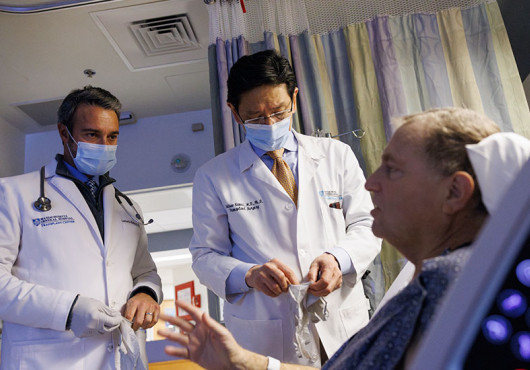
On the gurney, he was groggy, a side effect of medications to ease his pain and nausea. His face was gaunt. He looked feeble, a shadow of the stocky, healthy man he had been so recently. At first, he did not appear to recognize us, and I feared that I would not get a chance to say goodbye, or that he would be too confused or withdrawn to comprehend. My mentor, who had known the patient and his wife for the better part of a decade, held his hand and spoke to him, asking gently: Was he in pain? Did his family understand the extent of his illness? Did he need to speak with anyone? Was he at peace?
I wanted to say more to him, but in the moment it was all I could do not to cry. Cry for my patient—the stoic, the optimist, the young widower who only a year earlier had lost his closest love. But cry also for myself, for my helplessness to stop a process that was moving forward, over which I had no control.
And so I cried.
He was admitted to the hospital. For months he had delayed assigning a health care proxy, but I watched again as my mentor kindly persuaded him. His code status was also established, and he transitioned to comfort care.
A few days later, he transferred to a hospice close to home, and a week to the day after his admission, as he lay peacefully with his family by his side, death drew closed its curtain.
Erica Seiguer Shenoy, MD–PhD ’07, is a fellow in infectious disease at Massachusetts General Hospital and Brigham and Women’s Hospital.