At a glance
Harvard Medical School’s commitment to leadership in nutrition education began in 1942 with the founding of the first department of nutrition at any school of medicine or public health worldwide.
HMS has been reinvigorating the teaching of nutrition in its MD programs since 2019.
School faculty recently co-developed national recommendations for nutrition competencies for medical school graduates.
Nutrition education — including NIH-supported training grants — is available at HMS for MD, PhD, and master’s students; postdoctoral researchers; health professionals; and members of the public.
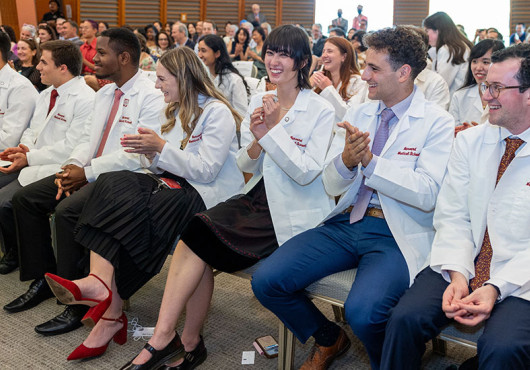
The aroma of Indian spices wafted from the industrial kitchen into the seating area of the Elements Café in Harvard Medical School’s Veritas Science Center, where MD students had prepared a four-course, heart-healthy meal featuring fresh vegetables, legumes, and brown rice.
Part of an eight-week Culinary Medicine and Nutrition course, the Feb. 10 evening class guided students to assimilate assigned readings on hypertension research; learn about dietary approaches to lowering blood pressure and cholesterol; and discuss how they could use their new knowledge to better counsel and treat patients with diet-related conditions.
By integrating different medical topics — such as diabetes or older adulthood — with education about what healthy and unhealthy ingredients look like for each case, while providing hands-on practice in basic culinary skills, the elective course helps equip these future doctors to support their patients’ and their own health through nutrition.
Julie Chung, a fourth-year MD student in the School’s Pathways program and one of the evening’s chefs, said the work will help her meet the needs of people like the primary care and outpatient cardiology patients who have asked her how to lower their blood sugar and blood pressure.
“This course gives us a chance to dive into both the scientific literature and actual cooking practices, which will help us make informed recommendations to these types of patients about foods that they will realistically enjoy [while meeting their health needs],” she said.
Chung and her classmates are benefiting from just one of the many touchpoints where HMS teaches nutrition in its MD curriculum and beyond.
Why it’s essential to teach nutrition in medical school
Understanding and promoting good nutrition is an essential skill for clinicians to maximize patient health and treat and prevent diet-sensitive diseases, such as type 2 diabetes, cardiovascular disease, stroke, and some forms of cancer. The importance of nutrition in medical education and health care is becoming increasingly apparent as studies show that certain foods that are ultra-processed, contain added sugars, and lack nutrients directly contribute to disability and premature death.
“Good nutrition and healthy lifestyle habits are a cornerstone for managing pretty much every medical condition,” said Eliza Leone, one of the Culinary Medicine and Nutrition instructors and a registered dietitian.


The U.S. government concurs. In 2022, the House of Representatives passed a resolution for medical schools to provide more meaningful nutrition training, and in 2025, the Department of Health and Human Services pushed for reforms in nutrition education.
HMS has been a longtime champion of nutrition education. Dean for Medical Education Bernard Chang says the School remains committed to its own ongoing review, revision, and improvement of educational programming in nutrition and other important areas.
For example, in 2019, the MD program responded to calls from students and faculty to reevaluate how, when, and where it delivers nutrition education. The result was the nutrition and lifestyle curriculum theme, which Marie-France Hivert, HMS professor of population medicine at Harvard Pilgrim Healthcare, was tapped to direct. The goal is for HMS-educated doctors to have the nutritional knowledge and skills to guide their patients in developing diets and lifestyles that promote longer, healthier lives.
Learners at the School also study and work with international experts in nutrition research and policy, including Harvard faculty members who edit the American Journal of Clinical Nutrition, the field’s top peer-reviewed science journal.
Harvard has also taken a national leadership role in developing standards for nutrition education in medical schools. Faculty from HMS, the Harvard T.H. Chan School of Public Health, and Harvard Law School joined medical educators, physicians, residency directors, dietitians, and nutrition scientists from nearly three dozen institutions across the United States and abroad to publish recommendations in JAMA Network Open on Sept. 30, 2024.
The authors proposed that medical school graduates should be proficient in 36 nutritional competencies that range from being able to provide patients with evidence-based nutrition information to communicating with them in a compassionate and nonjudgmental way. They advocated for the inclusion of these competencies in licensure and certification examinations for physicians and are advocating to strengthen nutrition assessment in the U.S. Medical Licensing Step 1 Exam, as seen in this September 2025 commentary co-authored by Stephen Devries, adjunct associate professor of nutrition at the Harvard Chan School, and HMS MD-PhD student John “Jack” Kincaid.
Plans are already underway to incorporate the competencies into HMS MD programs.
Reinvigorating a legacy in nutrition education
Recognition of the connection between nutrition and health, sometimes called “food is medicine,” hasn’t always been reflected in medical school curricula, including at times, at HMS.
“Diet and exercise play a much larger role in improving people’s health than one might think, based on what has customarily been taught in medical school in the recent past,” said Chang.
HMS has a deep legacy as a standard-bearer in nutrition instruction in medical education. In 1942, the first department of nutrition at any medical or public health school worldwide was established at Harvard. A joint endeavor between HMS and what is now the Harvard Chan School, it grew to become one of the largest departments at the University.
But throughout the 20th century, the emphasis on research and instruction in nutrition at U.S. medical schools surged and waned episodically. During a resurgence in the mid-1990s, the HMS Division of Nutrition was established to connect more than 100 faculty who had significant clinical and research interests in nutrition. The division continues to coordinate research, education, and clinical care across HMS, its affiliated teaching hospitals, and the Harvard Chan School.

By 2007, HMS initiated curricular reform to bring students to the clinic earlier. Several required courses were shortened, consolidated, or made longitudinal, and the equivalent of seven days of nutrition instruction was reduced to three. In 2015, nutrition was shifted from a standalone requirement to discrete content integrated throughout the curriculum.
“Teaching basic principles of nutrition and other lifestyle factors were squeezed into other courses to make room for ever-increasing amounts of information, such as new medications and technologies, novel approaches to patient care, and the advent of fields such as genomics or AI in medicine,” said Helen Delichatsios, faculty lead for the Culinary Medicine and Nutrition course and HMS assistant professor of medicine at Massachusetts General Hospital.
Stepping up nutrition instruction in the MD program
Since then, HMS medical education leaders — with input from students — have been refining classroom instruction in the basic and medical science of nutrition and enhancing clinical experiences with the application of that knowledge.
Changes and additions include:
- An elective offered since the early 1990s was revised as Nutrition Across the Lifespan.
- In 2018, the Metabolism, Nutrition, and Lifestyle Medicine advanced integrated science course launched. Students deepen their knowledge of nutrition science in the classroom, develop critical thinking towards scientific evidence, and practice presenting to their peers, in addition to seeing in the clinic how dietitians contribute to patient care teams and how physicians integrate nutrition and lifestyle counseling in their practices.
- In 2022, first-year MD students began receiving quick-reference information sheets with healthy eating and food resources to use when they meet with patients.
- The Culinary Medicine and Nutrition elective, launched in 2024 and supported by philanthropy, is geared towards medical students and has a few spots open for cross registrations from other Harvard schools.
- A required course in clinical nutrition science and its application to patient care — developed by the nonprofit Gaples Institute, of which Devries is executive director — was added to the curriculum of MD students in the Pathways and Harvard-MIT Health Sciences and Technology (HST) tracks. Devries and his colleagues published a study of educational outcomes for HST students Jan. 10 in the American Journal of Medicine.
- Numerous electives are sponsored by the Division of Nutrition and HMS-affiliated hospitals.
Each course underscores the value of physicians teaming up with allied health professionals, such as dietitians and others, who are subject-matter experts and can work more intensively with patients on developing and maintaining healthy lifestyles.
Students have also formed nutrition and lifestyle medicine interest groups, said Christopher Duggan, director of the Division of Nutrition and the HMS Samuel J. Meltzer, MD Professor of Pediatrics in the Field of Gastroenterology at Boston Children’s Hospital.
The School continues to build on its efforts to ensure that nutrition is a rich and dynamic part of every core course for MD students, said Hivert.
“A lot of material is already being taught,” she said, adding that the strategy is being revised to provide more cohesion from course to course.
Chang said that his team is continuing to enhance the curriculum in 2026.
By later this spring, competencies based on the recommendations outlined in JAMA Network Open are expected to be approved. This will inform the plan for integration throughout all four years of required courses and clinical experiences in the School’s MD programs, and in particular, will allow for more robust assessment of students’ knowledge and skills in this area.
Training in nutrition for graduate students and beyond
MD programs are not the only places at HMS emphasizing nutrition education.
Master’s and PhD students, postdoctoral researchers, practicing health professionals, and even members of the public can access a variety of resources and enroll in nutrition-focused courses.
For continuing learners, the following non-degree programs are available:
- In 2020, the Division of Nutrition expanded its programming for health professionals via clinical and research training in nutrition, including an annual symposium, monthly seminars, elective courses, research support at Mass General’s Boston Area Nutrition Obesity Research Center, and continued collaboration with the Harvard Chan School.
- The continuing education course Lifestyle Medicine: Tools for Promoting Healthy Change, developed and offered by Spaulding Rehabilitation Hospital and the Institute of Lifestyle Medicine and accredited by HMS, is for physicians, nurses, dietitians, psychologists, pharmacists, and others.
- The HMS Executive Education courses Nutrition and Wellness Coaching and Health and Wellness: Designing a Sustainable Nutrition Plan are designed for clinical care providers as well as health and wellness professionals.
For master’s and PhD students and postdoctoral fellows:
- Eating Well for the Busy Student is a new workshop that helps educate and encourage master’s students to cultivate and enjoy healthy eating. As in the culinary medicine course, students practice meal planning and preparation using affordable, readily available ingredients.
- The Food Ethics elective is available to students in the HMS master’s in bioethics program.
- Doctoral and postdoctoral students have the opportunity to participate in nutritional science research through a longstanding T32 training grant awarded by the National Institutes of Health to Harvard under Duggan and co-principal investigator Frank Hu, chair of the Harvard Chan School Department of Nutrition.
Additional options:
- HMS students can take classes that focus on nutrition and diet across the University and pursue additional degrees such as the master of public health in nutrition offered through the Harvard Chan School.
- Harvard Health Online Learning coordinates resources for the general public from nutrition experts, such as the courses Six-Week Plan for Healthy Eating and Lose Weight and Keep It Off.
- Millions of people have accessed free, scientifically backed information about diet, nutrition, and healthy lifestyles offered by Harvard Health Publishing.
Putting nutrition into practice
Back in the Elements Café, first-year Pathways MD student Aravind Viswanathan and his classmates savored the meal they cooked at the classroom-cum-dinner table.
“Having firsthand experience actually cooking food that tasted very good but was low in sodium, easy to make, and low cost but would also have a pretty big impact on health will definitely allow us to help patients with hypertension,” he said.
By strengthening nutrition education across the board, HMS is ensuring that graduates and other learners are well-versed in the science of nutrition and the role nutrients play in nourishing and repairing the body; practiced in guiding the treatment and prevention of diet-related diseases; and familiar with the public health implications of such work.
This ongoing effort illustrates how — through continuous self-evaluation, improvement, and collaboration — the HMS community fulfills its purpose of improving health and well-being for all.
Images: Gretchen Ertl