A renovated laboratory at HMS, headed by assistant professor of systems biology Angela DePace, has made Harvard history by becoming the University’s first wet lab to receive LEED certification from the U.S. Green Building Council. To merit LEED (Leadership in Energy and Environmental Design) certification, a building or facility must be designed to maximize energy savings, water efficiency, CO2 emissions reduction, improved indoor environmental quality, and stewardship of resources and sensitivity to their impacts. The lab’s makeover will help HMS do its part to meet the University’s goal of reducing greenhouse gas emissions to 30 percent below 2006 levels by 2016. In addition, the renovations provide a healthier work environment for the lab’s occupants.
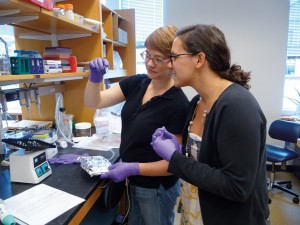
The green renovations represent a collaboration between DePace, who studies the evolution of gene regulation in early development, the HMS facilities team and Harvard University Green Building Services. The improvements include paints and finishes that emit a low level of volatile organic compounds (VOCs), energy-efficient appliances and equipment, and lighting system controls.
One of the most remarkable things about the renovation, said DePace, is that it does not look remarkable. “It looks like a regular lab.” Many supplies and furnishings were recycled from old labs, including the bench tops, fume hoods and sinks. DePace, who has a background in art and design and played an active role in the renovations, helped craft a strategic use of space that minimized demolition and waste. She also took advantage of the ample amount of natural light that comes into the lab, making sure that all the desks are near windows so lab members rarely have to turn on lights.
The greening of the lab has continued long after the construction crews left. DePace emphasizes sustainable practices in the lab whenever possible, such as using non-disposable supplies like reusable pipette tip storage boxes.