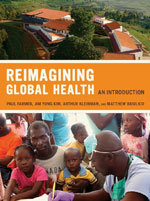
 Reimagining Global Health
Paul Farmer, Jim Yong Kim, Arthur Kleinman and Matthew Basilico
University of California Press
Reimagining Global Health brings together the experience, perspective and expertise of Paul Farmer, HMS chair of the Department of Global Health and Social Medicine and co-founder of Partners In Health, Jim Yong Kim, co-founder of Partners In Health and president of the World Bank Group, and Arthur Kleinman, HMS professor of medical anthropology in the Department of Global Health and Social Medicine and HMS professor of psychiatry at Cambridge Health Alliance, to provide an introduction to the field of global health.
The book is drawn from a course developed by a HMS student Matthew Basilico and provides framework for the study of global health. The authors emphasize their feelings on the importance of a transdisciplinary approach while also offering several historical and ethnographic perspectives of contemporary global health problems.
Reimagining Global Health presents case studies throughout the book that bring together ethnographic, theoretical and historical perspectives into a new investigation of global health. The authors believe the interdisciplinary approach outlined in the book can also be useful in undergraduate and graduate classes in anthropology, sociology, political economy and history, not only in the schools of public health, nursing and medicine.
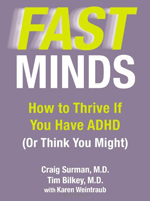 FAST MINDS: How to Thrive If You Have ADHD (or Think You Might)
Craig Surman and Tim Bilkey with Karen Weintraub
The Berkley Publishing Group
Millions of adults have unrecognized attention deficit hyperactivity disorder (ADHD) and they are often under-treated and under-supported. Craig Surman, HMS assistant professor of psychiatry, and Tim Bilkey, a psychiatrist specializing in the assessment and treatment of adult ADHD, wrote FAST MINDS: How to Thrive If You Have ADHD (or Think You Might) to help those with the disorder to better understand their struggles and challenges and better manage their lives.
Surman, also the scientific coordinator for the Adult ADHD Research Program at Massachusetts General Hospital, and Bilkey partnered with freelance health and science journalist Karen Weintraub to create FAST MINDS, an acronym that describes the most common characteristics of ADHD: forgetful; achieving below potential; stuck in a rut; time challenged; motivationally challenged; impulsive; novelty seeking; distractible; and scattered. FAST MINDS includes stories from people who have used the methods outlined in the book to adapt to life with ADHD or its most prominent traits. It also includes interactive pages with checklists and space to fill in personal data or observations.
The book is divided into three parts. The first section identifies how biologically based ADHD traits may be the source of life challenges, the second section helps those with ADHD to form new habits and remain on the self-improvement path, and the final section offers guidance on how to find and make the most of helpful resources.
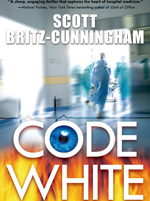 Code White
Scott Britz-Cunningham
Forge Books
Code White, by Scott Britz-Cunningham, instructor in radiology at Brigham and Women’s Hospital, is a fictional medical thriller about a young neurosurgeon named Ali O’Day.
O’Day, is performing a revolutionary new surgery to restore a blind boy’s sight on live television. As she works to implant a microcomputer to replace certain neurological functions in the boy’s brain, O’Day is interrupted by a “code white” alert: A bomb has been found in the medical center.
Britz-Cunningham uses his scientific background and knowledge to explain many concepts and procedures in the book, with many scenes taking place in the operating room. He balances his expert medical background with suspenseful entertainment in a way that is understandable and engaging to readers—both medical professionals and lay readers alike.
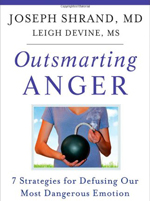
Outsmarting Anger: 7 Strategies for Defusing Our Most Dangerous Emotion
Joseph Shrand and Leigh Devine
Jossey-Bass
Anger, a basic human emotion, is often considered the most dangerous. How can we control our anger as well as the anger of those around us?
Joseph Shrand, HMS instructor of psychiatry, the Medical Director of Clean and Sober Teens Living Empowered and author of Outsmarting Anger: 7 Strategies for Defusing Our Most Dangerous Emotion, explains how to recognize the many forms of anger and how to defuse it.
In Outsmarting Anger, Shrand, along with medical writer Leigh Devine, offers a seven-step method to help turn anger impulses into success-oriented actions. The book is based on neuroscience and psychological studies as well as years of observations and research. It suggests that everyone has the ability to “outsmart anger” by using these techniques and tapping into the prefrontal cortex, the brain’s “anger absorption zone,” and using it to keep calm in situations that cause anger. Shrand also explores how to harness the anger of others, and neutralize it.
 The Harvard Medical School Guide to Tai Chi: 12 Weeks to a Healthy Body, Strong Heart & Sharp Mind
Peter Wayne with Mark Fuerst
Shambhala Publications, Inc., in conjunction with Harvard Health Publications
The Chinese art of Tai Chi has been around for centuries, and now there is evidence that Tai Chi can lessen the effects of diseases such as arthritis, osteoporosis and heart failure. Daily practice may lead to more vigor, energy, greater flexibility, balance and mobility.
Peter Wayne, HMS assistant professor of medicine, director of research for the Osher Center for Integrative Medicine at Brigham and Women’s Hospital and HMS, wrote The Harvard Medical School Guide to Tai Chi: 12 Weeks to a Healthy Body, Strong Heart & Sharp Mind, with health and medical writer Mark Fuerst. The book teaches how to incorporate Tai Chi into a daily routine.
Wayne, an internationally recognized teacher of Tai Chi and Oigong, presents a program based on research that Tai Chi can benefit the heart, bones, nerves and muscles, immune system and brain. Wayne writes that the practice is beneficial for all ages and can be completed in just a few minutes per day.
The book is divided into three parts. Part I explains Tai Chi and its essential elements. Part II includes scientific proof to support the benefits of Tai Chi. Part III outlines how to integrate Tai Chi into everyday life. The book also includes images to illustrate some of the movements and techniques.