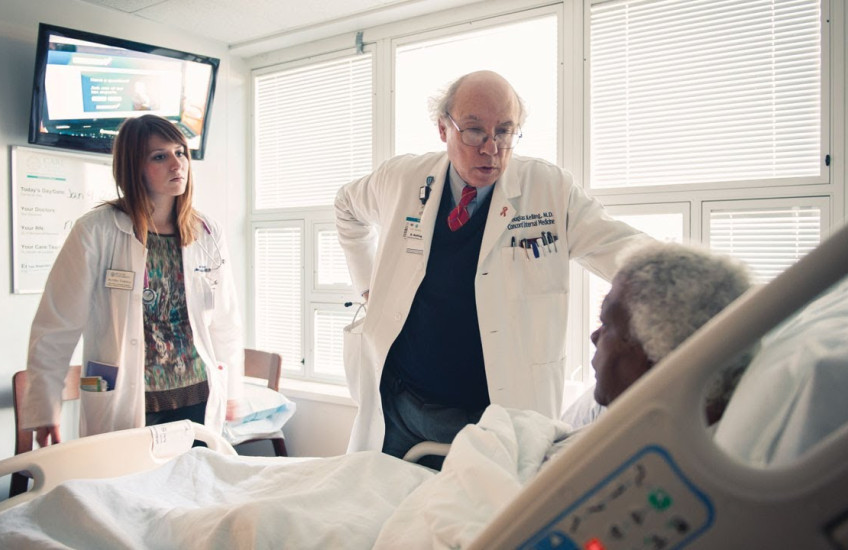
Annie Brewster, instructor in medicine at Massachusetts General Hospital, authored this post about the Healthy Story Collaborative, Inc., a nonprofit dedicated to harnessing the healing power of stories through collecting, honoring and sharing these narratives. Last week, the nonprofit launched a new program called Health Story Collaborative and Healing Story Sessions, which are live gatherings where patients share their narratives.
Doctors, researchers and drug companies are coming up with simple designs to address a complex ethical dilemma: how to make sure people with intellectual disabilities consent to join a drug trial. Brian Skotko, assistant professor of pediatrics at Massachusetts General Hospital, is quoted.
It may be getting harder for women to know exactly what they should and shouldn’t be doing when it comes to breast cancer screening with mammograms. Daniel Kopans, professor of radiology at Massachusetts General Hospital, is quoted.
An immune therapy approach that was on the fringes of cancer therapy is suddenly the hottest trend in cancer drug development. Research by Arlene Sharpe, the George Fabyan Professor of Comparative Pathology at HMS; Keith Flaherty, associate professor of medicine at Massachusetts General Hospital; and F. Stephen Hodi and Gordon Freeman, both associate professors of medicine at the Dana-Farber Cancer Institute; is cited.
A new exhibit at Harvard called “Body of Knowledge,” opened last week and runs through December 5. The Warren Anatomical Museum at HMS contributed many of the objects to the exhibit. David Jones, the A. Bernard Ackerman Professor of the Culture of Medicine at HMS, and Dominic Hall, curator of the Warren Anatomical Museum, are quoted.
Daniel Irimia, assistant professor of surgery at Massachusetts General Hospital, is building a microscopic racetrack for cells’ competition this spring.
Suicide is the third leading cause of death among teens 15 to 19 years old, according to the National Centers for Disease Control and Prevention. Timothy Wilens, associate professor of psychiatry, and Mai Uchida, instructor in psychiatry, both of Massachusetts General Hospital, are quoted.
Jack Belliveau, associate professor of radiology at Massachusetts General Hospital, whose quest to capture the quicksilver flare of thought inside a living brain led to the first magnetic resonance image of human brain function, died on Feb. 14 in San Mateo, Calif. He was 55.
The world’s first blood test to predict Alzheimer’s disease before symptoms occur has been developed. The test identifies 10 chemicals in the blood associated with the disease two to three years before symptoms start, but it might be able to predict Alzheimer’s decades earlier. Tracy Young-Pearse, assistant professor of = neurology at Brigham and Women’s Hospital, is quoted.