“I’m not feeling well. Can you hold my hand? You’re my husband,” moaned the patient lying on the table in the exam room.
“We’re going to take care of you. We have some great help here,” said Boston Mayor Thomas Menino, gamely falling into his role as the patient’s spouse.
The “patient,” a robot mannequin wired for sound, was Joanna, 53. She had arrived at the “ER”—a simulated classroom at the Tosteson Medical Education Center at Harvard Medical School—experiencing severe abdominal pain.
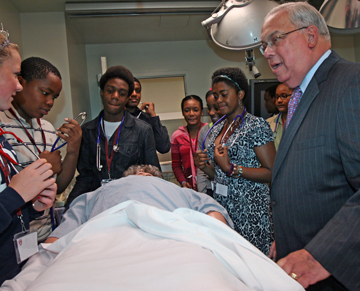
“Feel my belly,” she moaned,” as 12 teenagers from the HMS MEDscience Curriculum for High School Students filed into the room. Their task: to determine what was ailing their patient, utilizing the human biology lessons they learned in classes this week.
Armed with stethoscopes and several days of intensive training, the students began to pepper Joanna with questions as Menino looked on.
“Are you allergic to anything?”
“Are you on any medications?”
“What have you had to eat today?”
Joanna told them her stomach “started killing me” after a big breakfast of pancakes, toast and hash browns. The students ordered blood tests and X-rays. They learned that Joanna’s family had a history of heart attacks.
“Her oxygen level is low and she has a very high heart rate,” one student determined, while another deduced that there was no internal bleeding because her blood pressure was normal.
Systematically, the class arrived at the conclusion that Joanna’s gall bladder was full of bile and stones. It was going to have to be removed.
“Congratulations, doctors. You’ve saved another patient,” said Julie Joyal, RN, the program director and lead instructor on the lesson (who also provided the “voice” for Joanna.)
Menino was particularly impressed, telling the students he’s had his own difficult experiences with kidney stones.
“Oh, let me tell you, it’s one of the most painful things you’d ever go through,” Menino told the class, praising their efforts.
“You asked good questions and the conclusions you came up with were pretty good,” he said.
Increasing the students’ ability to display critical thinking skills and problem solving behaviors is one of the many goals of the program, which is designed to teach high school students about physiology and science in a nontraditional way.
“It’s an opportunity for them to be immersed in the science of medicine,” said Nancy Oriol, HMS Dean for Students and co-executive director of the program. “They really take care of a ‘patient’ in the way no high school student can.”
“The knowledge they gain just becomes sticky, because they are so engaged in the process,” Oriol said, adding that the effort to provide naturalistic, informal learning experiences has produced impressive results.
“These students come in with no knowledge of even what the vital signs are,” said Joyal, a director of the HMS program, which is in its fourth year in several Boston-area school districts.
They leave, Joyal said, with a broader understanding of medicine, physics and science, and perhaps, program directors hope, a desire to enter the field of medicine.
“We’ve made an impact on 450 students at this point,” Joyal said, adding that the program has been offered at Madison Park High School for the past three years.
“We’re codifying our curriculum and we’d like to make this available to more Boston schools, she said, explaining that Menino has expressed a desire to make Madison Park High, one of the city’s lowest performing schools, into a world-class program. “We hope to be part of that vision” said Joyal.
The course is designed to increase interest in Science, Technology, Engineering and Math – STEM subjects – by combining classroom learning with timely, real-life applications.
“When I first came, I didn’t know how to check blood pressure, and now I can do that,” said Xenia Darfah, a Boston student.
The class has brought science to life in a way that some students said they have never experienced.
“They’re teaching health literacy,” said Alvin Poussaint, HMS professor of psychiatry, who was on hand during the lesson to observe how the students performed.
“I think it makes it more real. It makes it more engaging, because you’re in a smaller environment,” said student Makeda Daniel.
“It’s hands-on, and you can look at how it is in real life. It’s easier to learn because you can see it,” said Selena Fonseca, of Boston.
Jamar Joseph, 18, took the class a few years ago and is now planning on a medical career in orthopedics or dermatology. He will enter Fitchburg State College in the fall.
“It actually steered me in the direction and helped my understanding of why I wanted to be a doctor,” Joseph said.
Most of the students in the summer class said they too are interested in medicine. Menino encouraged them to take advantage of every opportunity to pursue their goals.
“It’s a growing industry in Boston,” Menino said.