As a tropical storm bore down on Haiti in November 2010, relief agencies and government officials braced for flooding and the spread of a recent cholera outbreak. Given the desperate poverty, ongoing earthquake recovery efforts and the scarcity of health care providers, many wondered what could be done to contain the epidemic.
To help decision makers around the globe arrive at solutions to public health challenges such as those in Haiti, the Harvard School of Public Health recently unveiled an innovative new resource: The Forum at HSPH. By convening experts from the School and elsewhere, and by harnessing state-ofthe- art communications technologies, the Forum will serve as a platform for sharing ideas and recommendations grounded in research with local and national leaders who are in positions to implement public policies for change.
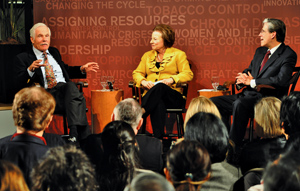
At the Forum’s official ceremonial launch on Dec. 9, 2010, philanthropist Ted Turner, founder of CNN and the UN Foundation, spoke with HSPH Dean Julio Frenk about strategies for putting global health goals into action. Their conversation— streamed live online to computers, smart phones and iPads—attracted viewers from 43 countries as diverse as Norway, India, Japan, Kenya and Brazil. When it comes to improving the health of people around the world, Frenk said, “Knowledge is the most powerful tool we have.”
The Forum at HSPH is just one facet of Frenk’s master plan to close the gap between the world’s generators and implementers of knowledge. Come March, when it will be running at full throttle, the Forum will host two interactive events each month. Along with addressing emergencies during roundtables and panel discussions, experts will analyze scientific controversies and spark debate on issues such as the paradox of co-existing malnutrition and obesity, or mammography practices and guidelines in the United States and developing nations.
The Forum’s 21st-century technology is housed in a 40-seat production studio outfitted with four remote-controlled cameras, stage lighting, overhead full-room audio and a 103-inch plasma screen, which carries images of data and of participants at remote locations. The facility can be used to stage video conferences that connect people at nearly 50 locations. Other capabilities include interactive webcasting and direct video feeds to network television stations for on-the-spot interviews and post-production editing. Press a button for “town hall,” “small panel” or “one-on-one interview,” and lighting and camera angles change to accommodate the presentation format.
“A Swiss army knife of communications outreach” is how Robin Herman, the Forum’s director and HSPH’s assistant dean for research communications, described this array of digital communications tools.
Although events are transmitted live, “That’s not how much of our target audience—decision makers—will experience the Forum,” Herman said. “Most are too busy to time their day to watch an hour-long discussion, let alone time differences across the globe.” It is in post-production, she said, that “we can really add value, enabling easy access to the information.”
On the Forum website at ForumHSPH.org, for example, users will find options for screening ondemand recorded discussions in order to access key segments quickly.
The Forum was launched by the School’s new Division of Policy Translation and Leadership Development, led by Robert Blendon, senior associate dean and professor of health policy and political analysis. The division brings under one umbrella three programs designed for public health and government leaders: the Center for Health Communication, the Center for Continuing Professional Education and the National Preparedness Leadership Initiative. As of September, the division will also host a new senior fellowship program, inviting high-level health leaders to spend six months at the School.
“We are promoting exchanges,” said Blendon. “When government officials and health care leaders come here for training, they let our faculty and students know what their pressing needs are. Now we have the capacity to share our science-based advice globally.”
Blendon has deep expertise in political analysis as well as in designing and conducting public opinion polls that illuminate issues in public health and health care delivery. The Forum “provides leaders with another tool for making decisions,” Blendon said. “It’s information in a form you can use, at a time when you need it.”
Timing is everything, Herman emphasized. One year ago, few cared about the health effects of oil spills. But after the Gulf spill in April 2010, she said, “Decisions had to be made quickly, and people were willing to listen.”