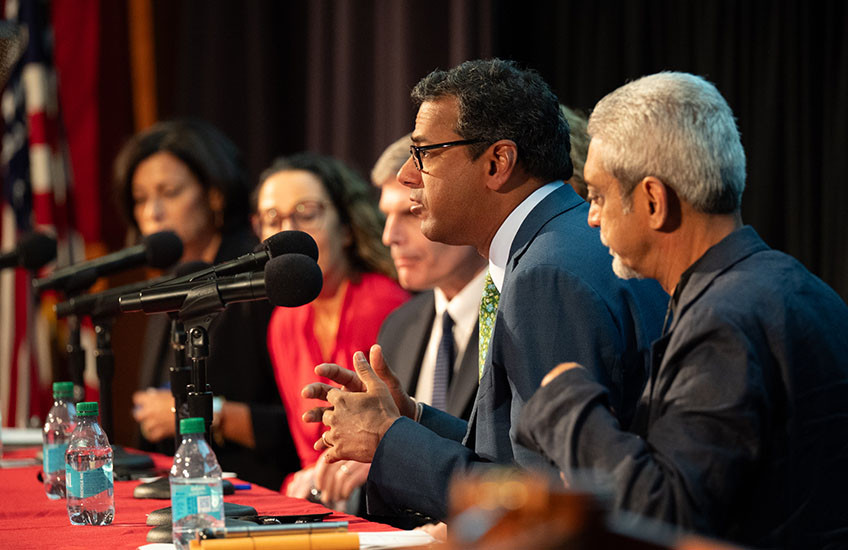
Amid rapid changes that are causing an upheaval in global health, Harvard Medical School community members gathered to revisit fundamental questions:
Why is investing in global health important?
What role should Harvard University and HMS play in shaping the future of this effort to improve health for all people?
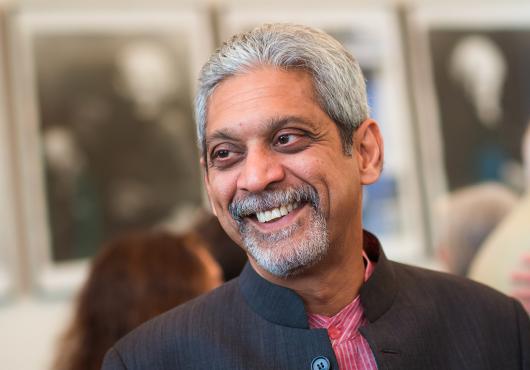
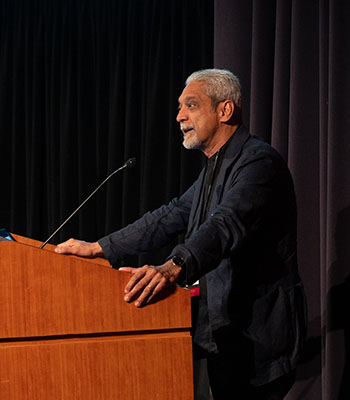
“The world is changing before our eyes, and the field of global health is also, therefore, at a historic inflection point where we need to reimagine what the goals of the field might be, and very importantly for all of us as members of this community, what our particular role will be in that new world,” said Vikram Patel, the Paul Farmer Professor and Chair of Global Health and Social Medicine in the Blavatnik Institute at HMS.
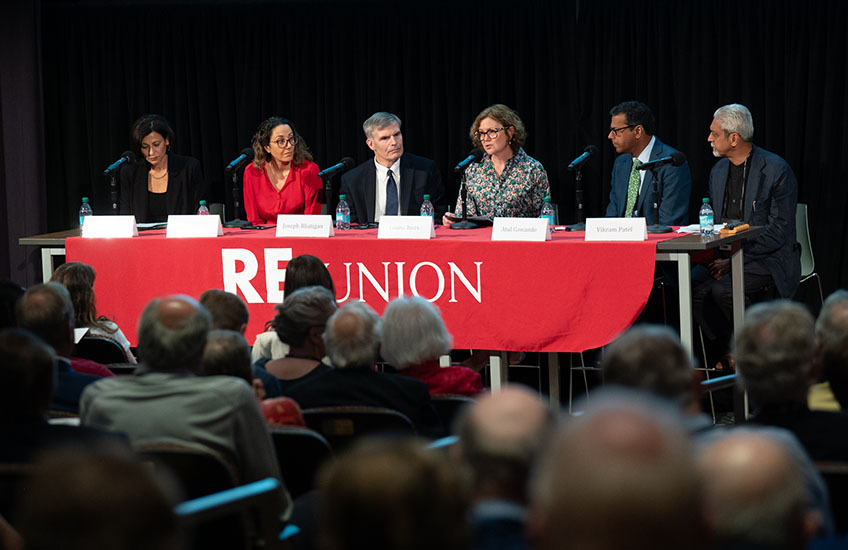
Patel spoke as moderator of “Reimagining Global Health,” a panel discussion held June 5 in the Joseph B. Martin Conference Center on the HMS campus as part of Alumni Day 2026.
The panel featured five prominent Harvard alumni faculty members, including surgeon and author Atul Gawande, former assistant administrator for global health at the U.S. Agency for International Development (USAID), and Rochelle Walensky, who from 2021 to 2023 served as director of the U.S. Centers for Disease Control and Prevention.
Speakers shared stories from their research and service that provide both cause for alarm and reason for hope.
An essential investment
Global health is rooted in a philosophy of achieving health equity, Patel explained. It seeks to prevent and remedy the consequences of actions — both recent and historical — that result in poorer health care and health outcomes for impoverished, disadvantaged, or marginalized groups. It addresses the social as well as the biological factors that contribute to illness.
Current events in Haiti demonstrate how disease can interlock with political unrest, violence, displacement, and hunger, said Louise Ivers, director of the Harvard Global Health Institute, professor of global health and social medicine at HMS, and director of the MGH Center for Global Health. About half the nation’s population, or 6.5 million people, are in need of humanitarian assistance.
“There’s such a human reality behind those statistics,” Ivers said. “You can see how vulnerable the population is to the most basic of illnesses,” including cholera and diphtheria.
Conducting global health research, bolstering infrastructure and expertise, and crafting policy benefits people in the United States along with the rest of the world, panelists emphasized.
“The ‘global’ word doesn’t only mean ‘out there,’” Patel reminded the audience.
Speakers pointed to ongoing U.S. outbreaks of measles and pertussis (whooping cough) as well as stark differences in health between and within different parts of the country, including a growing urban-rural divide. Life expectancy for people living in Massachusetts is 10 years higher than for those in Mississippi, said Walensky, HMS professor of medicine, part-time, at Massachusetts General Hospital.
Indeed, panelists argued, only by fostering health in each part of the world can lives be safeguarded everywhere else.
Infectious disease offers a prime example. As the COVID-19 pandemic showed, viruses know no borders, said Pardis Sabeti, core institute member of the Broad Institute of MIT and Harvard and professor of immunology and infectious diseases at the Harvard T.H. Chan School of Public Health. Without investing in health abroad and strengthening international relationships, the U.S. government can’t keep Americans safe, she said.
Yet one of the challenges of global health work, panelists agreed, is that its successes can be invisible.
Walensky described the tireless work of public servants to prevent and control infectious disease outbreaks so they don’t have a chance to rival the devastating impact of COVID-19. She cited outbreaks of Marburg, Ebola, Nipah, H5N1 flu, polio, and mpox in various parts of the world that were successfully quelled when she led the CDC.

It takes investment in the public health workforce, research infrastructure, and data and surveillance to keep infectious and noncommunicable diseases at bay, Walensky said. Fellow panelists echoed that current events are revealing what happens when nations divest.
“We took away vaccines, we took away support systems, we took away all the infrastructure and we basically said, ‘Viruses, let’s see what you can do’ — and we’re seeing it,” said Sabeti, referring to the Ebola outbreak in the Democratic Republic of the Congo.
Walensky said that cases of Ebola disease surged to an estimated 1,200 within three weeks of the WHO’s declaration of a public health emergency — a number that it took four months to reach during a previous outbreak in 2014.
Sabeti shared efforts to not only retain but expand the world’s ability to detect and contain pathogens before they become the next pandemic. After losing several sources of federal funding, in November 2025 she and colleagues in Nigeria were awarded $100 million from the MacArthur Foundation to bolster their pandemic surveillance program in West Africa. Her team is also working with the CDC to monitor the U.S. measles outbreak.
“What we’re trying to do in this moment is to build everything back while making it faster and more cost efficient and to really think about the sociological issues,” she said.
Gawande, meanwhile, has been investigating the consequences of the dismantling of USAID, which occurred shortly after he stepped down in January 2025. Among them is a rise in child deaths from severe malnutrition since the agency’s networks to distribute ready-to-use therapeutic foods collapsed.
“It has become rapidly evident that we already miss the systems,” said Gawande, the HMS Samuel O. Thier Professor of the Practice in the Department of Surgery, Part-Time, at Brigham and Women’s Hospital. “People are waking up to how much damage is done and how much these capacities are necessary, and there’s a desire for return to cooperation.”
Another benefit of improving global health is that lessons can be learned from low- and middle-income countries that, by investing in universal primary care, have surpassed the health outcomes of some of the world’s wealthiest nations at a fraction of the cost. Thailand has raised its population’s life expectancy to nearly that of the United States at just $300 per person per year, Gawande said, while Costa Rica and Chile have among the highest life expectancies in the Americas.
Augmenting medical education in global health also offers mutual benefit.
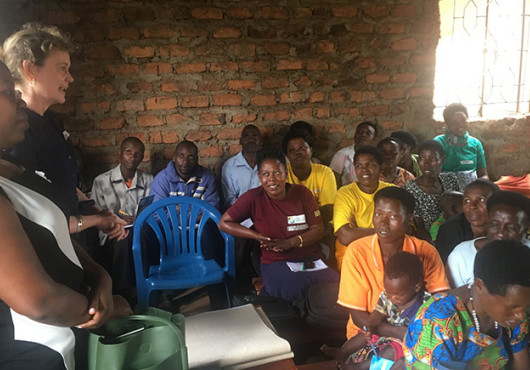
As chair of the Paul Farmer Collaborative steering committee, Joseph Rhatigan helps oversee a $50 million, 10-year partnership between HMS and the University of Global Health Equity in Rwanda, a medical school that HMS faculty members helped establish through the nonprofit group Partners In Health. Student and faculty exchange programs are deepening trainees’ firsthand knowledge of community health delivery and enriching teaching in both nations, he said, while research grants address the structural, social, and clinical drivers of health inequity.
The collaborative is changing “what medical education looks like at HMS as we have more people from outside our traditional community being able to join it,” said Rhatigan, associate professor of global health and social medicine at HMS and HMS associate professor of medicine at Brigham and Women’s.
The evolving role of the university
Universities are not simply observers of the world but have the power and responsibility to shape it, Ivers said.
“In this moment, not necessarily despite the onslaught against global health, but perhaps because of it, the University and [HMS] should continue to lead and lean into the global mission, which I think it very strongly is doing,” she said.
Panelists cited numerous paths by which Harvard can continue to be most effective, including training future global health leaders to design or provide care that accounts for the challenges faced in low-resourced areas with rampant disease; convening experts from around the world to share knowledge and perspectives and advance the agenda for health equity; and ensuring that treatments, vaccines, tests, and technologies get disseminated to all who need them.
Related Story
“Biomedical discoveries never just trickle out to the people who need them the most,” said Ivers.
“Research is also still important, like we said, but it’s not enough,” agreed Rhatigan, who is also chief of the Division of Global Health Equity and director of the Hiatt Residency in Global Health Equity program at Brigham and Women’s. “We need to have some kind of delivery plan [… to provide access for] folks who would otherwise not be able to afford these life-changing, life-saving treatments.”
Gawande said Harvard is in a strong position to build systems that support rural health care in the United States as rural hospital closures exacerbate care deserts. He said a nonprofit he co-founded, Ariadne Labs, has developed “home hospital” programs in which urban care centers can treat patients as far as 100 miles away for nearly half the conditions that normally entail admission to brick-and-mortar facilities.
Panelists also said they find inspiration in teaching students. Global health and health policy is regularly the most popular secondary field of concentration at Harvard College, said Ivers, and students are deeply engaged in examining why structural inequities persist, why the outcomes are so often seen as inevitable, and whose job it is to fix them.
“I think that, despite the many challenges across the globe, we have some hope to hold on to within our institution. We have optimism and passion from our students that can help take us forward,” Ivers said. “They’re ambitious about what it is possible to do.”
Walensky agreed that fostering the next generation’s drive will power change — and said that even now, public health servants, researchers, clinicians, students, and members of the public are proving that they will not tolerate the turn away from global health.
“A rebuild is ahead,” she said. “And we have incredible talent right here in our midst that will be a part of that.”
“You can be assured that the faculty, staff, and students of Harvard Medical School and Harvard University will not step back from our commitment to health equity both here in the United States and around the world,” Patel concluded. “This is a commitment that isn’t just scientific. It isn’t just humanitarian. It is fundamentally a moral commitment, a solidarity with humanity.”