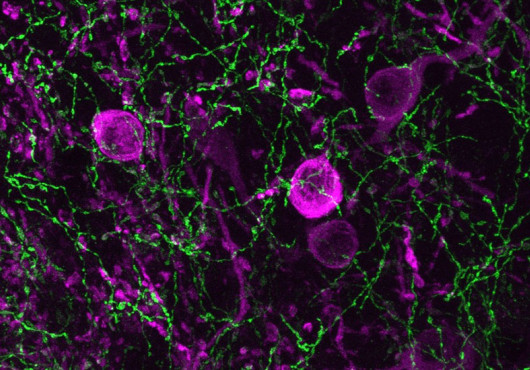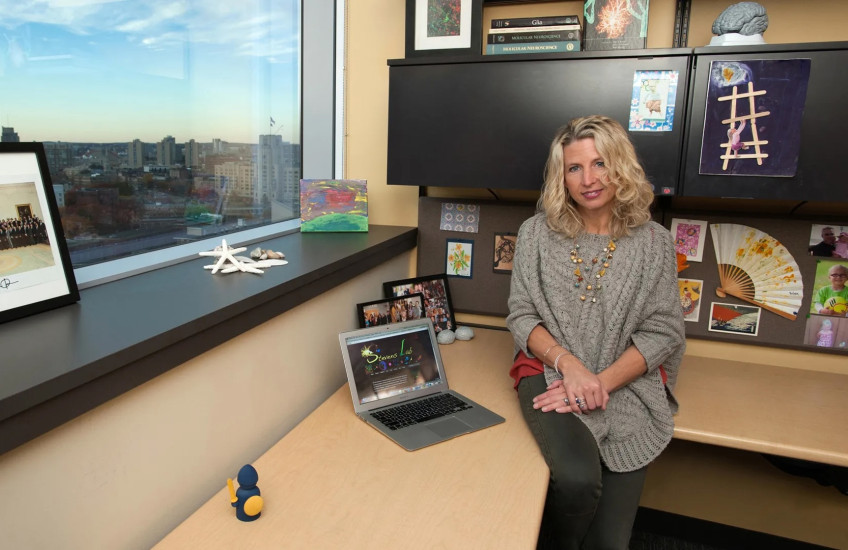
In efforts to fight Alzheimer’s disease, neuroscientist Beth Stevens, Harvard Medical School professor of neurology at Boston Children’s Hospital, has driven a transformation in thinking about microglial cells, which serve as an immune system for the brain.
Microglia patrol the brain for signs of illness or injury, helping clear out dead or damaged cells and selectively pruning synapses, which transmit information among neurons. Sometimes the process takes a dangerous wrong turn.
The Stevens Lab, based at Boston Children’s and the Broad Institute of MIT and Harvard, has demonstrated that aberrant pruning can contribute to Alzheimer’s disease, Huntington’s disease, and other disorders.
The work has created a foundation for new biomarkers and medicines to detect and treat neurodegenerative disease. It has the potential to affect care for the estimated 7 million Americans living with Alzheimer’s, which is incurable.
When she was starting out in the early 2000s, Stevens had no idea where her curiosity would take her.
“I was just following the science,” she said. “It was this interesting new area where the brain’s immune system was helping to sculpt synapses and circuits under normal development.”
She had a hunch about synaptic pruning — and she was right.
The importance of funding basic research
Vital support from federal agencies helped her follow through.
“The foundation of our research, from the time I was a postdoc to the first decade of my lab, was almost entirely driven by the National Institutes of Health and other federal funding,” she said.
That foundational research doesn’t always have a clear outcome, noted Stevens, who was named a MacArthur “genius” for her work on microglia in 2015.
“Someone that doesn’t think about disease implications might say, ‘Oh, the Stevens Lab is studying the visual system of a mouse. They’re trying to understand how a mouse’s visual system wires up.’ It can seem like that’s so far from ever translating into anything. Who cares how a mouse might see?”
But these studies allow scientists to explore questions they couldn’t in humans, she noted — which leads to new discoveries, which lead to new understandings of disease, which lead to treatments that improve human lives.
“Our microglial research is a great example of an immune-related pathway and cell type that we would never have been able to move forward without the basic science and curiosity-driven science from the beginning,” she said.
Adapted from an article in the Harvard Gazette.