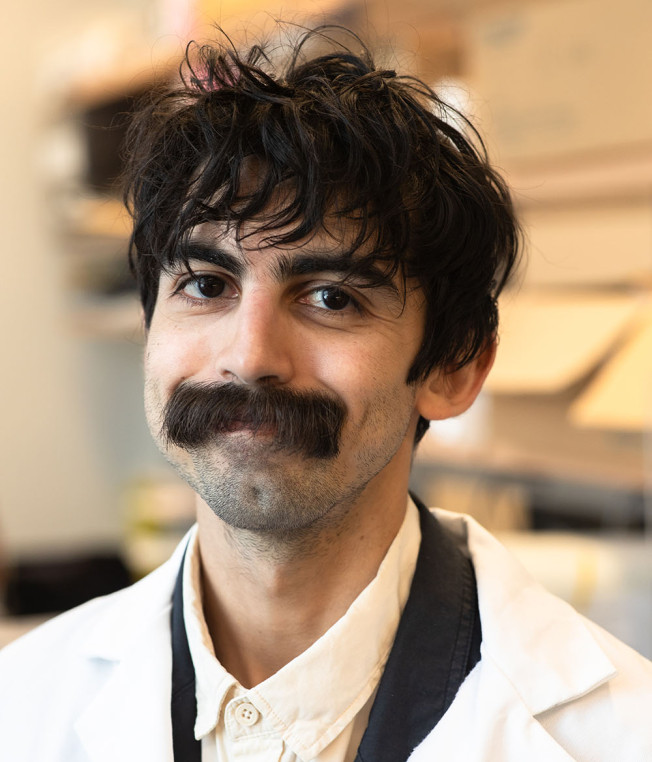
We interpret the world around us through a lens of previous experience and emotions and adjust our response accordingly. Dionnet Bhatti Mazo has spent more than a decade studying how this process unfolds among the neural circuits in our brains.
“What interests me is how the brain actually controls how we sense and evaluate our environment and how that influences our behavior and emotions,” he said.
Becoming a brain scientist wasn’t smooth sailing. But if there’s one theme that stands out in Bhatti Mazo’s life and career, it’s persistence. That trait has driven him from his childhood in New York and Atlanta raised by a single mother from Colombia, through becoming the first college graduate in his family, to figuring out a path into research and completing doctoral work at Harvard Medical School in the Harvard PhD Program in Neuroscience (PiN).
Persistence is also central to the questions he studies. His work examines how the brain generates responses that unfold over different timescales, such as the startle response versus chronic anxiety. He likes diving deep into the molecular mechanisms underlying these processes in model systems simpler than humans, both to contribute to our understanding of the brain and with the hope that it will someday help improve treatments for conditions involving disrupted response to the environment.
“What attracts me to basic science is that we can figure out really fundamental principles about how the brain works and then extrapolate them to processes that we know as humans, like anxiety,” he said.
Although Bhatti Mazo completed his PhD in fall 2025 and has already begun postdoctoral research at The Rockefeller University in New York, he will officially receive his diploma from the Harvard Kenneth C. Griffin Graduate School of Arts and Sciences and don his doctoral robes at the 2026 HMS PhD Hooding Ceremony on May 28.
Forging a path in neuroscience
Though Bhatti Mazo knew as a high schooler that he wanted to study neurobiological mechanisms underlying behavior, he didn’t start lab work until his junior year at the University of Georgia (UGA).
“As basically the first graduate in my family, when I got into college, I had no idea what to do,” he said. “I didn’t know how to get into science at all.”
He had learned from age 16 that getting jobs required making phone call after phone call, so he tried doing the same with lab heads at UGA.
“Coming from a family of immigrants, I learned that you just have to be pretty insistent,” he said.

It turned out the technique didn’t translate to the academic setting, but Bhatti Mazo was eventually accepted into a lab he was excited about, where he assisted a graduate student on her research into how contraceptives influence the brain and behavior.
Then a summer in a New York University lab helped him form a game plan for his career.
“That’s where I realized science was a path that I could go down,” he said. “I learned that undergrads can have their own projects. I learned that PhDs pay you. I just learned how to do science.”
He spent his senior year at UGA on an experiment he designed under the supervision of principal investigator Philip Holmes to look at how a neuropeptide called galanin affects fear expression in mice and ties into what humans experience as anxiety.
Despite his hard work, Bhatti Mazo’s first round of graduate school applications, in 2015, was unsuccessful.
So he found a different path to his dream job.
He continued looking into anxiety-like states in animal models as a post-grad lab technician and manager at Washington University School of Medicine in St. Louis, where he eventually earned his way into running his own experiments, and then as a research assistant at Rockefeller University, where he worked in the lab of Nobel laureate Paul Greengard.
He learned how to use cutting-edge techniques like optogenetics (using light pulses to turn neurons on and off) and fiber photometry (recording bulk neural activity) to explore different aspects of anxiety responses. He helped to develop a wireless photometer that allowed him to record more natural environmental interactions in animal models. He co-authored papers in top-tier journals, including Science Advances.
After four years of experience, he was again ready to try for graduate school. This time, he was accepted to every school he applied to.
Asking the right questions
Bhatti Mazo says he chose HMS for its intensive research reputation and sheer concentration of labs.
“On each floor, you have like three labs that are all doing amazing things, and so you could just go upstairs and ask, ‘How did you do this?’ You can email a PI and they’ll say, ‘Talk to this guy in my lab,’” he said. “It was easy to talk to people. That environment is what really made me into a good scientist.”
Mentors and colleagues taught him how to put different technologies to their best use to solve meaningful research questions.
“People at Harvard really know how to ask the right questions and how to answer them very deeply and rigorously, to give you insight into a true biological process,” he said.
In the lab of Todd Anthony, who was then HMS assistant professor of psychiatry and neurology at Boston Children’s Hospital, Bhatti Mazo shifted from studying anxiety to asking broader questions about how the brain evaluates the environment and selects appropriate behavioral responses. Specifically, he focused on an area of the brain called the lateral septum, which researchers suspected played a role in emotional behaviors.
Working in mice, he showed that the lateral septum integrates external and internal stimuli to produce physical responses to situations. He further showed that this happens through the coordinated actions of 10 distinct groups of neurons, which he defined and began to characterize.
Two years into this work, Anthony left Harvard and Bhatti Mazo had to find a new advisor.
“I had to figure out a way to continue what I wanted to do and what I already made a lot of progress doing without losing too much,” he said.
He turned to Gord Fishell, professor of neurobiology in the Blavatnik Institute at HMS, whom he’d already developed a mentor/mentee relationship with. Fishell’s expertise in neuron diversity, organization, and circuitry complemented Bhatti Mazo’s interests. He rebuilt his project in the Fishell Lab.
Through his work in mouse models, Bhatti Mazo demonstrated that the neuron groups in the lateral septum take inputs from either the hippocampus (giving context about the environment) or the hypothalamus (providing information about the subject’s internal state) to determine the appropriate fight, flight, or freeze action.
“I found that these neuron groups perform this really neat computation. If you look at the whole population, it predicts what the animal is going to do before they ever do it,” he said.
These experiments showed that the lateral septum is the home for neural activity that determines how the mice responded to a given situation — which, if it holds true in humans, could help scientists understand and intervene in the experiential reactions of patients with clinical anxiety.
His findings will be published in Nature.
The persistence of memory
After defending his thesis and earning recognition for various efforts outside the lab, including a PiN Excellence in Service Award for serving as co-president of what is now United Scholars in Neuroscience, Bhatti Mazo returned to Rockefeller University as a postdoc. There, he is extending his explorations into how persistent states such as memory and anxiety are represented and maintained in the brain at different timescales.
His singular dedication to his work has brought him to where he always hoped to be — doing bench science for a living.
“My whole life was science from 2015 to last year when things started toning down during my PhD,” he said.
He finally feels able to settle a bit and allows himself free time to pursue hobbies, which now center on rock climbing — something that requires a persistence of its own.
“It’s amazing because it’s not just physical, it’s mind, it’s balance. Not just strength, it’s endurance,” he said.
But that’s not to say his scientific drive has lessened at all, he said. “I still think about science all the time, and I think that’s really critical.”
Answering the Call to Improve Health
Celebrating the accomplishments of the Class of 2026