
When Nikki Pérez graduates with her MD from Harvard Medical School in May and begins her residency in neurosurgery at the Barrow Neurological Institute later this year, she will be continuing on a journey that started in early childhood.
When she was 4 years old, Pérez was diagnosed with an arachnoid cyst — a fluid-filled sac beneath the arachnoid membrane that surrounds the brain and spinal cord. Thankfully, the cyst didn’t require surgery, but Pérez found herself under the care of a neurosurgeon.
“I think that’s really what sparked my interest in neurosurgery,” Pérez reflected.
Growing up in a Cuban family in Miami, Pérez had no close relatives working in medicine. Inspired by her father’s career as a media executive, she pursued another passion, dance, and eventually enrolled in an arts high school, where she focused on theater. Then her freshman year biology teacher, who had a PhD in neuroscience, noticed her nascent talent in the sciences.
The teacher offered to arrange for Pérez to shadow her neighbor, a neurosurgeon at the University of Miami. The experience reignited Pérez’s early interest in neurosurgery.
“I fell in love with it from the second I walked into the OR,” Pérez said. “I liked the pace. I liked the way the team communicated. There was almost a choreography to it, like it was all being played out to music.”
Learning the steps
From then on, Pérez’s life followed a new trajectory. She majored in dance at Williams College, drawn to the way it connects the mind and body, but she also majored in biology, getting the scientific foundation she would need to enroll in medical school.
While at Williams, she also volunteered at nursing homes, working with residents to develop dance choreography specific to their conditions and abilities. The project became the foundation for her undergraduate thesis.
“The brain has a remarkable capacity for plasticity, and I saw that very clearly in working with residents,” Pérez said.
After graduation, Pérez moved to New York City to work in a lab at The Rockefeller University and prepare for the MCAT, the entrance exam required by almost all U.S. medical schools. She volunteered with Dance for PD, a nonprofit project that teaches dance to people with Parkinson’s disease. Knowing that many people with Parkinson’s describe difficulty initiating movement, Pérez saw how dance helped some participants manage their symptoms and move more easily.

“I remember talking to one of our participants who had been taking classes for years. She said, ‘I used to feel like my foot was glued to the ground, and I couldn’t move when I wanted. But now I think of my steps as dance, and I can walk.’”
“Seeing that impact with your own eyes, it’s pretty powerful,” Pérez said.
Personal loss to patient care
Not long after she moved to New York, Pérez’s father was diagnosed with pancreatic and colorectal cancers. She understood clearly her father’s prognosis. Since he was unmarried at that time and still living in Miami, she decided to delay applying to medical school so she could serve as his primary caregiver.
“I knew that we would probably only have a year if we were lucky,” Pérez said. “So I said, okay, I need to put my med school plans on hold for now and spend it with my dad. We were never going to get these moments back.”
Pérez flew home to Miami almost every weekend to help her father — prepping meals, cleaning his house, and coordinating his care with other family members. It shaped the kind of doctor she has become.
“It’s very different to care for someone with the perspective of a daughter than with the perspective of a provider, which you learn to adopt in medical school,” Pérez said. “I think being able to hold those two perspectives together allows me to connect with patients and their families more meaningfully.”
Pérez noted that the experience has also helped prepare her to convey both honesty and hope during the sometimes difficult conversations neurosurgeons need to have with patients and caregivers.
“There’s a way to share the truth fully but to still instill hope,” she said. “Sometimes the way you disclose information requires a real artistry to make sure that the family is fully aware of their loved one’s status and prognosis but still motivated and able to persist in the everyday of taking care of someone who’s critically or terminally ill, which is a lot of work.”
Collaboration and impact
Following her father’s death, Pérez worked for a startup in New York City for two years, saving money for medical school and preparing her applications.
When she arrived at HMS, she remained committed to pursuing neurosurgery, but she also discovered a passion for advancing the cause of global neurosurgery by addressing systemic inequalities in health care access.
Once more, her childhood helped drive that concern. She noted that health care challenges seen in Miami can resemble those in low- and middle-income countries more than those typically encountered in other parts of the United States or high-income settings.
“You might see a tumor that’s progressed way further than you would ever see in Boston, because your patient is from Colombia and may not have had the means to receive the same level of care until they were able to book a flight to Miami,” she said.
Pérez became involved with Mission: BRAIN, a nonprofit working to increase global access to neurosurgical care. As she worked on education and mentorship initiatives, though, she wondered if there was more that she could do to help people around the world get the care they need.
In her third year at HMS, she shared this curiosity with global neurosurgery leader Kee Park, lecturer on global health and social medicine, part-time, at HMS. Park invited her to lead a new initiative he and colleagues Gail Rosseau, adjunct professor of neurosurgery at Barrow, and M. Ali Aziz-Sultan, HMS associate professor of neurosurgery at Brigham and Women’s Hospital, were conceiving. Called the Boston Declaration, it would be a five-year effort to mobilize coordinated action to address persistent disparities in access to neurosurgical care worldwide.
Pérez and colleagues identified hundreds of stakeholders from neurosurgery, finance, government, and health care policy. The group developed concrete pledges that they announced at a meeting in Boston in April 2025. In the year since, Pérez has spearheaded efforts to ensure that the pledges progress. Under Rousseau’s mentorship, she also helped organize a one-year follow-up meeting in Dar es Salaam, Tanzania. The event aligned with the inaugural meeting of the International Society for Global Neurosurgery, which Pérez helped create and wrote the initial bylaws for.
Pérez credits the unique, collaborative learning environment at HMS for making the Boston Declaration and her involvement in it possible.
“The power of this institution is that you can dream up any idea and you tell someone about it and all of a sudden all these world-class experts will be coming to you with ideas that build on yours and allow you to make it a reality,” Pérez said.
Pérez has found eager mentors at HMS. She said she has benefited from not only their expertise but also the humility and excitement they bring to collaboration on difficult and important problems.
“My mentors have been excited to see what I come up with and then that sparks a new idea for them. Even though they have way more expertise and knowledge than I do, I really feel like it’s an equal partnership,” she said.
Answering the Call to Improve Health
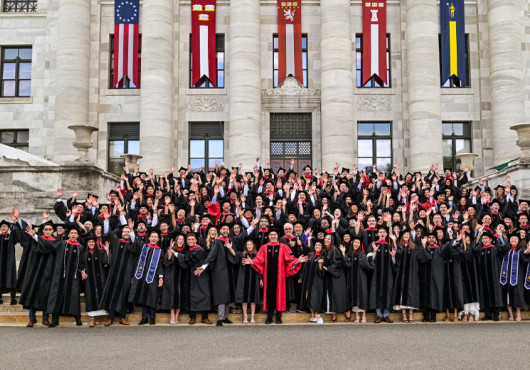
Celebrating the accomplishments of the Class of 2026