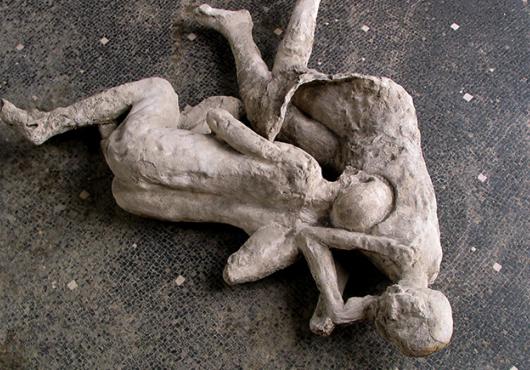

Growing up in Greece, Iosif Lazaridis shared his compatriots’ appreciation that they lived in “the crossroads of Europe and Asia,” past and present.
To the east lay Turkey and Armenia, gateways to the Near East and Asia. To the north were the Balkans, leading the way into central Europe.
Lazaridis wondered how people in these regions were related to one another. Who shared long-ago ancestry with whom? How might those forebears have moved around this part of the world and had children with one another throughout millennia? How deeply connected were their modern descendants despite national borders and political conflicts?
Thought-provoking content
In-depth stories on science and medicine
Many people moved to Greece from the Balkans after the collapse of the Soviet Union, and many Greeks descend from refugees who came from Turkey in the early 20th century, Lazaridis knew. “Surely these changes that happened as I was growing up and that I heard about from old people were just the tip of the iceberg of what had happened in the centuries before,” he said.
The questions simmered at the back of Lazaridis’ mind as he moved to California to earn a PhD in information and computer science. They followed him to Boston, where he joined the lab of geneticist David Reich at Harvard Medical School.
There, he and colleagues around the world began to unearth answers through the study of ancient DNA.
Now, Lazaridis is co-first author of a trio of papers, published Aug. 25 in the journal Science, that tell the most complete story yet of ancestry in this pivotal part of the world.
The studies describe 15,000 years of genetic history in what the team has dubbed the Southern Arc: the lands sweeping from southeastern Europe into the Middle East, encompassing more than a dozen countries from Romania and Serbia through Greece and Turkey into Armenia, Azerbaijan, Iran, Lebanon, and Israel.
Featuring the genomes of more than 1,300 ancient people, 727 of them sequenced for the first time, the work represents one of the largest analyses to date of ancient human DNA.
“Often there’s an artificial distinction between Europe and Asia that people make,” said Lazaridis, research fellow in genetics at HMS who serves as a staff scientist in the Reich lab. “For these studies, we said, we have a bunch of people who are neighbors; let’s forget about such preconceptions and try to figure out how they’re all related and who moved where across time.”
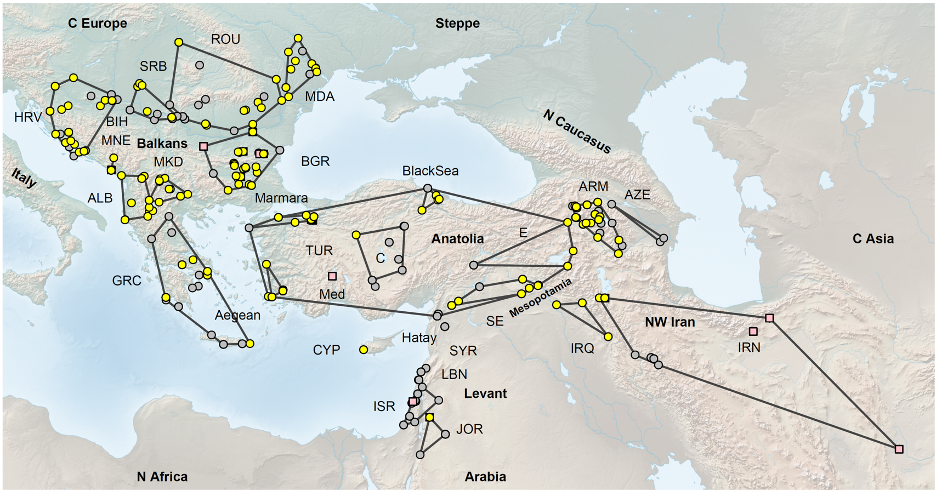
In addition to illuminating shifts in different populations’ genetic makeup across the centuries, the analyses provide fresh genetic insights into old mysteries such as the identities of Minoan and Mycenaean peoples and the geographic origin of Indo-European languages.
“This is a major leap forward in the field and a milestone in terms of richness of data from this complex region,” said co-senior author Reich, professor of genetics at HMS and professor of human evolutionary biology at Harvard University. “Some very striking stories emerge thanks to the power of ancient DNA in large sample sizes.”
No easy feat
The results were made possible by collaboration across borders and specialties. The Reich lab partnered with researchers at the University of Vienna to lead a 206-person team based in more than 30 countries.
“These studies were accomplished through a huge amount of raw human effort,” said Lazaridis.
Lazaridis shares first authorship of the papers with Songül Alpaslan-Roodenberg, a physical anthropologist from Turkey who is affiliated with the Reich lab and the University of Vienna. Reich shares senior authorship with Ron Pinhasi, a physical anthropologist and geneticist at the University of Vienna.
“One amazing thing about these papers is they represent cooperation between countries where it’s historically been difficult to get along, such as Greece, Turkey, Armenia, Albania, Bulgaria, and North Macedonia,” said Reich. “Navigating that was a complex issue.”
The team also overcame climatic challenges.
Until a few years ago, it was difficult or impossible to recover DNA from ancient people buried in regions like the Middle East because heat degrades the delicate material. The discovery in 2015 that an inner-ear bone does an exceptional job of preserving DNA and the development of new sequencing and analytic techniques threw open the doors to studying large collections of ancient DNA from previously inaccessible environments.
Co-authors in different fields worked together to interpret the findings in light of what was already known through archaeological evidence, ancient texts, and other materials. Some of the discoveries add detail to existing histories. Others fill in gaps. Still others challenge conventional theories.
“Once you look at this many individuals across space and time in an expansive view, you start seeing connections you couldn’t if you focused on only one site or period,” said Lazaridis.
The findings
“These findings are another example of how archaeogenetic results can provide a missing layer of information that cannot be obtained from other sources,” said Alpaslan-Roodenberg.
-
Paper 1
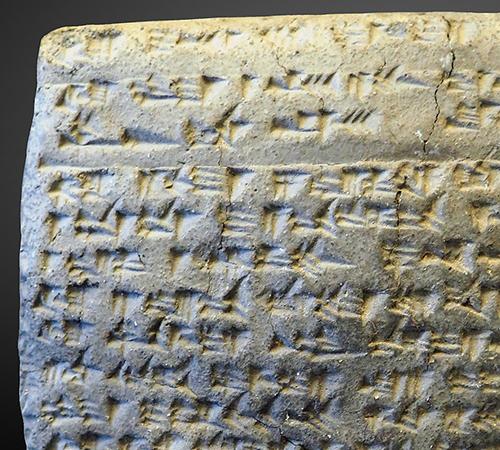
Solving the puzzle of the ultimate Indo-European homeland- Several major migrations are traced into, out of, and within the Southern Arc during the Copper Age and Bronze Age, from about 5000 BCE to 1000 BCE.
- In all other regions of the ancient world, the rise of Indo-European languages—the largest language family in the world—was until now associated with ancestry from the Eurasian steppe. In contrast, ancient people in Anatolia (modern-day Turkey) who spoke languages related to Indo-European had no steppe ancestry and experienced significant gene flow from West Asia. This suggests that the homeland of the language that gave rise to both Anatolian and Indo-European languages was in West Asia rather than the steppe.
- The authors hope that an ancient “missing link” population will be uncovered in West Asia or the Caucasus Mountains that would “bring to an end the centuries-old quest for a common source” that connects “many of the peoples of Asia and Europe” through “language and some ancestry.”
- Findings were made possible in part by the first in-depth ancient DNA from Armenia, spanning from 2,000 to 4,000 years ago.
- The team found many individuals around Eurasia with steppe ancestry, but only in Armenia did they see many who descended from members of the steppe culture known as the Yamnaya on the paternal line: “men whose fathers’ fathers across thousands of years can be directly linked to the earliest Indo-Europeans,” said Reich.
- One of Lazaridis’ favorite findings concerned the longtime mystery of the origins of the Greeks. “Greek is an Indo-European language, so its speakers have to be tied to the Indo-European family tree in some way, but when we look at the genetics of early Greece, steppe ancestry is present only at very low levels,” he said. “For the first time, we find that steppe ancestry in ancient Greece wasn’t homogeneous. It tells us that when Indo-European-speaking people came in from the steppe, they didn’t keep to themselves but became integrated into local societies.”
Source: “The genetic history of the Southern Arc: a bridge between West Asia and Europe”Image: Rama/Wikimedia Commons/CC BY-SA 3.0 FR
-

Paper 2
Illuminating the origins of the people who invented agriculture- The authors describe the first ancient DNA data from the Pre-Pottery Neolithic (late Stone Age) period of Mesopotamia, Cyprus, and northwest Zagros as well as the first ancient DNA data from Neolithic Armenia.
- Analyses before and after the invention of pottery reveal at least two waves of migration from the Fertile Crescent, where agriculture first arose, into Anatolia as farming began there as well.
- People who lived in West Asia during the Neolithic period only partly descended from those who lived there before the that period.
- Farmers in the Neolithic period commonly had ancestry from the Levant (present-day Jordan, Israel, Syria, and Lebanon), but this was gradually overtaken by DNA from the Caucasus and Anatolia through medieval times.
Image: NormanEinstein/Wikimedia Commons/CC BY-SA 3.0
-
Paper 3
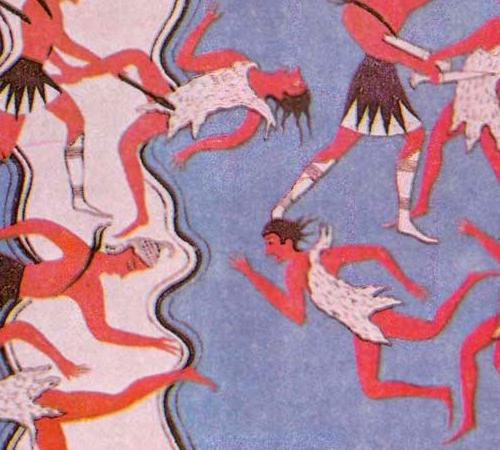
Ancient DNA joins literary and archaeological records in the post-Bronze Age Southern Arc- The authors aimed to add genetic insights to archaeological evidence and literature about ancient peoples in the region—including those in ancient Rome and Greece, the Urartian kingdom in present-day Armenia, and the Byzantine empire—and examine how well genetic analyses corroborated with that literature.
- Analyses spanned 3,000 years from the end of the Bronze Age through the present.
- Elite Mycenaeans in Greece did not have a different genetic makeup from the general population. Some Mycenaeans had steppe ancestry and others, including in a famous burial known as the Grave of the Griffin Warrior, did not.
- “I had read about the Griffin Warrior for years. To have an opportunity to study him was amazing,” said Lazaridis. “This person was buried 3,500 years ago with hundreds of gold pieces and precious stones, and for the first time we can say where he came from.”
- The warrior was clearly a member of the elite, Lazaradis said, one of a few Mycenaeans without steppe ancestry; but the team also saw a few relatives in the nearby Palace of Nestor who had clear links to steppe populations. “It seems that membership in the Mycenaean elites wasn’t reserved for the descendants of any particular group of people,” he said.
- The people of Anatolia have had “extraordinary” genetic continuity dating back to the Roman and Byzantine periods. Anatolians contributed the majority of DNA to people associated with the Roman Empire, including those who lived in the city of Rome.
- “We knew from our previous research that people who lived around Rome in the Imperial period were from various regions and that many originated from the Near East, but it was a complete surprise to find such a specific and clear link to Anatolia itself and not to other eastern parts of the Roman Empire such as the Levant,” said Pinhasi.
- Analyzing individuals from the ancient kingdom of Urartu, the team found that people who lived in the core part of the kingdom in the Lake Van region of present-day eastern Turkey largely had no steppe ancestry, while people in a part of the kingdom in what is now Armenia had some. The authors propose that those without steppe ancestry spoke an extinct tongue while the others could represent speakers of early Armenian, an Indo-European language.
- During medieval times, the Southern Arc was transformed by migrations associated with Slavic and Turkic speakers.
Source: “A genetic probe into the ancient and medieval history of Southern Europe and West Asia”Image: public domain
For Lazaridis, the papers provide a jumping-off point for yet more investigations even as they scratch his lifelong itch to know more about the people who live beside one another today.
“It’s tremendously satisfying that people from countries that haven’t seen eye to eye can engage in a study of the past that shows that all these conflicts are the last episode of long histories that are very linked,” he said. “Sure, there are differences, but if you go back in time you begin to appreciate the deep connections among people. That’s a good thing to know from this kind of data.”
Funding and authorship
The work followed ethical guidelines proposed last year by an international consortium that included co-authors of the current studies.
The studies were funded by the National Institutes of Health (grants GM100233 and HG012287), the John Templeton Foundation (grant 61220), a private gift from Jean-Francois Clin, the Allen Discovery Center program (a Paul G. Allen Frontiers Group advised program of the Paul G. Allen Family Foundation), and the Howard Hughes Medical Institute. Additional support is outlined in the Southern Arc paper.