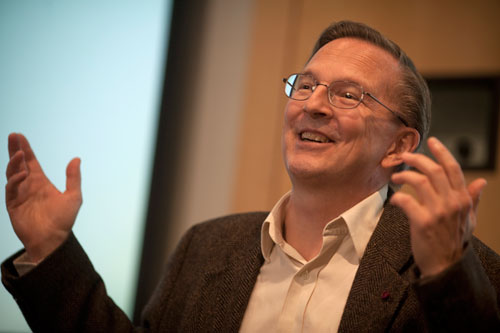
Soft-spoken and smiling despite days of grueling media attention, Jack Szostak, HMS professor of genetics at Massachusetts General Hospital, talked with Focus about his first moments after learning he was a winner of the 2009 Nobel Prize in Physiology or Medicine. He shared his philosophy on being a leader in science and said that the driver in most of his work is plain curiosity.
How did you feel when you got the phone call?
When I heard the phone ringing, I knew what was happening. There wasn’t anybody else that was going to be calling that early in the morning. It was pretty exciting, obviously. After hanging up, I knew the phone was going to start ringing continuously, and I probably didn’t have much time to get ready for everything. So I got up, got dressed, and went downstairs, and sure enough it’s been continuous talking from that point on.
As a young scientist, did you have a role model?
My adviser as a graduate student and postdoc was Ray Wu at Cornell. He gave all of us in his lab a lot of freedom to explore different questions. He was there to help out, but he didn’t micromanage us. I think my style is to try to be around to help when I’m needed, but also to encourage people to do things independently.
Did you suspect that your early basic science research would lead to important connections in medicine?
When we first started getting involved in the telomere stuff, it was really just out of curiosity about a very basic question about a longstanding issue.
One of the first hints in that direction, at least experimentally, Vicki Lundblad did in my lab as a postdoc. She took a genetic approach and found that when yeast cells couldn’t maintain their normal telomere structure, eventually over many generations they start to get into trouble—die off, chromosome rearrangements. That made us think, well, this has to be looked at in higher organisms. It’s really from all that subsequent work in higher organisms that the connections to aging and cancer emerged. That’s obviously been very nice to watch over the years.
What are you working on now?
Our current work is focused on the origin of life. We’re trying to synthesize structures in the lab that we think look like what the first cells might have looked like. Our approach to studying the origin of life really is a synthetic biology approach. We’re trying to build simple cells based on our model of what we think the first cells looked like.
What made you transition to that work?
My scientific career has wandered around from question to question. So there are just a huge number of really interesting questions. But the ones that are the most attractive are fundamental questions where I have the feeling that progress can be made. There are a lot of hard questions that are interesting that we just don’t have the tools to think about. There’s an interesting interplay between technology development and scientific progress. And we can’t have one without the other. As we’re trying to look at new questions, we also have to be developing new methods so that we can make progress. So they really go hand in hand.
In recreating a possible “first cell,” how can you tell how close you are to getting it right?
The origin of life is a kind of funny thing to study from a scientific point of view because we can’t go back and see what actually happened. All we can really do is try to define possible pathways. And there might have been many different ways to get started. Or maybe there is only one way. It might have been something relatively easy or it might have involved a lot of rare circumstances.
The hardest unsolved question to my mind in this whole thing is how you can get the replication of some kind of genetic material—some nucleic acid or related kind of material—how that can happen just spontaneously and chemically without complicated enzymes? That’s what we’re spending a lot of time on right now.
Do you think this work might result in connections to health and medicine?
It’s really hard to say what would come out of this in terms of practical applications. There have already been a few things in terms of development of potential new technologies. Another aspect of it is trying to understand some of the universal features of modern biology. That kind of better understanding of how things work and why we are the way we are could eventually be very useful.
All modern cells have certain common features. They all use DNA to store information. They all have cell membranes that are composed of lipid molecules. One thing that has come out recently is work of another grad student in the lab, Raphael Grupner. We were thinking about how membranes bend. This is a really important aspect of membrane remodeling in our cells. It’s very important for synaptic transmission, for example. He came up with some interesting ideas about how membranes bend, what the energetics are, and so I think that is an interesting example of something relevant in modern biology that came out of thinking about more primitive membranes that might have been involved in early cells.
Besides advancing science, what rewards do you get from your work?
Of course, it’s great to see interesting scientific stuff come out of the lab, but I think even more satisfying than that is to see students come in and mature and get excited about making their own discoveries and then go off and start their own labs and be really productive and successful.
Students may contact Jack Szostak at szostak@molbio.mgh.harvard.edu for more information.