Neuropathic pain is a complex and puzzling state. Often described as a “burning” or “shooting” pain—and frequently associated with neurodegenerative diseases such as multiple sclerosis—it is still not clear what causes this mysterious sensation. A team of HMS researchers reports online in the Feb. 10 Nature Medicine that a pair of enzymes belonging to the family of matrix metalloproteases (MMPs) appears to have distinct roles in the induction and maintenance of neuropathic pain.
Previous studies have indicated that inflammation induced by nerve injury plays a central role in pain pathogenesis, and MMPs are inflammatory mediators widely implicated in neuroinflammation and degeneration. “If MMPs are important in degenerative diseases, then they might also be involved in pain associated with nerve damage,” said Ru-Rong Ji, HMS associate professor of neurobiology at Brigham and Women’s Hospital.
Neuropathic pain is primarily managed with general analgesics such as morphine. But these only block pain temporarily since they fail to tackle the underlying pathology, which remains poorly understood.
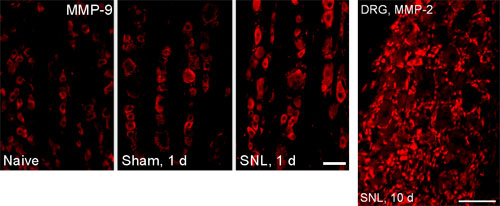
To address this, Ji and colleagues conducted a comprehensive series of experiments looking at the involvement of two major MMPs—MMP-9 and MMP-2—in neuropathic pain. They began by harvesting tissue from the dorsal root ganglia of rats at various time points after inducing pain symptoms via spinal nerve damage and measuring MMP activity and localization.
Using a variety of analytical tools, the team was able to show that there was a time course difference between MMP-9 and MMP-2 as well as a localization difference. MMP-9 was expressed early and transiently within sensory neurons; MMP-2 was expressed later on in surrounding glial cells and had a far more persistent effect. “Based on this pattern, we hypothesized that MMP-9 would be critical for the induction phase,” said Ji, “and MMP2 would be critical for the maintenance phase of neuropathic pain.”
The team went on to explore the contributions of these MMPs to pain symptoms and to investigate possible underlying mechanisms. Using a multistrategy approach, Ji and his group demonstrated that MMP-9 acts as instigator, activating well-characterized downstream pain molecules such as IL-1 beta to cause rapid onset of pain symptoms. MMP-2 carries on what MMP-9 starts by taking over pain molecule activation and promoting the persistence of pain symptoms.
“Different phases of neuropathic pain were not clearly defined before. The traditional drugs blocked all neurotransmission so it didn’t matter if there were different phases,” said Ji. “We have not only identified MMPs as new players in neuropathic pain development and maintenance, but also that inhibition of MMP-9 and MMP-2 is highly effective in attenuating neuropathic pain. We could have new targets for treatment.”