Research at Harvard Medical School sheds new light on how chromosomes move apart during cell division, a delicate maneuver implicated in a multitude of disorders, including some cancers and birth defects. While the puzzle is rooted in high school biology, the solution comes straight from gym class: Chromosomes move apart with two “hands,” like students climbing a rope.
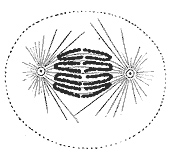
First, the high school biology: When a cell divides, its genetic material is apportioned evenly through a process called mitosis or, for reproductive cells, meiosis. Each X-shaped chromosome splits into two identical halves, called chromatids, which migrate to opposite poles of the cell with the help of a temporary structure,the spindle, made up of microtubule filaments. When the process works, each new cell receives a virtually identical set of chromosomes. When it doesn’t, copy-number errors can lead to chromosomal disorders including Edwards, Patau and Down syndromes or to some types of cancer.
The risk of such errors has fueled intense interest in how, exactly, the cell’s genetic material moves during mitosis and meiosis. Researchers have long known that a complex structure of proteins, called the kinetochore, connects the chromatid to spindle microtubules. One theory held that a molecular motor in the kinetochore moved the chromatid by walking along spindle microtubules. But scientists came to suspect instead that as spindle microtubules shrink, they generate force to pull the chromatid along with it.
That presented a new paradox. The kinetochore had to move with the ends of shrinking microtubules, while also holding fast to what structure remained. “How do you move without letting go?” said Sophie Dumont, who tackled the question as a research fellow in the lab of Tim Mitchison, Hasib Sabbagh Professor of Systems Biology at HMS. “There’s a contradiction there.”
Dumont’s answer: Use two hands. Like a climber inching up a rope in gym class, the kinetochore maintains constant friction with a passive contact, or hand, while an active hand generates force to move. As the microtubules keep shrinking, more and more force is generated and the hands move closer together.
Dumont compares the motion to an inchworm. “Like the worm’s rear end, the passive interface always drags behind and touches the ‘ground,’ while the active interface, like the inchworm’s head, dynamically moves to generate force.”
The two kinds of connections help the chromosome move safely, without falling off the shrinking spindle microtubules. “The passive connection is your anchor for dear life,” Dumont said. “The active connection is there when you need it to move.”
The results were published June 21 in the journal Science. Dumont and Mitchison collaborated with Ted Salmon, the James Larkin and Iona Mae Ballou Distinguished Professor at University of North Carolina, Chapel Hill, and an expert in spindle microtubules.
To uncover how kinetochores hold on to the microtubules that move them, Dumont used fluorescent biomarkers to tag proteins at either end of the kinetochore — one, near the chromosome and the other near the microtubules. The tags showed the kinetochore stretching apart, then scrunching up, as a function of which hands made contact and what force they generated.
“We observed that the active and passive connections work at the same time, fulfilling the two basic needs of chromosome segregation: holding onto and moving with microtubules,” said Dumont, who completed her postdoctoral fellowship in June and took a post as an assistant professor in the Department of Cell and Tissue Biology at the University of California at San Francisco.
Dumont cautions that while she believes the two-hand theory is the simplest that fits the evidence, it is by no means proven. Experiments, she said, that modify the kinetochore’s connections — tweaking the passive hand to make it more or less sticky, for example — could shed further light on a critical aspect of cell division.