It’s no secret that in the past decade or so, career prospects have been changing for graduate students in the life sciences.
“It used to be the sort of narrative that everybody who got a PhD in life sciences went on to be a faculty member — then data started to come out that that wasn’t true,” said Jason Heustis, assistant dean for student development and evaluation in the Office for Graduate Education at Harvard Medical School.
“It turns out 80 percent of people will probably end up not pursuing a faculty position. They’re going on to multiple, different career trajectories. People are now going into science communication, venture capital management, consulting, teaching, curriculum design, or higher ed administration,” he said.
As the life sciences career landscape has changed, and the range of opportunities has expanded, so has the number of tools and resources available to help with career exploration, with finding job postings, with connections to mentors, with development of interpersonal skills, and even with navigating mental health and wellness services.
Trusted health and wellness information
From Harvard Health Publishing
But such an explosion of information can often create confusion because resources are rarely organized for ease of use and may even be redundant.
“In many institutions, dissemination of career-related information takes place via email, but students often miss these notices, and more importantly, do not recall them when they are looking for a resource or service,” said Utsarga “Tito” Adhikary, who joined with Heustis and others to create a solution.
“Graduate students often end up receiving the same email from the school, department, or program, and affinity groups, leading to email clutter and eventually tuning out email messages due to the frequency and redundancy of content,” said Adhikary, a researcher in the Loren Walensky lab at Dana-Farber Cancer Institute who studies cell death and cell cycle mechanisms in the context of cancer.
Last fall, Heustis’ group unveiled a new tool developed over three years with the help of funding from a 2019 HMS Dean’s Innovation Award in Education. At the time, co-creators Adhikary, Rachel Rudlaff, and Bolutife Fakoya were Harvard doctoral students and are now alumni of the Biological and Biomedical Sciences (BBS) program at HMS.
The online tool they created, Cog City, pulls together dozens of resources into one easily accessible, searchable platform that’s officially called the Graduate Bioscience Career Cognitive City.
Comprehensive resource map
Heustis said he expects that future site users will range from prospective to current graduate students, postdoctoral fellows, peer mentors, faculty members looking to support graduate students, career educators, and alumni.
Heustis called the Cog City platform the most comprehensive resource map of its kind built to support trainees. The idea for Cog City emerged after the group worked on the HMS Career Navigator portal which was designed to be a one-stop site to connect trainees with tools, resources, events, and news related to career and professional development.
“We were just finding people were having a hard time going to all the different platforms. So, we focused on redoing the site to integrate everything,” Heustis said when describing how Cog City grew from Career Navigator.
 “When thinking of a career after my PhD training, I oscillated between academia and biotech. I navigated many sites that provide career resources, but most career sites focused on one domain, either academia or industry,” said Cyrianne Keutcha, a PhD candidate currently studying the molecular mechanisms underlying Plasmodium invasion of erythrocytes in the Duraisingh Lab at the Harvard T.H. Chan School of Public Health.
“They mainly provided CV or resume guidelines as information for the career, and some of the more advanced sites had limited access to the general public,” said Keutcha, who joined the team working on Cog City.
“I was left seeking a site that exposes students to all life science career opportunities and provides guidelines for these opportunities in an extensive manner,” she said.
As they developed the Cog City site, the team identified more than 300 resources for graduate student professional development and built a taxonomy to categorize them so trainees could easily find what they need.
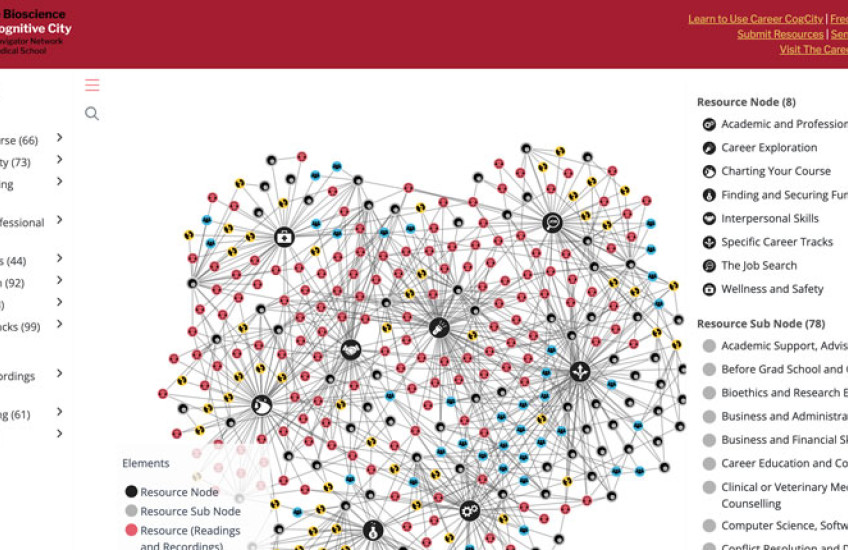
“We were excited about the idea of presenting all the information from the navigator as an interactome — an interactive network map that allows users to see connections between resource categories and more quickly find what will be useful to them,” said Adhikary.
Career exploration
Slightly resembling a colorful, interactive Buckyball, the network map on the Cog City tool allows users to filter topics by resource themes, such as career exploration or finding and securing funding, or by resource types, such as articles, podcasts, videos, or interactive learning.
Site nodes and subnodes include a wealth of topics, such as information for careers in bioethics and research ethics or career education and coaching. Eventually users will be able to customize the network map to their needs.
Users can also submit additional resources they might wish to see added to the site, and they will be able to filter search results for such resources as networking communities. Some of the 48 networking communities listed include groups such as 500 Women Scientists or the American Society for Biochemistry and Molecular Biology.

“We realized the value of a more dynamic visual interface to present a large number of resources to our audience, and we also wanted to make the library of resources we collated accessible to any interested trainee— including those from other institutions,” said Adhikary.
“Creating this free public version of Cognitive City also allowed us to make clearer that this interactome is a public resource, and not just for students at our institution,” he said.
Adhikary and Rudlaff, both PhD students during the development of the tool’s taxonomy, were able to provide direct insight into the kinds of information trainees are looking for and what might be most helpful.
“My favorite feature on Cog City is the login option for Harvard students,” said Keutcha. “Logging in allows our site to track and record student activities. I love this feature because navigating graduate school alone is challenging and time-consuming, so I need a system that keeps track of my progress. Cog City records articles I read, or plan to read, and connects me to the related resources of interest and their source.”
“To be honest, this is a project that kind of grew into something much cooler than we thought we were doing when we started,” said Heustis. “I’m very proud of the fact that the students were so heavily involved in building it.”