At a glance
Researchers have devised a new way to deactivate hard-to-drug members of the G protein-coupled receptor (GPCR) family, the target of 30 percent of current FDA-approved drugs.
Rather than blocking the receptors on the cell surface, engineered molecules link GPCRs to a protein that drags them inside cells for disposal.
The work offers a fresh approach for developing treatments for conditions from high blood pressure to cancer.
The future of federally funded research at Harvard Medical School — supported by taxpayers and done in service to humanity — remains uncertain. Learn more.
About one-third of all drugs approved by the U.S. Food and Drug Administration target G protein-coupled receptors (GPCRs), a family of more than 800 cell-surface receptors that regulate a wide range of vital functions, including blood pressure, heart rate, and immunity.
These drugs block GPCR function, usually by binding to and preventing their interaction with molecules that would normally bind to and activate them. But this method has limitations.
For example, current drugs don’t work well for GPCRs surrounded by high concentrations of the molecules that activate them. The drugs also have no effect on a minority of GPCRs that are always active, producing signals even without an activating molecule. This has left the therapeutic potential of many members of the GPCR family untapped.
Seeking a solution for these shortcomings, four labs at Harvard Medical School and Dana-Farber Cancer Institute combined their expertise to control GPCR signaling in a whole new way. Rather than blocking the receptors’ activity, their strategy removes selected GPCRs completely.
Reported Sept. 30 in Nature and enabled in part by federal funding, this approach could be a gamechanger for pharmaceuticals and offer a novel way to study this vast receptor family.
“GPCR degradation opens exciting new avenues for developing therapies for patients,” said study co-senior author Xin Zhou, HMS assistant professor of biological chemistry and molecular pharmacology at Dana-Farber.
The ties that bind
To rid cell surfaces of certain GPCRs, the researchers relied on a molecular engineering principle called induced proximity — a research focus of the Zhou Lab.
Induced proximity involves so-called bispecific molecules that connect two molecules.
“By being physically tethered together, one biomolecule’s function can influence the other’s,” explained Zhou. “There is a big unmet need in developing induced proximity approaches to target the GPCR family.”

The lab is particularly interested in a molecule known as the transferrin receptor 1, or TfR1. Responsible for pulling the iron-carrying protein transferrin into cells, TfR1 continually shuttles back and forth between the cell surface and interior — collectively bringing hundreds of molecules into a single cell per second — and is found on many different cell types in the body.
If they could molecularly link TfR1 to specific GPCRs, Zhou reasoned, it could drag the GPCRs into cells. The right bridging molecule could then route the GPCRs to cellular garbage disposals known as lysosomes that degrade them.
Better than existing blockers
To engineer a bispecific molecule capable of this feat, Zhou’s lab teamed up with co-senior author Andrew Kruse, professor of biological chemistry and molecular pharmacology in the Blavatnik Institute at HMS. His lab studies GPCRs with the help of nanobodies, antibody fragments that bind to these receptors. Kruse and colleagues have amassed a large library of nanobodies.
Co-first authors Kaitlin Rhee and Lawrence Shue, Harvard Kenneth C. Griffin Graduate School of Arts and Sciences PhD students in the Zhou Lab, led the work.
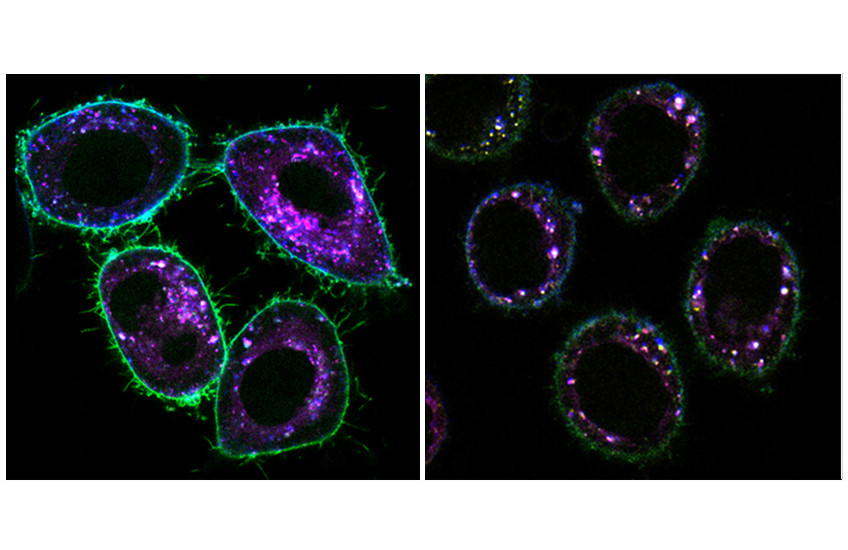
They developed bispecific molecules that connect TfR1 to nanobodies that bind specific GPCRs, using a bridge derived from part of an antibody called immunoglobulin G1. This brings the GPCRs into cells, where they can be degraded. The team called these molecules GPCR-TfR1-targeting chimeras, or GTACs.
As a pragmatic proof of principle, the team targeted GPCRs that have key functions in health and disease and a variety of operating mechanisms.
One was the angiotensin II type 1 receptor (AT1R), the target of a class of drugs known as angiotensin receptor blockers. Taken by nearly 6 percent of U.S. adults, these drugs treat high blood pressure, heart failure, and chronic kidney disease. Despite their popularity, Kruse said, they aren’t a perfect solution — many patients still have poor symptom control, even on several of these medications combined.
When the researchers treated cells engineered to overexpress both AT1R and TfR1 with an inactivating anti-AT1R nanobody, they reduced AT1R signaling by about 30 percent — about the same as angiotensin receptor blockers in the same experiment system.
But when they treated cells with the GTAC, they reduced signaling by up to 90 percent. It prevented activation of other molecules downstream of AT1R as well.
Drugging the undruggable
The team had similar success with RXFP1, a GPCR that binds the hormone relaxin-2, which promotes remodeling of the cardiovascular and other systems in pregnancy; CCR6, a GPCR that regulates inflammation and has been implicated in autoimmune diseases; and BILF1, a GPCR produced by cells infected with the Epstein-Barr virus, which is associated with many cancers.
Researchers have had challenges targeting each of these GPCRs using traditional pharmaceutical approaches. For instance, targeting AT1Rs with angiotensin receptor blockers causes fetal toxicity, so they can’t be used to treat pre-eclampsia, a condition marked by dangerously high blood pressure in pregnancy. Conventional antibodies struggle to fully block CCR6 because its natural activating molecules bind tightly to the receptor at two different sites. BILF1 remains constantly active without needing any molecule to switch it on, making it difficult to shut down with conventional drugs.
The team’s results suggest that GTACs can effectively target GPCRs like these that are considered “undruggable” by contemporary pharmaceutical standards.
The researchers didn’t limit their evaluation to engineered cells. Working with the labs of Karen Adelman, the Edward S. Harkness Professor of Biological Chemistry and Molecular Pharmacology at HMS, and Jun Huh, associate professor of immunology at HMS, they also investigated GTACs in cells that naturally express these GPCRs and in animal models.
For example, treating heart cells with the anti-AT1R GTAC significantly reduced their beats, and treating a mouse model of psoriasis with the anti-CCR6 GTAC significantly reduced symptoms.
The team plans to continue exploring GTACs’ promise by targeting other major GPCRs — and potentially developing them into a new class of pharmaceuticals.
“This project was really possible because of the incredible scientific community at Harvard Medical School,” Kruse said. “Whether across the Quad or across the river, you can access world-class expertise in virtually any field or technology.”
Authorship, funding, disclosures
Additional authors include Akimasa Adachi, Pengwei Sun, James Osei-Owusu, Dingjingyu Zhou, Aoxing Cheng, Yi Ran Xu, Qingyue Li, Apoorva Baluapuri, Edward P. Harvey, Meredith A. Skiba, and Bianxiao Cui.
This research was supported by the National Institutes of Health (grants R01NS121934, R01CA31121801, R01GM134539, R01CA260415, R01AR079489, R01AR081264, R00EB030587, DP2GM154013, K99HD110612, T32GM139775, 2T32GM132089-06, and 2T32GM132089-06), the 2024 Landry Cancer Biology Research Fellowship, the 2026 Cancer Biology Fellowship from the Jean Strouse Sharf and Lisa Sharf Green Cancer Research Fund, the Daiichi Sankyo Foundation of Life Science, the Japanese Dermatological Association, the Mochida Memorial Foundation for Medical and Pharmaceutical Research, the HHMI Hanna H. Gray Fellows Program, the Smith Family Foundation, the V Foundation for Cancer Research (T2025-003), the Helen Gurley Brown Foundation, the DFCI Accelerator Program, and the Damon Runyon Cancer Research Foundation (DRR-91-26).
Rhee, Shue, Dingjingyu Zhou, Osei-Owusu, Cheng, Kruse, and Xin Zhou have filed patent applications covering the GTAC technologies (PCT/US2025/020274, PCT/US2025/020271, PCT/US2025/060865, PCT/US26/36667, and two unpublished provisional applications).
Xin Zhou is a co-founder, equity holder, and advisor of atida bio; is a scientific founder, equity holder, and advisor of VincenTx; and has received research funding from Merck unrelated to this work. Kruse is a co-founder and consultant for Tectonic Therapeutic and Seismic Therapeutic and for the Institute for Protein Innovation, a nonprofit research institute. Adelman is a consultant to Odyssey Therapeutics, serves on the scientific advisory board of CAMP4 Therapeutics, and has received research funding from Novartis unrelated to this work.