Imagine a shot of Novocain or an epidural block that prevents pain completely but does not numb the face or paralyze the legs. Trips to the dentist, childbirth, and surgery would be more manageable for the doctor and the patient. And since patients could be mobile more rapidly, recovery after surgery and the risk of complications might be reduced. Research by scientists at Massachusetts General Hospital and HMS has brought this milestone a step closer by selectively inhibiting pain-sensing neurons in rats without interfering with other types of nerve cells.
The experimental animals received injections near the sciatic nerve and subsequently lost the ability to feel pain in their paws. But they continued to move normally and react to touch. The injections contained QX-314, a normally inactive derivative of the local anesthetic lidocaine, and capsaicin, the active ingredient in chili peppers. In combination, these chemicals targeted only pain-sensing neurons, preventing them from sending signals to the brain.
“We’ve introduced a local anesthetic selectively into specific populations of neurons,” explained Bruce Bean, HMS professor of neurobiology and an author on the paper, which appears in the Oct. 4 Nature. “Now we can block the activity of pain-sensing neurons without disrupting other kinds of neurons that control movements or nonpainful sensations.”
“We’re optimistic that this method will eventually be applied to humans and change our experience during procedures ranging from knee surgery to tooth extractions,” added senior author Clifford Woolf, the Richard J. Kitz professor of anesthesia research at MGH.
Despite enormous investments by industry, surgical pain management has changed little since the first successful demonstration of ether at MGH in 1846. General and local anesthetics work by interfering with the excitability of all neurons, not just those that sense pain. These drugs have pronounced side effects, such as loss of consciousness in the case of general anesthetics and temporary paralysis with local anesthetics. “We’re offering a targeted approach to pain management that avoids these problems,” said Woolf.
Red Hot ResearchThe new work builds on research done since the 1970s showing how electrical signaling in the nervous system depends on the properties of ion channels. “This project is a perfect illustration of how research trying to understand very basic biological principles can have practical applications,” said Bean.
The new technique exploits the membrane-spanning protein TRPV1, which is unique to pain-sensing neurons. It forms a channel enabling large molecules to enter and exit the cell. A molecular gate typically blocks this passage, but it opens when cells are exposed to heat or the hot pepper ingredient capsaicin. Exposing the pain-sensing neurons to capsaicin leaves the channels open while other neurons are unaffected since they do not have the TRPV1 channels.
The technique also takes advantage of a property of the lidocaine derivative QX-314. Unlike most local anesthetics, QX-314 cannot penetrate cell membranes to block the excitability of the cell; it typically stays outside of neurons, where it has no effect. When pain-sensing neurons are exposed to capsaicin, however, the gates guarding the TRPV1 channels open, and QX-314 can enter the cells. Once inside, it plugs up sodium channels like any other local anesthetic molecule, interfering with neuronal communication by stopping the flow of ions and thereby shutting down electrical signals emanating from the cells.
Path to Prime TimeThe team first tested its method in the petri dish. Alexander Binshtok, an instructor in anesthesia in Woolf’s lab, applied capsaicin and QX-314, separately and in combination, to isolated pain-sensing and other neurons and measured their responses. The combination of capsaicin and QX-314 selectively blocked the excitability of the pain-sensing neurons, leaving the others unaffected.
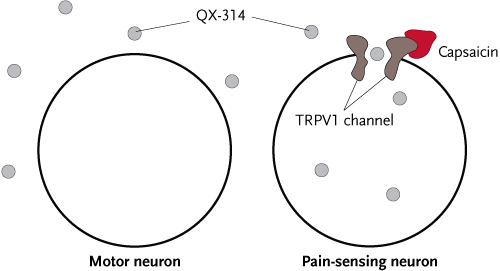
Next, Binshtok injected these chemicals into the paws of rats and tested their ability to sense pain by placing them on a heat source. The animals tolerated much more heat than usual. He then injected the chemicals near the sciatic nerve and pricked the animals’ paws with stiff nylon probes. The rats ignored the provocation. Although they seemed immune to pain, they continued to move normally and respond to other stimuli, demonstrating that QX-314 had failed to penetrate their motor neurons.
Before this technique can be applied to humans, however, the researchers have to overcome several hurdles. They must figure out how to open the TRPV1 channels without producing even transient burning pain before the QX-314 can enter and block the nerve cells. And they have to prolong the effect of the drug by tinkering with its formulation.
“Eventually this method could completely transform surgical and postsurgical analgesia, allowing patients to remain fully alert without experiencing pain or paralysis,” said Woolf. “In fact, the possibilities seem endless. I could even imagine using this method to treat itch, as itch-sensitive neurons fall into the same group as pain-sensing ones.”